

Benefits of an Outdoor Side Burner: Elevating Your Culinary Island
The steaks are searing over an open flame, yet you spend the evening stranded indoors, shuttling back and forth to reduce a delicate sauce or boil sides while your guests converse on the patio. You didn't design an outdoor retreat simply to divide your attention between two kitchens or overheat your indoor living space on a warm evening. Understanding the real benefits of an outdoor side burner reveals how a secondary heat source eliminates that friction, transforming an isolated grill station into a fully realized culinary sanctuary.
Adding dedicated burner power allows you to prepare complete, chef-caliber meals under the open sky while keeping lingering steam, heat, and pungent cooking aromas entirely outside. Whether you want to simmer a gentle glaze or power a high-mass stockpot, having precise temperature control beside your primary grill keeps you connected to your company. In this guide, we explore how balancing BTU output, resilient cast brass engineering, and spatial planning will help you select the ideal burner to complete your outdoor kitchen island.
Key Takeaways
- Explore the core benefits of an outdoor side burner to eliminate the indoor-outdoor divide and keep heavy heat and cooking aromas out of your home.
- Expand your culinary repertoire beyond open grilling by introducing precise flame modulation for delicate sauces, sautés, and large-pot boils.
- Compare heat outputs across single, double, and 60,000+ BTU power burners to balance island countertop space with your specific cooking style.
- Learn critical island planning guidelines, including landing zones, combustible clearances, and manifold gas line sizing to prevent fuel starvation.
- Harmonize stainless finishes, control bezels, and cutout profiles by pairing components from premier makers like Bull, AOG, and Blaze.
Why Add a Side Burner? Eliminating the Indoor-Outdoor Divide
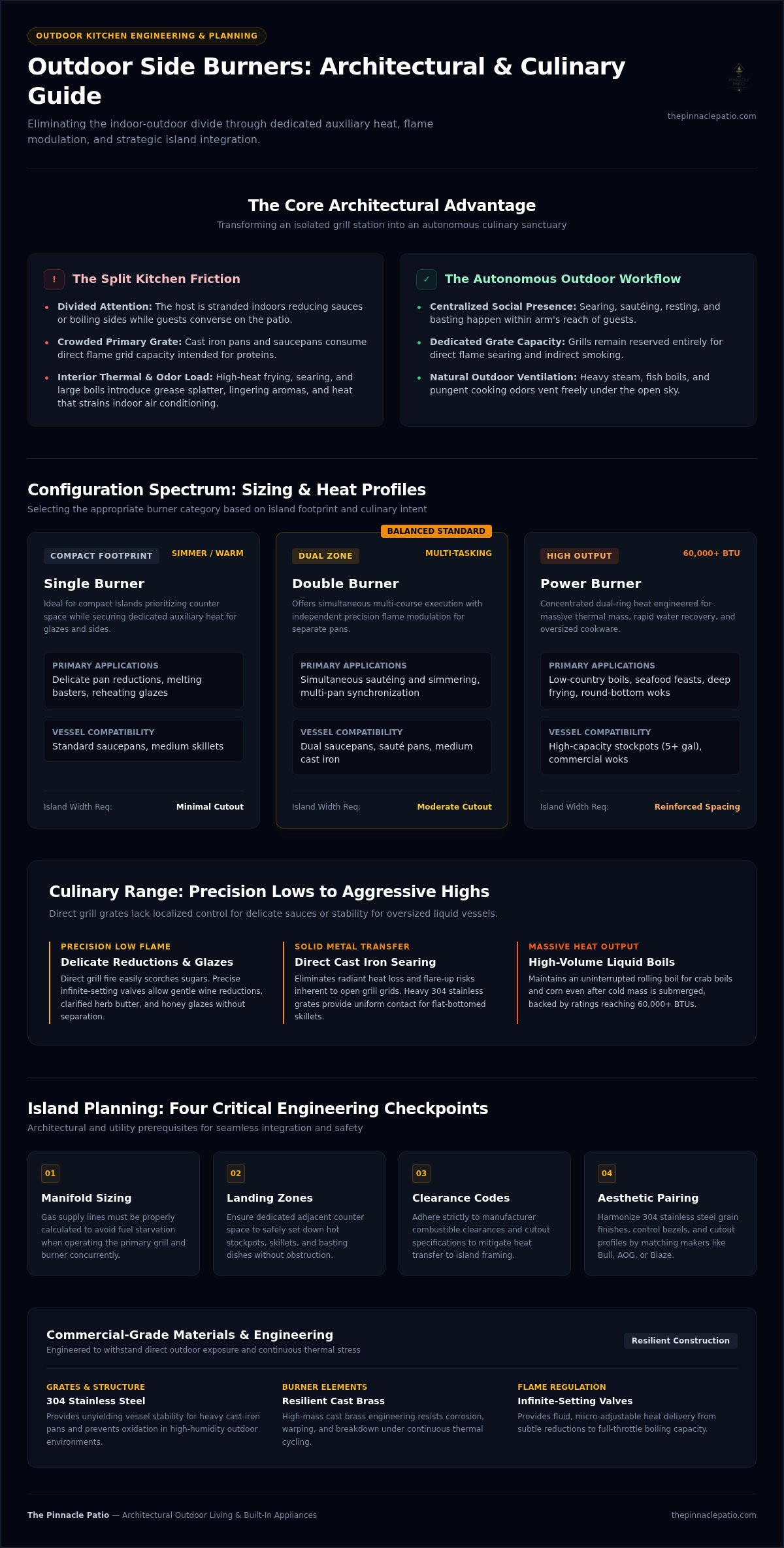
A standalone grill often creates an unintentional separation in your home. While steaks or vegetables cook on the patio, the rest of the meal usually requires an indoor range for boiling, reducing, or warming. The cook ends up shuttling back and forth across the patio threshold, dividing their attention and leaving open flames unattended. Realizing the full benefits of an outdoor side burner begins with closing this physical divide, establishing an autonomous culinary hub that brings every preparation step directly into your primary entertaining space.
Integrating a secondary dedicated heat source into your counter space expands functionality in three distinct ways:
- Centralized Workflow: Keeps searing, sautéing, and resting within arm's reach rather than across two different rooms.
- Dedicated Grate Capacity: Preserves the primary grilling grid entirely for direct flame work and indirect smoking, rather than crowding it with heavy skillets or saucepans.
- Total Outdoor Autonomy: Transforms standalone built-in grills into complete, multi-course culinary workbenches.
Preserving the Host Experience and Social Flow
Cooking for company should never feel like an isolated chore. Running indoors to check a simmering glaze interrupts the rhythm of conversation and pulls the host away from their guests. By integrating a dedicated burner into your outdoor kitchen, every task happens within the social circle. Side-by-side cooking keeps you fully present, allowing friends and family to gather around the counter, share drinks, and engage in the cooking process without missing a beat.
Mitigating Indoor Heat, Smoke, and Lingering Odors
Certain culinary techniques simply belong outside. High-heat cast-iron searing, frying bacon, and boiling seafood produce heavy grease splatter, intense ambient steam, and stubborn aromas that linger in drapery and ductwork for days. Venting high-heat tasks out under the open sky protects your indoor air quality and keeps your interior pristine.
Summer entertaining also places a significant burden on residential cooling systems. Boiling a large five-gallon pot of water or running multiple indoor burners introduces substantial thermal loads, forcing air conditioners to work overtime. Shifting high-output boiling and frying outdoors eliminates that radiant heat entirely, keeping your home interior cool and comfortable throughout warm-weather gatherings.
Culinary Versatility: What an Outdoor Side Burner Truly Unlocks
Many outdoor cooks assume a secondary burner serves only to warm baked beans or keep barbecue sauce fluid. In practice, the true benefits of an outdoor side burner center on expanding your culinary reach from purely dry-heat grilling into wet-heat and precision pan techniques. Integrating high-performance burners beside your grill allows you to synchronize complex menus so delicate side dishes, pan-seared elements, and fire-roasted proteins finish at the exact same moment.
A dedicated burner introduces precise culinary advantages that a standard grill grate cannot replicate:
- Direct Thermal Transfer: Solid metal grates support flat-bottomed cookware without the radiant heat loss or flare-up risks inherent to open grill grids.
- Precise Flame Modulation: Infinite-setting control valves let you dial back to a gentle simmer or open the throttle for high-velocity heat.
- Heavy Vessel Stability: Commercial-grade 304 stainless steel grates easily bear the weight of seasoned cast-iron pans, high-capacity stockpots, and round-bottom woks.
Delicate Simmering, Sauces, and Custom Glazes
Direct grill fire is notoriously unforgiving with delicate sauces. Sugars scorch quickly, and indirect zones rarely offer steady, localized temperature control. A dedicated brass burner allows you to gently reduce red wine reductions, clarify herb butter, or melt honey glazes without separation. Basting proteins directly from a warm saucepan next to your grates preserves internal moisture and yields rich, caramelized finishes on poultry or ribs.
High-Volume Boiling, Deep Frying, and Cast Iron Searing
Cooking outdoors opens the door to aggressive, high-mass culinary methods that challenge indoor kitchens. Boiling oversized pots for crab feasts, low-country boils, or sweet corn requires continuous heat that standard indoor ranges struggle to supply quickly. Outdoor burners deliver the focused output needed to maintain a rolling boil even after cold ingredients hit the water.
High-heat oil frying for wings and tempura stays completely outside, eliminating airborne grease mist that settles over living spaces. The concentrated flame also lets you preheat a heavy cast-iron skillet to extreme temperatures. You can reverse-sear thick steaks with a butter baste immediately after they leave the slow-smoke zone of your primary grill.
If you want to configure your cooking zones to support both delicate simmering and high-heat pan work, you can schedule a consultation with our team to explore ideal appliance layouts.
Single vs. Double vs. Power Burners: Sizing and BTU Ratings
Selecting the right burner configuration comes down to balancing raw heat output against available counter space. While all secondary burners expand cooking capabilities, sizing and burner mechanics differ significantly between standard configurations and specialized commercial units. Unlocking the true benefits of an outdoor side burner means pairing your culinary ambitions with the proper burner architecture.
Standard Single and Double Drop-In Burners (15,000 to 30,000 BTUs)
Standard burners match the familiar output of residential indoor ranges, making them ideal for everyday side dish prep, vegetable sautéing, and sauce reductions.
- Single Burners (12,000 to 15,000 BTUs): Offer a compact footprint for smaller islands, leaving ample countertop area for food prep and plate staging. Units like the Kokomo drop-in single burner provide dedicated flame control without consuming critical prep surface.
- Double Burners (22,000 to 30,000 total BTUs): Feature dual independent controls, such as the 24,000 BTU Kokomo or 25,000 BTU American Outdoor Grill (AOG) models. They allow you to hold a gentle 2,000-BTU simmer on one burner while searing vegetables on the other at 12,000 BTUs.
High-Output Power Burners for Heavy Stockpots (60,000+ BTUs)
When cooking requires intense thermal mass, standard burners fall short. High-output power burners, such as the 61,000-BTU dual-ring unit from Bull Outdoor Products, generate three to four times the energy of a conventional burner. Concentric flame rings let you use the inner ring for smaller saucepans or ignite both rings simultaneously to bring five gallons of water to a rolling boil in under 15 minutes.
Power burners feature heavy-duty commercial cast grates engineered to hold immense weight without bending. Many include removable center rings designed specifically to cradle round-bottom Asian woks directly over focused flames.
Material Integrity: Commercial 304 Stainless Steel Construction
Outdoor cooking appliances operate under harsh environmental exposure. High heat cycling, weather shifts, and acidic marinades rapidly degrade lower-grade metals. Premium burners utilize heavy-gauge 304 stainless steel for the chassis and heavy cast brass for the burner elements.
Cast brass resists corrosion from acidic boil-overs and distributes heat evenly across the cookware base. In contrast, stamped stainless tubes or 430-grade alloys lack nickel content, leaving them vulnerable to rust and pitting in humid or coastal climates. Pairing robust 304 construction across your burners and built-in grills guarantees long-term durability and aesthetic harmony across your island.
Island Planning: Gas Plumbing, Clearances, and Placement
Maximizing the benefits of an outdoor side burner requires thoughtful mechanical planning before you make the first cut into your countertop. A high-output burner changes the operational dynamics of your island structure. Proper placement protects adjacent surfaces, maintains safe clearance distances, and ensures uninterrupted gas delivery when every appliance is firing at once.
Ergonomic Layouts: Workflow and Countertop Spacing
Positioning determines how naturally you move between tasks. National Kitchen & Bath Association (NKBA) outdoor guidelines recommend a landing area of at least 12 inches on one side and 15 to 24 inches on the prep side of a side burner. This dedicated perimeter prevents boiling pots from crowding primary grill traffic and keeps hot pan handles out of walkways.
If you prefer an expertly proportioned footprint that balances cook surfaces with plating space, consider pre-configured luxury outdoor kitchens designed with optimized appliance spacing.
Fuel Supply Coordination: Natural Gas vs. Liquid Propane
Gas plumbing must account for total simultaneous demand. Operating pressures vary by fuel source: 7.0 inches Water Column (W.C.) for Natural Gas (NG) and 11.0 inches W.C. for Liquid Propane (LP). Adding a 25,000-BTU side burner to an 80,000-BTU primary grill pushes combined load over 100,000 BTUs.
- Supply Line Diameter: Under NFPA 54 standards, shared gas manifolds over pipe runs exceeding 50 feet require a dedicated 3/4-inch Schedule 40 supply line rather than a standard 1/2-inch line to avoid gas starvation and weak, yellow flames.
- Isolation Valves: Every drop-in burner requires an accessible manual shut-off valve located beneath the counter structure for emergency isolation and seasonal servicing.
- Fuel Calibration: Verify factory burner orifices correspond to your fuel infrastructure prior to installation, as LP and NG require different orifice apertures.
Ventilation and Non-Combustible Clearance Guidelines
Safety certifications under ANSI Z21.58 / CSA 1.6-2022 govern crosswind burner stability, ventilation, and combustible boundaries. If your island cabinetry incorporates combustible materials like treated wood framing or composite paneling, an insulated jacket is mandatory to eliminate fire hazards. Without a zero-clearance insulating liner, bare cutouts demand 12 to 24 inches of clearance from combustible walls.
Island cabinetry also requires properly positioned cross-ventilation louvers. Because propane is heavier than air, LP vents must sit near the base of the island to vent settling gas. Natural gas rises, requiring venting near the upper countertop edge.
Selecting the Perfect Side Burner for Your Outdoor Island
A cohesive island design unites culinary performance with architectural balance. While adding a dedicated cooking element brings significant functional upgrades, realizing the true benefits of an outdoor side burner requires selecting a model that matches your daily habits and integrates cleanly into your island layout. Striking the right balance between cooking capacity and available counter space ensures your station remains comfortable and visually unified.
Coordinating Aesthetics Across Premier Built-In Grill Brands
Visual consistency transforms a collection of individual outdoor appliances into an intentional culinary suite. Matching control knob profiles, bezel styles, and stainless steel grain direction across your components creates an uninterrupted, tailored presentation. Pairing your side burner directly with matching built-in grills from trusted manufacturers like Bull, AOG, Kokomo, and Blaze delivers a seamless visual identity.
Pay close attention to faceplate styling and mounting formats:
- Slide-In Burners: Extend through the front countertop bullnose to align flush with the grill control panel, creating a continuous horizontal profile.
- Drop-In Burners: Rest directly inside a countertop cutout, preserving the continuous face of stone or masonry cabinetry below.
- Control Illumination: Align knob backlighting styles, such as 120V LED bezels, to ensure your appliances share a unified glow during evening entertaining.
- Protective Covers: Select heavy-gauge stainless steel covers that shield burner rings and grates from windblown pollen, moisture, and debris when not in use.
Maximizing Investment Value in Custom and Prefab Islands
Countertop space is one of the most valuable assets in any outdoor layout. A dual burner or high-mass power burner provides exceptional heat, but it shouldn't crowd out essential prep zones. If your space is compact, a high-output single burner leaves generous stone landing area for cutting boards and serving trays without sacrificing pan performance.
For modular and prefabricated island designs, selecting factory-configured openings within Pinnacle Outdoor Kitchens simplifies the entire build. These layouts feature precision appliance cutouts engineered specifically for top-tier appliances, eliminating costly framing modifications and guaranteeing adequate ventilation paths.
Working through utility needs, ventilation paths, and clearances early protects your investment for decades to come. By scheduling a complimentary consultation with our outdoor kitchen specialists, you can review equipment pairings, gas line demands, and cutout dimensions before making any structural cuts.
Complete Your Outdoor Culinary Vision
Investing in a dedicated cooking station reshapes how you host and cook outside. The lasting benefits of an outdoor side burner extend far beyond extra flame; they eliminate indoor isolation, expand your menu into high-heat and wet-cooking techniques, and keep lingering smoke and heat out of your home. By matching your cooking style with the proper BTU output, durable 304 stainless steel construction, and intentional countertop spacing, you create an integrated kitchen environment that stands up to decades of gatherings.
Coordinating gas lines, non-combustible clearances, and equipment profiles requires careful planning. Our design specialists offer layout guidance across premier manufacturers, including Bull, AOG, Kokomo, and Blaze, ensuring your drop-in components fit effortlessly into your custom or prefabricated island.
Take the guesswork out of island planning and build an outdoor space where hosting feels natural and every meal comes together seamlessly.
Frequently Asked Questions
Is an outdoor side burner worth the extra island space and expense?
Yes, especially if you cook multi-course meals or host frequently. Experiencing the practical benefits of an outdoor side burner means you no longer run inside to manage side dishes, sauces, or boiling water while grilling. It keeps intense heat and grease splatter outdoors, protects your primary grill grates for direct cooking, and turns your island into an autonomous kitchen. If linear counter space allows, it is one of the most functional upgrades you can add.
Can an outdoor side burner boil water as quickly as an indoor stove?
Standard outdoor burners match residential indoor ranges, boiling medium saucepans in roughly the same time. However, ambient wind and cold temperatures can slow heat transfer outdoors. If rapid boiling is your primary goal, a specialized power burner rated above 60,000 BTUs will dramatically outperform an indoor range. Power burners concentrate massive heat directly into the base of large stockpots, bringing several gallons of water to a boil in under 15 minutes.
What is the difference between a standard side burner and a power burner?
The primary difference lies in BTU output, grate design, and flame structure. Standard single and double side burners produce 12,000 to 15,000 BTUs per burner, which is ideal for sautéing vegetables, warming glazes, and simmering delicate sauces. Power burners deliver 60,000 BTUs or more through concentric dual-ring flames. They also feature heavy-gauge commercial grates designed to support the immense weight of oversized brew pots, cast-iron Dutch ovens, and large woks.
Can I connect my side burner and built-in grill to the same gas line?
You can share a fuel source, but the supply plumbing must be sized for the combined BTU demand. Connecting a high-output built-in grill and a side burner to a single supply line often pushes consumption over 100,000 BTUs per hour. Under national fuel gas codes, runs exceeding 50 feet typically require a 3/4-inch hard line rather than a 1/2-inch line to prevent gas starvation, flame yellowing, and pressure drops when running both units simultaneously.
Can I use regular indoor cookware on my outdoor side burner?
Most standard indoor cookware works well on an outdoor burner, but heavy cast iron and multi-clad stainless steel perform best. Thin aluminum pans can warp or develop hot spots over concentrated outdoor flames. In addition, outdoor gas cooking produces soot and carbon deposits that can discolor mirror-polished exterior finishes. Many homeowners maintain a dedicated outdoor cookware set comprising seasoned cast-iron skillets, commercial stainless saucepans, and carbon steel woks.
Do outdoor side burners require special covers or weather protection?
Yes, fitted stainless steel covers or marine-grade vinyl covers are essential for protecting burner ports. While the external chassis uses weather-resistant 304 stainless steel, open burner orifices can easily clog with blowing dust, rain, spider webs, and organic debris when left uncovered. Built-in units often include a flat stainless steel cover lid that shields the brass burners from moisture and creates a flush, usable counter surface when the appliance is idle.