

Bromic Luxury Heaters: How to Choose the Right Outdoor Heater
The heater with the highest output isn’t automatically the right choice for your patio. With bromic luxury heaters, the better fit depends on how you use the space, which fuel works with your home, where a unit can be placed, and how it will sit within the overall design.
Choosing between electric and gas involves more than comparing heat output. Consider the utility arrangements at your home, the heater’s placement options, and the areas where people gather. Those details help you identify a model that fits your patio’s layout without competing with its architecture or furnishings.
This guide explains how to compare Bromic heater families by fuel, placement, and design. It also shows which features of your outdoor space should shape the decision. An open entertaining area, a covered patio, and an outdoor kitchen each present different planning considerations. Access to utilities, overhead and wall structures, and the atmosphere you want all deserve attention alongside the product’s stated output. The goal is a considered shortlist that suits both your space and the way you use it.
Key Takeaways
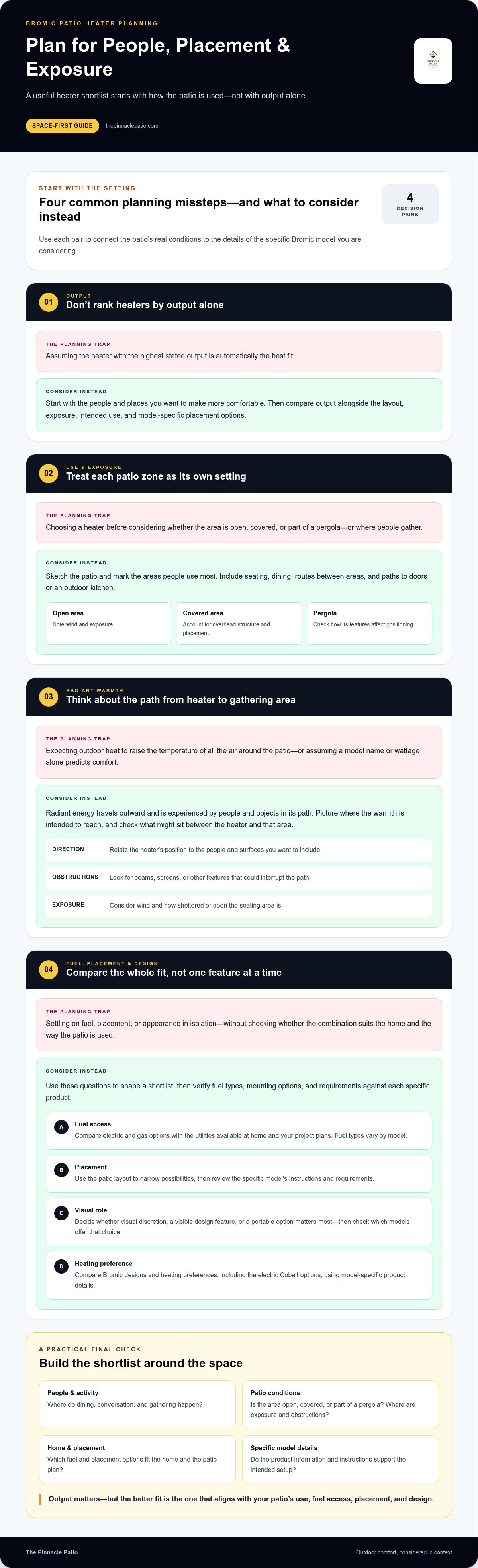
- Start with where people gather and how exposed the patio is to wind, rather than choosing by heater output alone.
- Compare electric and gas options against your fuel access and project plans. Fuel types vary by model.
- Use the patio layout to narrow placement options, then review the specific model’s instructions and requirements.
- Compare Bromic luxury heaters by design and heating preference, including the electric Cobalt options.
- Consider how radiant warmth, placement, and nearby obstructions may affect comfort in your outdoor space.
Bromic Luxury Heaters: Start With How You Use Your Outdoor Space
Choosing a patio heater is about matching warmth to the way you use the space. A dining table used most evenings has different priorities from a lounge arranged for conversation or a patio that hosts occasional gatherings. Start with the people, activities, and places you want to make more comfortable, then compare fuel preference, placement, and visual style.
This space-first approach helps narrow the choices before model details compete for attention. An open terrace, a covered dining area, and a pergola each present a different setting. Exposure, overhead structure, and furniture arrangement all inform where a heater may fit. They don’t establish how much area a particular model will heat, so keep the product’s specifications in view as you refine your shortlist.
Describe the setting before comparing models
Begin by noting whether the space is open, covered, or part of a pergola. Then sketch the areas people use: dining chairs, lounge seating, the route between them, and paths to doors or an outdoor kitchen. This simple map turns placement into a practical decision instead of an afterthought. It also gives you a clearer basis for comparing patio heaters for your plans.
Consider how the area is used during a typical evening. For dining, note where guests sit and whether the table is used regularly. For a lounge, map the main conversation spots. If you entertain occasionally, identify where people tend to gather when the patio is busiest. These details clarify which areas matter most without assuming a heater will cover a particular footprint.
Include exposure in your assessment. A sheltered corner and an open edge of the patio may feel quite different, and beams, screens, or other features can affect where a heater may be positioned. For a general introduction to the different kinds of outdoor heating appliances, see Wikipedia’s overview. Use it as background, then evaluate Bromic models using their product details and your space.
Set priorities for comfort and appearance
Decide what role the heater should play in the design. Do you want it to blend into the setting, act as a visible design feature, or offer the flexibility of a portable option? Treat these as priorities to compare, not assumptions about what every model offers. Fuel preference matters too, because practical choices depend on both your space and the specific product.
- Regular dining: Focus on the table and the pattern of everyday use.
- Lounge time: Map the seating arrangement and the places where conversation naturally gathers.
- Occasional entertaining: Consider how people move through the space and where they tend to pause.
- Design priorities: Decide whether visual discretion, a strong design presence, or portability matters most.
Compare those priorities with the fuel and placement options listed for individual models. A suitable choice balances the setting, fuel, and desired atmosphere, so the heater works with the patio’s function and design.
How Bromic Outdoor Heaters Deliver Radiant Warmth
Outdoor comfort isn’t simply a matter of raising the temperature of all the air around a patio. Radiant heating works differently: energy travels outward and is experienced by people and objects in its path. That distinction helps explain why a heater’s position and the conditions around it matter as much as its stated output.
These are general heating principles, not a promise of a particular result from any Bromic model. Comfort depends on the selected heater, its placement, and the outdoor setting. A wattage figure or model name alone can’t determine whether a unit suits a specific layout.
What radiant outdoor heat means in practice
Picture someone sitting at a patio table. With radiant heat, the relevant question is how warmth reaches that person and nearby surfaces, not whether the heater warms every pocket of outdoor air. The effect depends on what lies in the heater’s path and how the space is arranged.
A beam, screen, or other obstruction may interrupt that path, while wind and exposure can affect how warmth is experienced. A sheltered seating area and an open edge of a patio therefore call for different planning, even if the same people use both.
Why context matters as much as output
Before comparing output, picture the heater’s direction in relation to the gathering zone. Consider whether a wall or ceiling position could orient warmth toward the people and surfaces you want to include, and whether architectural features might sit between the unit and that area. Mounting options and suitability are model-specific, so use the product information when narrowing your choices.
Choose heater output as part of the complete space plan, not by wattage alone. The layout, exposure, placement, and intended use all inform the decision. For an open, exposed patio, wind and unobstructed positioning deserve particular attention. A covered area has its own structural and placement considerations. Neither setting guarantees a specific level of comfort.
- Direction: Consider where warmth is intended to reach.
- Exposure: Account for wind and how open the area is.
- Obstructions: Look for structures or furnishings that could sit in the heater’s path.
- Model details: Compare output and mounting options using the specific product information.
This approach keeps general expectations separate from product-specific claims. Two heaters with different wattages aren’t automatically a simple ranking. A more useful comparison is how each model’s documented output and placement options relate to the space. When evaluating bromic luxury heaters, start with product details and the conditions around the intended location, then refine your shortlist by design and fuel preference.
Explore the patio heater collection to compare options in the context of your outdoor space.
Electric vs. Gas Bromic Heaters: Compare the Choices That Matter
Fuel choice affects which utilities need to be considered, how the heater fits into patio planning, and which models are worth a closer look. Neither electric nor gas is universally better. Start with the fuel arrangements available at your home, then weigh them against the intended placement and visual priorities.
Fuel types vary by model, so use each product’s current listing for its exact fuel and requirements. This matters when comparing Bromic luxury heaters by name alone: models within a collection or family can have different configurations.
| Decision point | Electric | Gas |
|---|---|---|
| Fuel access | Review the model’s electrical requirements and how they fit the planned location. | Match the fuel identified in the product listing to the arrangements available at your home. |
| Planning | Consider the electrical connection alongside the proposed placement and the product’s specifications. | Consider the listed fuel and how the heater will fit the patio configuration. |
| Appearance | Compare the model’s form and placement options with the look of the space. | Use the same design-led comparison while accounting for the model’s documented configuration. |
| Portability | Don’t assume a model can be moved; rely on its product description. | Consider a portable option only when the specific listing identifies it as portable. |
When an electric model may suit the plan
An electric option may suit a plan that prioritizes an integrated appearance and has a suitable location for the unit. Check the product information for the heater’s electrical requirements before settling on placement. The Bromic Eclipse Smart-Heat Electric 2900W Heater is one electric example. Its listing provides the product-specific details to review.
When a gas model may suit the plan
Gas may be worth comparing when the listed fuel aligns with the arrangements available at home and the heater fits your patio configuration. The Bromic Platinum 300 Smart-Heat Natural Gas Heater and Bromic Platinum 500 Smart-Heat Natural Gas Heater are natural-gas examples. Their names identify the fuel, but consult each listing for further model-specific details.
For either fuel, separate utility access from the question of where warmth is intended. A model’s appearance may suit the design, yet its listed fuel or requirements may not align with the planned location. Review the product details before treating a model as a fit.
Also distinguish fixed placement from portability. Don’t infer that a heater can move because it uses a particular fuel or belongs to a certain family. Portability is a model-specific feature, so include it in the comparison only when the product listing documents it.
Once fuel and configuration narrow the field, compare the remaining models by their documented design and placement details in the patio heater collection. This keeps the decision grounded in your home’s practical arrangements rather than a broad claim that one fuel suits every patio.
Match a Bromic Heater to Patio Layout, Placement, and Use
A useful heater shortlist begins with a clear picture of the space, not a product name. Mark the dining or seating area where people spend time, then note how the patio is arranged around it. This gives you a practical way to compare models and describe what matters: where warmth is intended, how the space is used, and which fuel and placement options fit the plan.
Plan around the people and areas you want to warm
Make a simple sketch of the patio and identify the main gathering zone. A dining table used regularly and a lounge arranged for conversation create different priorities. Add nearby ceilings, walls, beams, and furnishings to show the layout. These details can inform placement planning, but they aren’t clearance guidance. Use the model’s instructions for technical requirements.
If your patio has separate dining and lounge areas, assess each zone rather than treating the whole space as uniform. Note which areas are used most often and how people move between them. This makes your priorities clearer and keeps model comparisons focused on intended use, not appearance alone.
Follow a practical planning sequence
- Map the gathering area. Mark the main seating or dining zone and note any separate area used regularly.
- Note exposure and surroundings. Record whether the location is open or covered, plus nearby walls, ceilings, and furnishings.
- Identify fuel preference. Consider the fuel arrangements available to you and compare them with the fuel stated for each model.
- Compare models. Review documented output, design, mounting options, and model-specific instructions against your plan.
Keep these notes beside you as you browse bromic luxury heaters. A concise description such as “covered dining area, seating centered beneath a ceiling, electric preference” is more useful than starting with a wattage target alone. It gives you consistent criteria for weighing product details and helps prevent comparisons based on irrelevant features.
Several assumptions can lead to a poor shortlist. Don’t choose solely by wattage, appearance, or model name. Don’t assume every model shares the same fuel, mounting method, or controls, even within one product family. Read the current product information for the specific model, and follow its instructions for technical installation questions. Installation planning should involve qualified professionals familiar with the relevant requirements.
Once your gathering zones, surroundings, and fuel preference are clear, compare the documented options against that plan. The patio heater collection offers a place to continue exploring with those priorities in mind.
Explore Bromic Luxury Heaters by Design and Heating Preference
Once your preferred fuel and patio layout are clear, compare individual models by the characteristics documented in their product listings. Wattage can help distinguish options, while design details and listed fuel help you decide which products deserve a closer look. Treat these as starting points for a shortlist, not a promise of how a heater will perform in a particular space.
Shortlist by documented model characteristics
- Electric output options: The Bromic 4000W Cobalt Electric Heater and Bromic 6000W Cobalt Electric Heater offer two electric options with different stated wattages. Compare each listing with your planned location and electrical requirements.
- Lighting and design: The Bromic Eclipse Smart-Heat Electric 2900W Heater is an electric example with documented dimmable ambient lighting. That feature may matter if you want the heater to contribute to the patio’s atmosphere as well as provide warmth.
- Natural gas models: The Bromic Platinum 300 Smart-Heat Natural Gas Heater and Bromic Platinum 500 Smart-Heat Natural Gas Heater are examples whose names identify natural gas as the fuel. Use each current listing for further model-specific details.
These examples show how to make a more useful comparison than ranking heaters by wattage alone. First, match the listed fuel to your preferences and arrangements. Then consider whether documented features, such as dimmable ambient lighting, suit the role you want the heater to play. Finally, review the current product information for specifications relevant to your intended placement.
Don’t assume a feature or fuel applies across an entire product family. Models in the same series may differ in documented output or configuration. Treat each product listing as the reference for that model, and compare like with like.
Make the final comparison with expert support
Bring your layout notes into the final review: the area where people gather, your preferred fuel, and the visual character you want to preserve. Compare those priorities with the product’s stated fuel, output, and features. This keeps the decision anchored in your space rather than a model name or headline number alone.
The Pinnacle Patio offers Bromic luxury heaters alongside outdoor kitchen islands, built-in grills, and other outdoor living products. The company focuses on product sales, so on-site installation is not part of its offering. For heater installation, follow the product documentation and work with a qualified professional.
Review the current listings before settling on a shortlist. Matching documented product details to your layout and preferences can make the choice clearer, whether you’re considering an electric model with ambient lighting or a listed natural gas option.
Make Your Outdoor Space Ready for More
Before choosing a model, picture an ordinary evening in the space. Where do you want guests to linger? Which area should feel comfortable for a meal or conversation? Turning those questions into clear priorities can help you choose a heater that feels intentional rather than simply adding another appliance to the patio.
Use that vision to make your final comparison. Decide which qualities are essential and which are preferences, then review current product details against the way you plan to use the space. The right bromic luxury heaters should make sense for your home’s layout and the atmosphere you want to create, not just stand out on a product page.
Take the next step by comparing models against your patio plan. A considered choice starts with the gathering areas, fuel arrangements, and design priorities that matter most to you.
Frequently Asked Questions
What is the difference between radiant heat and heating outdoor air?
Radiant heat means comfort isn’t measured simply by whether patio air feels uniformly warmer. Consider how guests experience warmth from their actual seats rather than relying on a general air-temperature reading for the whole space. When chairs face different directions, each person’s position can shape their experience. Use the model’s product information and your intended seating arrangement to set realistic expectations.
Can a Bromic heater work in an uncovered patio?
It may suit an uncovered patio if the specific model’s instructions and site conditions support that use. An open area can be more exposed to wind than a sheltered one, so don’t rely on a general coverage estimate. Check the product documentation for the model’s intended placement, then consider how exposed the patio is during the times you plan to use it. This helps you decide whether to shortlist that heater for the space.
How many Bromic heaters do I need for my patio?
There’s no fixed heater count for every patio. The number depends on the selected model and the configuration that fits your project. If you’re considering more than one unit, compare each model’s published details and account for its specific fuel or electrical requirements and control options. Those details can affect the overall configuration, so get qualified product guidance before settling on a quantity for a complex setup.
Do Bromic outdoor heaters need professional installation?
Yes. Bromic heaters must be installed by a licensed and authorized technician in accordance with applicable electrical or gas requirements. Follow the documentation for the exact model, since connection and placement instructions can differ. The Pinnacle Patio sells the heaters but does not provide on-site installation. Technical installation details should be handled by the qualified technician responsible for the work. Don’t treat installation as a one-size-fits-all task across different models.
Can one outdoor heater serve both a dining area and a lounge?
It may be possible, depending on the model and how the furniture is arranged. Consider whether the dining chairs and lounge seats are used at the same time, and whether their positions change between everyday use and entertaining. For example, movable dining chairs can alter where people sit relative to a planned heater position. Compare the arrangement you’ll use most often with the selected model’s product details before deciding.
Are Bromic heaters suitable for outdoor kitchens?
Yes. Bromic’s collection description identifies outdoor kitchens among the settings for its electric and gas heaters. For a specific cooking area, consider how the heater fits into the kitchen’s planned use and review the individual model’s fuel and installation instructions. Bromic luxury heaters are available in different model configurations, so use the current product listing to compare relevant details rather than assuming one option suits every outdoor kitchen.