

Bull Outdoor Kitchen: How to Choose the Right Bull Grill for Your Space
The largest Bull grill isn’t automatically the best choice for your outdoor kitchen. A well-planned bull outdoor kitchen starts with how you cook, the space available, and how the grill will fit into the island and its utilities. A larger cooking surface can make it easier to prepare different foods at once, but it also takes up more room that could otherwise serve as prep or serving space.
Grill width, burner count, and BTU ratings are useful comparison points, but none tells the whole story. Burner placement affects how you create heat zones; fuel type, cutout dimensions, and clearances determine what the island can accommodate. Because specifications vary by model, use the current product documentation for the exact grill you’re considering before finalizing the design.
This guide explains how to compare Bull grill options by cooking style and available space, then assess fuel, materials, burner performance, and island fit. You’ll also find a practical checklist of measurements and model-specific details to review as you plan a kitchen that works for everyday meals and gatherings.
Key Takeaways
- Start with your cooking habits, available space, and overall kitchen plan to narrow down the right Bull grill configuration.
- Use 30-inch, 36-inch, and 42-inch categories as planning references, not as confirmation of a Bull model’s dimensions or required cutout.
- Compare 304 and 430 stainless steel by considering the environment, maintenance, and documented grill construction.
- For a compatible bull outdoor kitchen, confirm the exact model’s dimensions and clearances before coordinating fuel and other utilities.
- Review the full set of current product details rather than relying on a single specification, such as burner count or BTU output.
Why Choose a Bull Grill for an Outdoor Kitchen?
Start with three practical questions: what you cook, how much space you can devote to cooking, and how the grill fits into the wider kitchen plan. A Bull built-in grill can be the central cooking station, with preparation surfaces and storage arranged nearby. The right model should suit your routines and fit the island plan, rather than being selected by brand name alone.
Compare the exact model’s current documentation for dimensions, burner configuration, fuel options, and other specifications before planning around it. Browse the built-in grill collection to compare options, then use the manufacturer’s model-specific information to guide your selection.
What makes a built-in Bull grill different from a freestanding grill?
A built-in grill is planned as part of an island, so its position can relate directly to preparation space, serving areas, and the flow between cooking and gathering. A freestanding grill is typically valued for being movable; a built-in grill has a defined place in the kitchen plan. That changes how you plan the space: the island needs to accommodate the selected grill and its requirements, not just provide a convenient place to set it. Don’t assume construction details or included components are identical across models.
Start with the way you cook and entertain
Consider an ordinary week as well as a full gathering. Do you usually cook a few weeknight meals, prepare food for a larger group, or cook several items at once that benefit from separate heat zones? Your cooking frequency and serving needs can help you decide how much grill width is useful and how much adjacent counter space you need for ingredients, trays, and plating.
A wider grill may give you more room to organize a meal, but it also uses more of the island. Balance cooking area with the work surfaces and circulation that make the kitchen comfortable to use. Give the grill, prep area, and serving space clear roles so the cooking zone doesn’t feel crowded.
How to Compare Bull Grill Sizes, Burners, and BTU Output
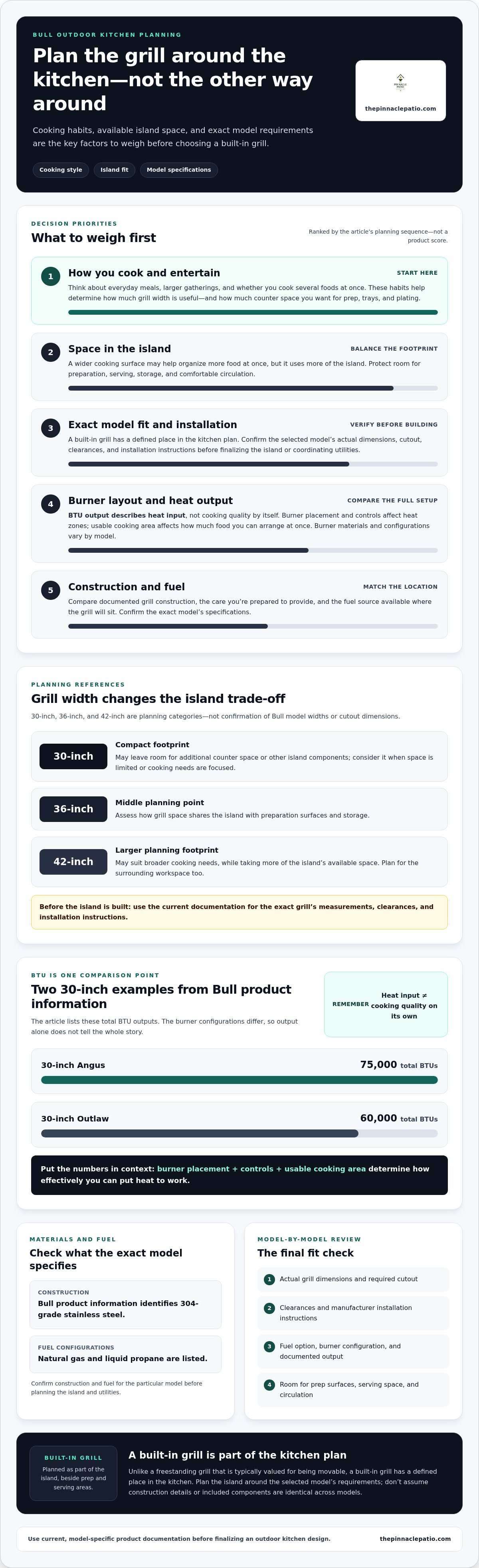
Grill width helps you estimate how an appliance may fit in an island, but it doesn’t tell you its cooking capacity or performance. Compare the space available with the burner arrangement, usable cooking area, and documented output. For a bull outdoor kitchen, use width categories to begin planning, then check the exact model’s specifications before finalizing the island.
How do 30-inch, 36-inch, and 42-inch grill plans differ?
These widths are useful categories for comparing footprints and general planning trade-offs. They don’t establish which sizes Bull currently offers or the cutout a particular model requires.
| Planning category | Space and cooking trade-off | Planning approach |
|---|---|---|
| 30-inch | A more compact footprint may leave room for additional counter space or other island components. | Consider it when the available island area is limited or cooking needs are focused. |
| 36-inch | A middle planning point may balance grill space with room for preparation and serving. | Assess how the grill shares the island with work surfaces and storage. |
| 42-inch | A larger planning footprint may suit broader cooking needs, while taking more of the island’s available space. | Allow for the grill and the surrounding workspace in the overall layout. |
These are planning categories, not confirmed Bull model widths or cutout dimensions. Before the island is built around a grill, use that model’s current product documentation for its actual measurements, clearances, and installation instructions.
What do burner count and BTU output tell you?
BTU output describes heat input, but it doesn’t measure cooking quality on its own. Burner placement and controls affect whether you can create useful heat zones; the cooking surface determines how much food you can arrange at once. For comparison, Bull’s current product information lists the 30-inch Angus at 75,000 total BTUs and the 30-inch Outlaw at 60,000 total BTUs. Their burner configurations differ, so compare the full specifications rather than output alone.
BTU output tells you how much heat a grill can deliver; burner layout and usable cooking area determine how effectively you can put that heat to work. Multiple burners can support separate zones when the model design and controls allow, which can help you manage foods with different cooking needs. Burner materials also vary by model, so check current documentation instead of assuming every Bull grill uses the same construction.
Include safe positioning in the plan. The NFPA offers guidance on grill placement and clearances; the manufacturer’s instructions for the exact grill govern its installation requirements. Browse the built-in grill collection, or schedule a consultation for guidance comparing grill size and configuration with your island plan.
Bull Grill Materials and Fuel: What Should You Compare?
Material and fuel choices affect how a grill suits its environment and the kitchen plan. Compare the documented construction, the care you’re prepared to provide, and the fuel source available at the intended location. Bull’s current product information identifies its grills as constructed from 304-grade stainless steel and lists natural gas and liquid propane configurations. Confirm the specifications for the particular model before planning around it.
304 Vs. 430 stainless steel: what should buyers understand?
304 and 430 are different grades of stainless steel, with different compositions and corrosion-resistance characteristics. In general, 304 offers greater corrosion resistance than 430, which can matter when a kitchen is exposed to salt air or persistent moisture. That does not make stainless steel maintenance-free or guarantee a particular service life.
Bull’s current product information identifies 304-grade construction. For any grill, check the stated material in its product documentation rather than judging the grade by appearance or brand. Coastal exposure also makes care an important part of the decision: salt deposits can affect stainless surfaces, so plan for regular cleaning and follow the manufacturer’s care instructions.
Natural gas or liquid propane: how does fuel affect planning?
Natural gas and liquid propane (LP) require different utility planning. Natural gas needs a compatible connection to the planned supply, while LP relies on an appropriate propane supply. Decide which source suits the site before selecting the grill so the island layout and utility coordination support the chosen configuration.
Current Bull information lists grills in both fuel configurations, but setup can vary by model. Read the exact model’s documentation for its available configuration and any approved conversion guidance. Verify fuel compatibility against the selected grill’s documentation before planning utilities. Treat fuel type as a model-specific decision, not an assumption based on the brand.
Material and fuel are only part of a considered bull outdoor kitchen plan. The model’s documented construction, care guidance, fuel configuration, and island requirements should work together. Fuel choice also doesn’t replace safe cooking practices: the USDA Food Safety and Inspection Service explains how to check the safe minimum internal temperature for grilled foods.
How to Check Bull Grill Fit, Clearances, and Outdoor-Kitchen Compatibility
A grill may suit your cooking style but still be a poor fit for an island if its dimensions, clearances, or fuel configuration don’t align. Plan a bull outdoor kitchen around the exact grill model, using its current manufacturer documentation for cutout and installation requirements. A category width or rough sketch isn’t enough to finalize the layout.
Which measurements and clearances should you verify?
Keep the grill’s exterior dimensions separate from the island cutout dimensions. Exterior dimensions describe the appliance; cutout dimensions specify the opening needed for the built-in configuration. They serve different purposes, so don’t use one in place of the other.
Work through these checks in order:
- Choose the specific model you intend to build around.
- Record its exterior and cutout dimensions from the current product documentation.
- Review the model’s clearances and ventilation instructions before setting the island position or surrounding materials.
- Coordinate utilities with the grill’s documented fuel configuration and the property’s existing setup.
Clearance requirements can vary by appliance and installation context. Follow the selected Bull model’s instructions instead of relying on a general number from another grill or an online planning example. Keep the documentation on hand as the island design develops so the measurements and clearances remain tied to the same model.
How do you coordinate the grill with the island and utilities?
Once you’ve established the grill’s fit, plan how people will move around the kitchen. Map the grill’s position against preparation and serving surfaces, the approach to the cooking area, and any planned adjacent appliances. Resolve access, ventilation, and work-zone questions against the model’s instructions and island design rather than assuming the same requirements apply to every setup.
Plan fuel at this stage, too. Match the grill’s documented configuration to the utility arrangement, then consider how the connection route relates to the island and nearby components. If you’re including other appliances, consider their dimensions and utility needs together instead of adding them after fixing the grill position.
Explore the outdoor kitchen collection as you compare island options and consider how the grill, work surfaces, and other components should fit together. A measured plan helps bring those choices into alignment before the design is finalized.
Choose a Bull Outdoor Kitchen Configuration and Plan Your Next Step
Choose a grill that suits your cooking habits, then check that it fits a workable island plan. Rather than deciding by width, burner count, or BTU output alone, compare current specifications for the exact Bull model you’re considering. Materials, fuel configuration, accessories, cutout dimensions, and clearances all help determine whether the grill suits your space and intended use.
Think of the grill and island as parts of one plan. The grill should support the way you prepare meals, while nearby work surfaces and other components should make cooking and serving feel natural. As you refine the layout, browse the outdoor kitchen collection to consider how island options can complement your grill selection.
A final Bull grill selection checklist
Before settling on a configuration, use this checklist to match your priorities with the product details:
- Cooking style: Identify the meals you prepare most often, the number of people you typically serve, and the usable grill width that fits those needs.
- Model specifications: Review the exact grill’s documented materials, burner construction, BTU output, fuel configuration, and included accessories.
- Island fit: Compare the model’s exterior dimensions and required cutout dimensions with the planned island, then follow its current instructions for clearances.
- Overall layout: Consider how the grill relates to preparation space, serving flow, other appliances, and utility planning.
These details help you assess a bull outdoor kitchen as a complete cooking space, rather than a grill selected in isolation.
When is a consultation useful?
A consultation is useful when the grill model, island dimensions, fuel setup, and appliance placement need to work together. Bring the Bull model you’re considering, your planned island dimensions, and questions about utility coordination. These details make it easier to discuss sizing and compatibility before finalizing your product choices.
Build Your Outdoor Kitchen Around the Right Grill
A successful bull outdoor kitchen plan begins with your cooking habits and available space, then takes shape around the specifications of the exact grill model. Compare usable cooking area and burner arrangement alongside BTU output, and verify material, fuel configuration, cutout dimensions, and clearances in current product documentation. This gives you a more complete basis for choosing than any one headline specification.
The Pinnacle Patio offers Bull grills and built-in grills alongside outdoor kitchen islands, so you can consider the grill and broader layout as parts of one plan. Thoughtful sizing and compatibility choices help create a practical cooking space connected to how you prepare meals and gather outdoors.
With the right information in hand, you can choose a setup suited to your space and cooking style, and ready for the meals you’ll share outdoors.
Frequently Asked Questions
Is a Bull grill a good choice for an outdoor kitchen?
A Bull grill can be a suitable choice if a model’s cooking features, size, fuel configuration, and installation requirements fit your plans. Choose a grill that supports the way you cook and works with your island, rather than selecting by brand alone. Compare current model documentation for burner layout, BTU output, materials, dimensions, and clearances. The Pinnacle Patio offers Bull grills alongside built-in grills and outdoor kitchen islands.
What size Bull grill should I choose for an outdoor kitchen?
Choose a size based on how much you cook, how many people you typically serve, and how much island space is available. Width categories such as 30, 36, and 42 inches can help with early planning, but they don’t confirm Bull model availability or cutout size. Bull’s current lineup includes examples such as 30-inch Angus and Outlaw grills, so verify the actual dimensions and cooking area for the model you select.
Are Bull grills available for natural gas and liquid propane?
Current Bull product information lists grill models in natural gas and liquid propane configurations. Fuel options and setup are model-specific, so match the grill configuration to the utility plan for your outdoor kitchen. Review the exact model’s documentation for its fuel connection and any approved conversion guidance. Don’t assume a grill includes conversion components or can be changed to another fuel type without following the manufacturer’s instructions.
How many BTUs should an outdoor kitchen grill have?
There isn’t one BTU rating that suits every outdoor kitchen. BTU output describes heat input, but burner arrangement, controls, and usable cooking area also affect how a grill works for your meals. For comparison, current Bull information lists the 30-inch Angus at 75,000 total BTUs and the 30-inch Outlaw at 60,000 total BTUs. Compare the full specifications and choose based on your cooking needs, not the largest number alone.
What does 304 stainless steel mean for an outdoor grill?
304 is a grade of stainless steel known for its corrosion resistance. Bull’s current product information identifies 304-grade stainless steel construction for its grills. In outdoor or coastal settings, material is one consideration alongside routine care, since salt and moisture can affect stainless surfaces over time. Follow the grill manufacturer’s cleaning and maintenance guidance, and don’t treat any stainless-steel grade as maintenance-free or rust-proof.
Can I install a Bull grill in a prefabricated outdoor kitchen island?
A Bull grill may fit a prefabricated island if the island is designed to accommodate that exact model. Compare the grill’s exterior dimensions with the required cutout dimensions, then review the model’s installation instructions for clearances and ventilation. Also consider how the island’s construction and utility layout correspond to the grill requirements. A general width match alone doesn’t establish compatibility, so use current manufacturer documentation before finalizing your configuration.
What should I check before buying a Bull built-in grill?
Start with your cooking style and available island space, then review the exact model’s dimensions, cutout, clearances, fuel configuration, burner construction, BTU output, and materials in its current documentation. Check which accessories are included rather than assuming they come with the grill. Finally, coordinate utility placement and surrounding work surfaces with the island plan. This comparison helps you select a grill that fits your cooking routine and planned kitchen.