

Drop-In Grill vs. Slide-In Grill: How to Choose in 2026
The label on a grill can be less useful than the measurements in its installation guide. In the drop-in grill vs slide-in grill comparison, terminology varies between manufacturers and retailers, so a name alone won’t tell you whether a grill suits your island plan. Before committing to a substantial outdoor kitchen investment, verify the fit for the exact model you’re considering.
The reliable approach is to compare the grill’s documented requirements with the island design. This guide explains how the terms are commonly used, why they shouldn’t replace model-specific instructions, and which specifications to check before choosing a configuration.
You’ll learn to compare cutout and overall dimensions, installation clearances, and relevant fuel and utility requirements. You’ll also consider how a grill’s form affects the island’s finished appearance and everyday use. With the right details in hand, you can choose a grill and island that work together in function and style.
Key Takeaways
- In the drop-in grill vs slide-in grill comparison, treat each term as a label to verify against the specific grill’s manufacturer documentation.
- Check the selected model’s documented opening specifications and clearances before finalizing an island plan.
- Compare grill and island requirements together, including fuel configuration and compatibility, rather than planning them separately.
- Use a clear sequence: shortlist models, retrieve official documentation, compare fit, then finalize the island layout.
- Explore premium built-in grill options available through The Pinnacle Patio to compare models with your project requirements.
Drop-In vs. Slide-In Grills: Defining the Terms
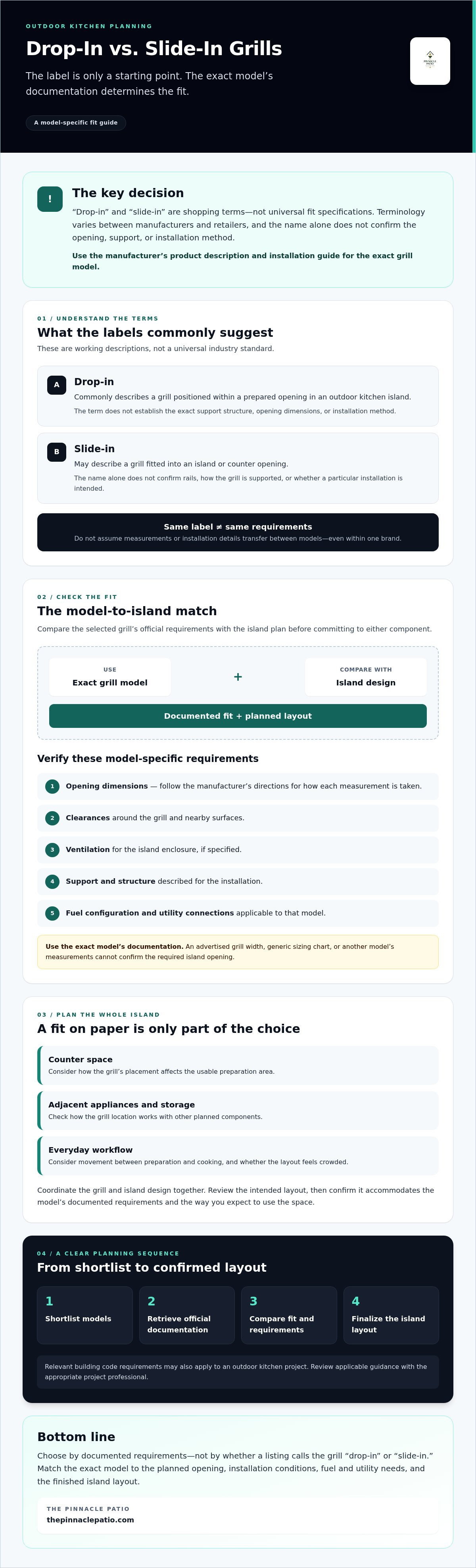
Short answer: terminology can vary between manufacturers and retailers, so confirm how the manufacturer describes the specific grill. Both “drop-in” and “slide-in” may be used for grills intended to sit within an outdoor kitchen island or counter. Neither label, by itself, confirms how a particular model is supported, what opening it needs, or how it should be installed.
A useful working distinction, not a universal industry standard, is that a drop-in grill is generally described as a grill placed into a prepared island opening, while slide-in grill may refer to a grill fitted into an island or counter opening. Retail terminology can overlap. In the drop-in grill vs slide-in grill comparison, the manufacturer’s product description and installation documentation are more dependable than the label.
If you’re new to outdoor cooking equipment, barbecue grill basics offers a general overview of grill types and fuels. For island planning, focus on the selected model’s documentation. A category name can help you start browsing, but it can’t confirm fit.
What is commonly meant by a drop-in grill?
Retailers commonly use “drop-in” for a grill positioned within a prepared opening in an outdoor kitchen island. The phrase suggests an integrated look, but doesn’t establish the exact support structure, opening dimensions, or installation method. Those details depend on the model. Before planning the island, check the manufacturer’s product and installation documents for the required fit and any related instructions.
What is commonly meant by a slide-in grill?
Some retailers use “slide-in” for a grill fitted into an island or counter opening. The name alone doesn’t confirm that the grill has rails, how it’s supported, or whether it’s designed for that installation. In some listings, the terminology may refer to a different grill configuration. Verify the model’s intended use with its manufacturer rather than assuming the label describes a particular construction.
Think of the terms as shopping language, not fit specifications. A grill that appears to suit an island concept still needs to match the opening and installation requirements documented for that exact model. Reviewing those details early helps keep the appliance choice and island plan aligned, without relying on assumptions that may not apply across brands.
How Grill Fit, Island Openings, and Specifications Shape the Choice
A grill label can help narrow a search, but it can’t tell you whether a particular model will fit your island. Let the manufacturer’s cutout and installation documentation guide the decision. For a reliable drop-in grill vs slide-in grill comparison, match the exact model’s requirements to the island plan before purchasing either component.
Check compatibility against the exact grill model and island design. Two grills described with the same label may call for different openings or installation conditions. Don’t transfer measurements from one model to another, even within the same brand.
Which measurements should you confirm before choosing?
Start with the selected model’s official product specifications and installation guide. Compare the opening dimensions listed there with the planned island opening, following the manufacturer’s directions for how each measurement is taken. Also check the model-specific requirements for:
- Clearances around the grill and any nearby surfaces
- Ventilation for the island enclosure, if specified
- Support and any structural conditions described for the installation
- Fuel configuration and utility connections applicable to that model
Use documentation for the exact grill, not a generic sizing chart or an assumption based on the grill’s advertised width. Broader building code requirements may also apply to an outdoor kitchen project, so review relevant guidance with the appropriate project professional.
How does the island plan affect grill selection?
Fit is only part of the decision. The grill’s placement affects how much usable counter space remains, where adjacent appliances and storage can go, and how easily the cook can move between preparation and cooking. A model that fits the opening on paper may still be a poor choice if it disrupts the intended workflow or crowds another planned component.
Coordinate the grill and island before finalizing either purchase. Review the outdoor kitchen island options alongside the grill’s documentation, then confirm that the layout accommodates the appliance and the way you expect to use the space. If dimensions or configuration are uncertain, a sizing and compatibility consultation can help you review the plan before you commit.
Drop-In vs. Slide-In Grills: A Practical Comparison
There’s no dependable winner based on the label alone. In a drop-in grill vs slide-in grill comparison, use each term as a prompt to investigate the specific model, then compare its documented requirements with the island plan.
| What to compare | “Drop-in” label | “Slide-in” label |
|---|---|---|
| Fit documentation | Confirm the manufacturer’s opening specifications for the exact model. | Confirm the manufacturer’s opening specifications for the exact model. |
| Island readiness | Check that the planned island suits the documented installation. | Check that the planned island suits the documented installation. |
| Clearances and support | Follow the model’s stated clearance and support requirements. | Follow the model’s stated clearance and support requirements. |
| Layout coordination | Consider counter space, adjacent appliances, storage, and workflow. | Consider counter space, adjacent appliances, storage, and workflow. |
The labels don’t establish whether one option is easier to install, safer, more durable, or compatible with more islands. Those judgments depend on the appliance and project details, not the terminology in a product listing.
When might a drop-in label suit your project?
A grill described as “drop-in” may suit your plan if the manufacturer confirms that its documented opening requirements match the island design. Check the stated support and clearance requirements as well. Don’t assume the label tells you how the grill is constructed or supported. Verify those details for the model you’re considering.
When might a slide-in label suit your project?
A “slide-in” model may be a candidate if its manufacturer confirms compatibility with your planned island and its documented installation requirements work for the project. The term alone doesn’t establish rails, support design, or installation method. If the product information doesn’t resolve those points, request the official documentation before selecting the model.
The better choice is the model whose documented fit and installation requirements align with your island, utilities, and intended layout. Compare the manufacturer’s information before you commit, and keep the grill and island decisions coordinated. You can review available built-in grill options with those project criteria in mind.
A Pre-Purchase Checklist for Comparing Grill Models and Island Plans
A deliberate sequence keeps the grill choice and island design aligned. Use these steps before purchasing components, whether a listing calls a model drop-in, slide-in, or built-in:
- Shortlist models that suit your cooking needs and planned layout.
- Retrieve each exact model’s official product and installation documentation.
- Compare its documented fit requirements with the planned island and utility configuration.
- Finalize the island plan only after confirming the model’s requirements and resolving open questions.
This process makes the drop-in grill vs slide-in grill decision practical: compare verified model details, not assumptions attached to a product label.
What should you verify in the manufacturer documentation?
Use documentation for the exact model and configuration you’re considering. Similar-looking grills, even from one manufacturer, may have different requirements. Check the official sources for:
- Model and fuel configuration, confirming the documentation matches the product being considered.
- Opening specifications and clearances to compare with the planned island.
- Compatibility requirements for the island and any related components.
- Any unclear or unavailable details that need confirmation before purchase.
Don’t fill gaps with generic rules or another model’s measurements. Product-specific requirements should come from the manufacturer’s documents. If a detail is missing or ambiguous, seek clarification before finalizing the plan.
Who handles installation and construction questions?
The Pinnacle Patio sells outdoor kitchen islands and grills, but doesn’t provide on-site installation or masonry services. Coordinate construction and site-specific questions with the appropriate project professional, who can review the selected grill’s documentation alongside the planned island and utilities. Once you have candidate models, browse the built-in grill collection and compare their official specifications.
Choose the Grill That Completes Your Outdoor Kitchen Plan
The right choice isn’t determined by whether a listing says “drop-in” or “slide-in.” Compare the exact grill model’s documented fit and installation requirements with your island plan, fuel configuration, and intended layout. That’s the most reliable way to move from terminology to a configuration you can plan around.
As you refine your shortlist, compare official product details for grills from Bull, AOG, and Kokomo. Brand recognition can help guide product discovery, but it doesn’t replace model-specific information. Check the opening requirements, clearances, fuel configuration, and compatibility for the exact model under consideration.
How to move from comparison to a compatible grill
Start with the island plan, then narrow your grill options to models whose manufacturer documentation aligns with it. Keep the product and installation documents with the island specifications so your project professional can review the same details. If a model’s documentation leaves a question unanswered, seek clarification before treating it as a match.
Explore outdoor kitchen options as you consider the grill’s position, available counter space, storage, and other planned components. For guidance on island assembly and site-specific construction, coordinate with your project professional and follow the requirements documented for the selected products.
Use the label only as a starting point. The useful comparison is between the specific grill’s documented requirements and the island configuration you intend to build. A well-matched plan considers appearance and workflow alongside fit, so the grill sits naturally within the kitchen and works for the way you expect to cook.
When is a consultation useful?
A consultation may be useful if island dimensions, grill compatibility, or configuration remain uncertain after you review the manufacturer’s information. Bring the model details and island plan so the discussion can focus on product selection and how the components relate. The Pinnacle Patio offers product guidance, not on-site installation or masonry services. Coordinate construction work with your chosen project professional.
With the project requirements in view, the drop-in grill vs slide-in grill decision becomes less about labels and more about selecting a model that fits your outdoor kitchen plan.
Build Your Outdoor Kitchen Around a Verified Fit
The key to the drop-in grill vs slide-in grill decision is to look beyond the label. Retailers may use the terms differently, so confirm the exact grill model’s manufacturer description, opening specifications, fuel configuration, clearances, and compatibility before finalizing your island plan.
Coordinate the grill and island as one design decision. The Pinnacle Patio offers outdoor kitchen islands and built-in grills, including options from Bull, AOG, and Kokomo, to help you explore products that suit your project requirements. Manufacturer documentation should guide model-specific fit, while your project professional can address construction and site conditions.
With the right information in hand, you can move forward with a plan that feels considered, functions well, and brings your outdoor kitchen vision within reach.
Frequently Asked Questions
What is the difference between a drop-in grill and a slide-in grill?
There isn’t a universal technical distinction between the labels. Retailers and manufacturers may use “drop-in” and “slide-in” differently, and both may describe grills intended for integration into an outdoor kitchen. In the drop-in grill vs slide-in grill comparison, rely on the exact model’s manufacturer description and installation documentation. Compare its stated requirements with your planned island opening before deciding whether it’s suitable.
Are drop-in grills and slide-in grills the same thing?
Not necessarily. Some sellers use the labels in similar ways, but the terms don’t confirm identical grill construction, mounting systems, or dimensions. Don’t assume two products are interchangeable because their listings use similar wording. Review the exact model’s product information and installation instructions, then check whether your island meets its documented requirements. If important details are unclear, ask the manufacturer or a qualified project professional before purchasing.
Can a drop-in grill fit in an existing outdoor kitchen island?
It may fit, but the “drop-in” label alone can’t establish compatibility. Compare the existing island opening with the exact grill model’s documented dimensions, and check any stated clearance, support, or utility requirements. Don’t order based only on the grill’s advertised size or a measurement from a similar model. If the island’s construction or measurements are uncertain, review the manufacturer’s instructions with a qualified project professional before proceeding.
How do I measure an island opening for a built-in grill?
Start with the exact grill model you’re considering and use its manufacturer-provided cutout and installation documents. Follow the instructions for which opening dimensions to measure, then compare them with the specified requirements and any stated clearances. Avoid generic measurement ranges or dimensions from a similar grill, since model requirements can differ. If the documentation doesn’t explain a measurement clearly, confirm it with the manufacturer before finalizing the island opening.
Does the grill label tell me which fuel type it uses?
No. “Drop-in” and “slide-in” describe retail or installation terminology, not a confirmed fuel type. Check the exact model’s manufacturer documentation for its listed fuel configuration and compatibility information. Make sure those details align with the utilities planned for your outdoor kitchen before purchase. If you’re planning or changing utility connections, coordinate with the relevant project professional and confirm the grill’s requirements first.
Should I choose the grill before designing the outdoor kitchen island?
Coordinate the choices rather than treating them as separate decisions. Shortlist a grill, review its exact specifications, and make sure the island plan reflects its documented fit and requirements. This helps you plan counter space, storage, adjacent appliances, and cooking workflow together. Finalize the island opening only after confirming the selected model’s documentation, so the design accounts for the appliance you intend to use.
Does The Pinnacle Patio install drop-in or slide-in grills?
No. The Pinnacle Patio sells outdoor kitchen islands and built-in grills, but doesn’t provide on-site installation, hardscaping, or masonry services. Buyers should coordinate project-specific construction and installation with an appropriate professional. The Pinnacle Patio can offer consultation guidance on product sizing, compatibility, configuration, and design questions. For a productive discussion, have the grill model information and island plan available so the relevant details can be reviewed together.