

Grill Warranty Comparison: Bull vs. AOG vs. Kokomo in 2026
The grill with the longest “lifetime” promise may not offer the broadest protection where it matters most. A useful warranty comparison for top grill brands looks beyond the headline and asks which parts are covered, for how long, and under what conditions.
It’s reasonable to expect a premium built-in grill to be supported for years, but warranty terms can differ between the housing, burners, cooking grates, ignition systems, valves, and accessories. Bull, AOG, and Kokomo use component-specific coverage, so a lifetime term for one part does not describe the warranty for the entire grill. The exact model and claim conditions matter, too.
This comparison explains how to review each brand’s warranty structure and which ownership details to look for, including original-purchaser requirements, proof of purchase, exclusions, and labor or shipping responsibilities. You’ll see how to compare terms consistently and what to weigh alongside warranty coverage as you plan a built-in grill for your outdoor kitchen.
Key Takeaways
- Compare the warranty for the specific grill model and configuration you’re considering, not just the brand’s headline coverage.
- A warranty comparison for top grill brands is most useful when it separates coverage for the housing, burners, grates, ignition, and other components.
- Review purchase and claim conditions alongside coverage periods so you understand what documentation and responsibilities may apply.
- Weigh warranty terms alongside the grill’s fit in your outdoor kitchen and the way you plan to use it.
Why a Grill Warranty Comparison Matters Before You Choose a Built-In Grill
Choosing a built-in grill means balancing performance, fit, cooking needs, and manufacturer support. Warranty terms belong in that decision, but a headline such as “lifetime coverage” doesn’t tell you which parts qualify or what conditions apply. A useful warranty comparison for top grill brands looks at coverage component by component, then considers whether the terms suit your ownership expectations.
Coverage may differ for the grill’s housing, burners, cooking grates, ignition system, and other parts. It may also depend on the model, who purchased it, and the manufacturer’s written terms. Two grills with similar headline durations can therefore provide different coverage for the components you care about. A brand-wide summary may combine terms that do not apply to every grill in its lineup.
For a consistent comparison, use the manufacturer’s warranty document for the exact model. Check the model scope and document date, then compare the same component categories, coverage periods, conditions, exclusions, and claim responsibilities. This helps separate a written warranty term from a general description that may leave out qualifications.
What a Grill Warranty Can and Cannot Tell You
A manufacturer warranty is written coverage for specified defects or components, subject to the terms in the document. For a general background on the concept, see Understanding the legal definition of a warranty. A warranty is not a prediction of how long a grill will last or a promise of maintenance-free ownership. Care, use, and the exact coverage language all matter. Do not assume one duration or set of conditions applies to every part.
Which Brands Belong in This Comparison?
Bull, AOG, and Kokomo are relevant options for homeowners considering built-in grills from The Pinnacle Patio. Compare their terms using manufacturer warranty documents and the same criteria, rather than ranking brands by a single headline. As you explore the built-in grill selection, keep the intended model in view. The warranty question is about the written terms for that specific grill.
Before using a warranty summary to guide your decision, check that it identifies the model and separates component coverage. A practical review should also capture who is eligible, what conditions govern coverage, and whether the document assigns claim responsibilities to the owner. These details give you a more useful comparison than a long coverage period on its own.
How to Read Grill Warranty Terms by Component and Condition
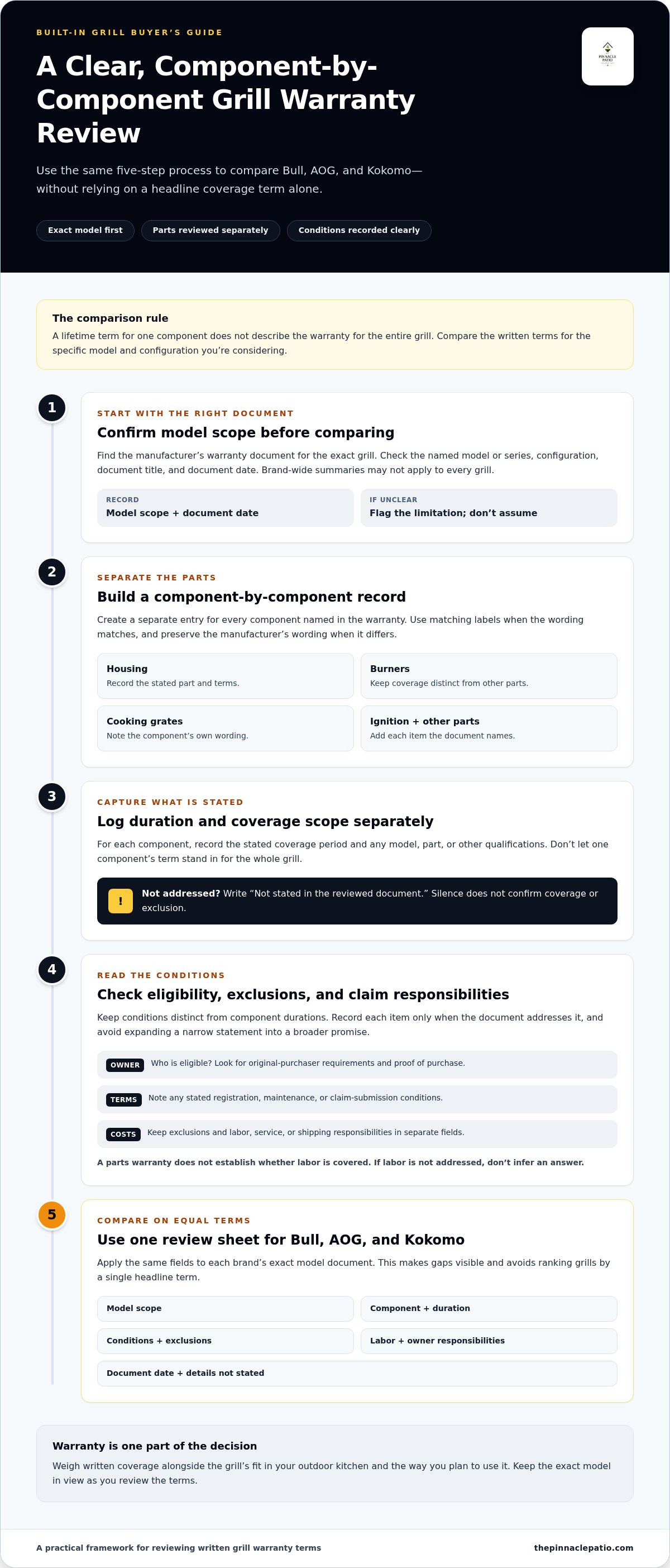
A useful warranty comparison for top grill brands starts with the document for the exact grill you’re considering. Treat each warranty as a set of separate terms, not one promise covering the appliance as a whole. This makes it easier to compare brands fairly and understand what the manufacturer states for each component.
Warranty terms describe the items covered, the duration and conditions of coverage, and responsibilities involved in a claim. When a detail is not addressed in the document, record it as not stated. Do not assume it is included or excluded.
Start with the manufacturer’s warranty document for the intended model. Check its title, named models or series, document date, and stated scope. A brand may use different terms for different grills or configurations, so do not apply a general brand summary without confirming that it covers the model you’re evaluating. Keep a copy with your product notes and record when you reviewed it. If the model scope is unclear, flag that limitation rather than filling in the gap.
Compare Coverage for Individual Grill Components
Create a separate entry for each component named in the warranty. Use consistent labels when the wording matches, and retain the manufacturer’s term when it differs. This highlights meaningful distinctions without implying that coverage is identical across brands.
- Component: Record the named part, such as a burner, cooking grate, or housing.
- Duration and scope: Note the stated period and any model or component qualifications.
- Unlisted items: Use “not stated in the reviewed document” when a component is not addressed. Do not treat silence as a coverage decision.
Read Conditions, Exclusions, and Claim Requirements
Record conditions separately from component durations. Look for language about eligible owners, proof of purchase, registration, maintenance, and claim submission. Note each item only when the warranty addresses it. This helps you understand both the stated coverage and the steps or limits that may affect a claim.
Keep exclusions and labor or service terms in their own fields. Paraphrase carefully, or quote a short phrase when exact wording matters. A parts warranty does not establish whether labor is covered. Similarly, silence about labor does not confirm coverage or exclusion. Avoid combining separate exclusions into a broader claim than the document supports.
A compact comparison sheet can track model scope, component, duration, conditions, exclusions, labor language, owner responsibilities, and document date. This makes missing information visible and gives you a more dependable basis for weighing the grill against your kitchen plans. If you’re also considering model fit, sizing, or configuration, a grill planning consultation can help bring those decisions together.
Bull vs. AOG vs. Kokomo: A Fair Grill Warranty Comparison
Warranty terms can vary by model, so compare the manufacturer’s document for the exact grill you’re considering. The table below identifies what to establish for Bull, AOG, and Kokomo before making a direct comparison. It does not treat a reported summary as a confirmed term for every model.
| Brand and model scope | Component | Stated duration | Conditions | Exclusions | Document date |
|---|---|---|---|---|---|
|
Bull Match the warranty document to the intended grill model. |
Record the components named in the document. | Enter the duration stated for each component. | Note the applicable owner and claim conditions. | Record exclusions that apply to the model. | A policy document is reported as updated February 14, 2025. Compare its date and scope with the document for your intended model. |
|
AOG Match the warranty document to the intended grill model and series. |
Record the components named in the document. | Enter the duration stated for each component. | Note the applicable owner and claim conditions. | Record exclusions that apply to the model. | Use the date shown on the applicable manufacturer document. |
|
Kokomo Match the warranty document to the intended grill model. |
Record the components named in the document. | Enter the duration stated for each component. | Note the applicable owner and claim conditions. | Record exclusions that apply to the model. | Use the date shown on the applicable manufacturer document. |
How to Complete a Fair Comparison
For each brand, use the manufacturer’s warranty document and confirm that its model scope includes the grill you’re considering. Record the document date, then enter only the terms it states. If a field is not addressed, label it “not stated in the reviewed document.” If the wording or model scope is ambiguous, flag it rather than resolving the question through a summary or a term from another model.
Once you have the documents, compare equivalent components and conditions. Do not present a duration from a secondary summary as a verified manufacturer term unless it matches the wording for the specific model. Similarly, do not assume that coverage, exclusions, or claim conditions apply across an entire brand lineup because they appear in a document for one grill.
This method gives Bull, AOG, and Kokomo the same standard of comparison and makes gaps visible. Keep the warranty document with your product notes. If you consider a different model, revisit the comparison using the terms that apply to that grill.
As you narrow your choice, consider warranty terms alongside the grill’s fit and intended place in your outdoor kitchen. The built-in grill selection lets you explore models from these brands while keeping the model-specific warranty in view.
How to Choose the Warranty That Fits Your Grill and Outdoor Kitchen
A warranty is most useful as part of a broader purchase decision. The right choice depends on the written terms for the specific grill, how you plan to use it, and whether the model suits your outdoor kitchen. Use this process to move from general brand claims to a decision based on both written coverage and project fit.
- Identify the intended model. Narrow your choices to a specific grill and configuration. A brand-level summary may not reflect the terms for every model or component.
- Review the applicable warranty document. Match its model scope to the grill you’re considering. Note the document date, then record stated coverage, conditions, exclusions, and claim responsibilities.
- Compare equivalent terms. Review the same components across brands, such as the housing, burners, grates, and ignition system, where the documents address them. Keep labor language, owner requirements, and exclusions separate from parts coverage.
- Weigh the grill against your plans. Consider written coverage alongside cooking needs, dimensions, fuel compatibility, and the outdoor kitchen layout. Favorable warranty terms will not resolve a mismatch in fit or configuration.
Match Warranty Priorities to Your Ownership Plans
Think about the grill’s intended role. If you plan to use it often for family meals, you may focus on different components than if you reserve it for occasional entertaining. This does not make one coverage category universally more important. It helps you decide which written terms deserve closer attention for your routine.
Review any stated requirements for care, maintenance, registration, proof of purchase, and claim submission. If you expect to keep the grill for years, understand who the warranty identifies as eligible for coverage and what responsibilities it assigns to the owner. Prioritize according to your plans, but base your decision on written terms rather than assumptions about how warranties usually work.
Consider the Grill as Part of a Complete Outdoor Kitchen
A built-in grill needs to work within the dimensions and configuration of the kitchen around it. Confirm the model’s dimensions and fuel compatibility against the planned space and utilities. The warranty document is not a substitute for product-fit details. Appliance placement and the wider layout matter, especially when the grill is one part of a coordinated cooking area.
Explore built-in grill options while comparing model fit with the written warranty. For whole-space planning, consider how the grill relates to island sizing and other appliances rather than choosing on coverage duration alone. The warranty comparison for top grill brands is most useful when it supports a choice that fits your cooking plans and outdoor kitchen.
Choose Your Grill with Clear Warranty Information and Expert Guidance
A confident grill decision brings together the terms for the specific model, the way you expect to use it, and how it fits into your outdoor kitchen. A warranty comparison can clarify differences in component coverage and stated conditions, but it cannot determine whether a grill suits your layout, cooking plans, or configuration. Consider those factors together before making a long-term selection.
The Pinnacle Patio helps shoppers considering Bull, AOG, and Kokomo grills weigh product choice, compatibility, sizing, and configuration. A consultation can support those decisions and help you organize questions about the model you’re considering.
Prepare for a Product Consultation
A little preparation makes the discussion more focused. Bring the grill model you’re considering and the manufacturer warranty document you reviewed. If you’re comparing models, bring each document and note the terms you want to understand, such as component coverage, exclusions, or owner responsibilities.
It also helps to have your outdoor kitchen plans at hand. Share the intended layout and relevant dimensions, along with questions about how the grill may fit with surrounding appliances and the planned configuration. The conversation can then address product selection in the context of your space, rather than treating the grill as a standalone purchase.
- Model: Note the brand and specific grill under consideration.
- Warranty: Bring the manufacturer document and identify the coverage terms you want to discuss.
- Kitchen plan: Gather layout details, dimensions, and compatibility questions.
This preparation is useful when you’re choosing between models with different component terms or considering how a grill will work within a planned island. It keeps the discussion focused on your priorities and the details that shape a practical selection.
Move from Comparison to a Confident Selection
Keep your comparison tied to the exact model, its named components, and the conditions in its manufacturer warranty. If a term is unclear or absent, leave it unresolved rather than treating an assumption as coverage. Then weigh the written details alongside the grill’s dimensions, fuel compatibility, and the design of the kitchen around it.
Explore the built-in grill collection to consider Bull, AOG, and Kokomo options in the context of your project. A good selection aligns the grill’s written terms and configuration with how you plan to cook and use the space.
Make Your Next Grill Decision with Confidence
A thoughtful warranty comparison for top grill brands gives you a clearer basis for choosing, but the next step is to connect that research to the space you’re creating. Consider how the grill will fit your kitchen plan, work with its intended configuration, and support the way you expect to cook. Bringing those priorities together helps you make a considered decision and plan an outdoor kitchen that works as a whole.
The Pinnacle Patio carries Bull, AOG, and Kokomo grills, with consultations to help shoppers think through sizing, compatibility, and configuration. Bring your preferred model and project questions to the conversation, then choose with both product fit and your plans for the space in mind.
Your outdoor kitchen should feel considered from the first choice to the first meal. With clear priorities and knowledgeable guidance, you can take the next step with confidence.
Frequently Asked Questions
What should I compare in a built-in grill warranty?
Compare the model covered, named components, coverage periods, conditions, exclusions, claim steps, and any labor or shipping language. In a warranty comparison for top grill brands, use the manufacturer’s document for each model rather than relying on a brand-level summary. If your shortlist includes two models from one brand, check that the terms apply to each exact model and configuration before comparing them.
Do all parts of a grill have the same warranty coverage?
No. Do not assume every component has identical terms. The applicable manufacturer document determines which parts are named and what coverage is stated for each. Look for the housing, burners, cooking grates, and ignition components, then record the wording and duration separately. If a component is not addressed, treat its status as unresolved rather than assuming it has the same coverage as another part.
Does a grill warranty cover labor as well as replacement parts?
That depends on the model-specific warranty language. Look for separate statements about parts, labor, service, and shipping. Coverage for a replacement part alone does not establish that labor is included. If the document says nothing about labor, record it as “not stated” rather than inferring coverage or exclusion. Apply a brand-level summary only after confirming that it matches the model you’re considering.
Can a grill warranty be transferred to a new owner?
Check the applicable warranty document before assuming coverage transfers with the grill. Its terms may identify who qualifies as the purchaser or warranty holder, which can affect a future owner. If you’re buying a home with an existing built-in grill, identify the model and locate its warranty paperwork. The original owner’s description or the remaining coverage period alone does not establish that you qualify for warranty support.
Do I need to register a grill to use its warranty?
Registration requirements depend on the warranty document for the exact model. Look for a stated registration process, deadline, or language making registration a condition of coverage. Keep proof of purchase and model information with your records, too. If the warranty does not mention registration, do not infer a requirement. Note that the document does not state one and follow any other instructions it provides.
What can void or limit a grill manufacturer warranty?
The answer depends on the exclusions and conditions in the warranty for your model. Review its language about use, care, installation, damage, and claim procedures rather than relying on a general list of common exclusions. If you have questions about exposure or upkeep, look for wording that specifically addresses those circumstances. Do not treat an exclusion from another model or brand as applicable to your grill.
Is a lifetime grill warranty the same as lifetime coverage for every component?
No. Read a “lifetime” statement in context: check which component it names, which model it covers, and what conditions accompany it in the warranty document. Other parts may have separate terms, or may not be addressed. If a summary uses “lifetime warranty” without identifying the covered components and model scope, review the applicable manufacturer document before drawing conclusions about the whole grill.