

How Many Bromic Heaters Do I Need? 2026 Sizing Guide
Calculating outdoor heating by overall square footage is the quickest way to end up with uncomfortably scorched lounge chairs and freezing dining corners. When homeowners ask, "how many Bromic heaters do I need for my patio," raw dimensions alone will lead them astray. True thermal comfort relies on targeted radiant zoning. You likely already know the frustration of uneven heat distribution, especially when trying to balance exposed breeze corridors against sheltered architectural ceilings and strict clearance requirements.
In this 2026 sizing guide, you will master the exact heat calculations, directional coverage zones, and model specifications required to flawlessly warm your outdoor living space. We explore the distinct performance profiles of the Platinum, Tungsten, and Eclipse collections across both gas and electric platforms. You'll gain the confidence to select the ideal system for your specific footprint, creating a seamless layout plan ready for your licensed contractor to execute with precision.
Key Takeaways
- Target specific activity zones like dining areas and deep-seating lounges rather than heating your entire outdoor footprint, ensuring even radiant warmth without wasting energy.
- Determining how many Bromic heaters do I need for my patio comes down to mapping exact directional coverage boundaries against your local climate and ceiling heights.
- Select collections based on architecture and fuel availability, contrasting the low-profile aesthetic of Platinum Electric with the potent wind resistance of Tungsten Gas or the dual-purpose illumination of Eclipse.
- Factor in essential installation clearances early, including minimum mounting heights and buffer zones from combustible materials, to maintain safety and peak radiant efficiency.
- Coordinate dedicated electrical or gas supply requirements and multi-channel zoning controls in advance so your licensed contractor can execute the layout seamlessly.
Understanding Radiant Heat Coverage: Sizing Patio Heating by Activity Zones
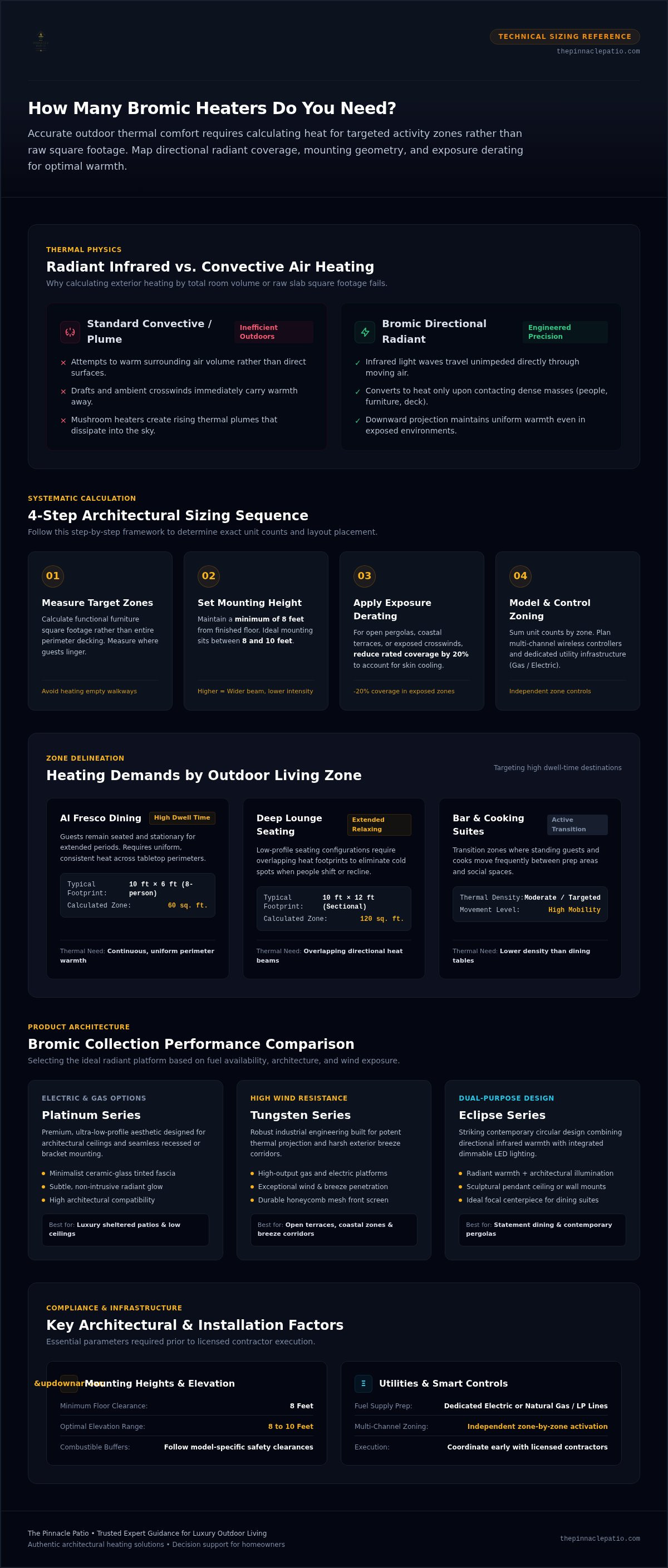
Radiant zone heating is purposeful heat directed to occupied spaces rather than surrounding empty air. When planning an outdoor layout, asking how many Bromic heaters do I need for my patio begins with analyzing social habits rather than calculating total exterior square footage. Unoccupied walkway perimeters don't need dedicated thermal energy. Instead, heating should focus entirely on where people gather, converse, and linger.
The Mechanics of Infrared Directional Warmth
Traditional convective systems attempt to warm surrounding air, which is an inefficient approach outdoors where drafts immediately carry the warmth away. As established in the engineering principles of radiant heating and cooling, infrared waves travel through the air unimpeded, converting into thermal comfort only when they contact dense masses like furniture, decking, and people.
Because infrared energy operates as direct radiant light, wind and open breezes cannot displace the heat path. This focused transfer contrasts sharply with standard portable propane mushroom heaters, which release diffuse thermal plumes that quickly rise and dissipate into the night sky. High-performance radiant panels project downward with intentional direction, ensuring reliable warmth even in exposed environments.
Delineating Your Patio Comfort Footprints
Accurately determining how many Bromic heaters do I need for my patio requires dividing your outdoor living area into distinct functional destinations:
- Al Fresco Dining Tables: Guests remain seated and stationary for extended meals, requiring consistent, uniform heat across the full tabletop perimeter.
- Deep Lounge Seating: Low-profile seating arrangements require overlapping heat footprints to prevent cold spots when people shift or recline.
- Bar Counters and Cooking Suites: These active transition zones require less thermal density than dining areas, as cooks and standing guests move frequently between prep areas and social spaces.
Calculate the exact square footage of each isolated comfort zone rather than measuring the broad perimeter of an exterior concrete slab. Accounting for human dwell time ensures you invest in targeted warmth where it matters most. You can explore verified options across our curated collection of patio heaters to match the specific dimensional requirements of each living zone.
Step-by-Step Calculation: How Many Bromic Heaters Does Your Patio Require?
Establishing exact equipment counts eliminates guesswork. To solve how many Bromic heaters do I need for my patio, follow an architectural sequence that factors in precise furniture footprints, mounting geometry, and environmental exposure. Moving systematically ensures you invest in dependable warmth rather than redundant hardware.
Step 1 & 2: Surface Dimensions and Mounting Elevation
Begin by measuring the target floor square footage using functional furniture perimeters rather than perimeter decking. For example, an eight-person dining suite spanning 10 by 6 feet forms a primary comfort zone of 60 square feet. Deep lounge seating configurations typically require a broader 10 by 12-foot zone.
Next, confirm your mounting elevation against manufacturer specifications. Bromic heaters require a minimum clearance of 8 feet from the finished floor, with ideal placement sitting between 8 and 10 feet. Increasing mounting height expands the radiant beam dispersion across the floor, but it softens thermal intensity at seated level. Lower heights concentrate heat onto a tighter perimeter. Reviewing established outdoor heater safety guidelines helps ensure your chosen elevation maintains proper clearance away from overhead ceilings and combustible structures.
Step 3 & 4: Environmental Derating and Unit Summation
Third, apply an environmental derating adjustment. Radiant infrared cuts through moving air, but steady crosswinds increase convective cooling on human skin. For open pergolas, coastal terraces, or spaces without solid windbreaks, reduce the manufacturer's rated square-foot coverage by 20 percent to establish a resilient baseline.
Finally, divide your target footprint by the adjusted coverage capacity of the selected heater model. When arranging multiple units along a single line, integrate a 15 to 20 percent lateral beam overlap between adjacent fixtures to eliminate drop-offs in warmth. For intricate layouts with varying ceiling heights or wind conditions, you can schedule a consultation with our specialists to review zone coverage before finalizing your layout.
Bromic Model Coverage Comparison: Platinum, Tungsten, and Eclipse Performance
Selecting the right heater family directly influences how many Bromic heaters do I need for my patio. Each model line features specialized emitter geometry, heating elements, and exterior fascias tailored to distinct architectural spaces. Balancing electric wattage against gas output allows you to match physical footprints with thermal performance.
Platinum Smart-Heat: Sleek Minimalist Heat Footprints
Bromic Platinum Smart-Heat Electric units feature a premium 304 stainless steel chassis fronted by a Schott tinted ceramic-glass screen that minimizes red light emission. The 2300W model covers approximately 65 sq. ft. running on a 240V, 9.6A circuit. Step-up options include the 3400W and 4500W models for larger spaces. These units excel in semi-enclosed spaces and can be recessed flush into ceiling cavities.
For gas installations, the Platinum Smart-Heat Gas 300 Series (23,600 BTU) warms up to 160 sq. ft., while the 500 Series (39,800 BTU) expands coverage up to 215 sq. ft. Both gas variants are rated to maintain performance in wind speeds up to 11 mph.
Tungsten Smart-Heat: Robust Industrial Thermal Reach
Engineered for high radiant projection, the Tungsten series uses a honeycombed mesh screen to distribute heat evenly. Tungsten Electric models provide structured coverage tiers:
- 2000W Model: Heats up to 65 sq. ft.
- 3000W Model: Heats up to 100 sq. ft.
- 4000W Model: Heats up to 130 sq. ft.
- 6000W Model: Heats up to 160 sq. ft.
Where extensive square footage demands heavy output, Tungsten Gas models deliver deep coverage blankets. The Tungsten Gas 300 Series (26,000 BTU) covers up to 160 sq. ft., and the Tungsten Gas 500 Series (43,000 BTU) warms up to 215 sq. ft. with wind resistance up to 8 mph. For flexible layouts, the Tungsten Portable Gas (38,500 BTU) covers up to 215 sq. ft. and provides up to 8 hours of runtime on a standard propane cylinder.
Eclipse Smart-Heat: Contemporary Elegance and Radiant Light
The Eclipse Smart-Heat Electric line integrates radiant warmth with dimmable illumination. Driven by a 2900W circular element with adjustable heat output (0, 33, 66, and 100%), the Pendant model warms up to 144 sq. ft., while the Portable version covers up to 121 sq. ft.
Both options feature a ceramic fascia and an integrated 3000K warm white LED ring light. This dual-purpose design makes Eclipse suited for conversation circles and outdoor bar counters where both heat and ambient lighting are needed from a single ceiling mount.
Key Architectural Factors That Impact Heater Quantities and Placement
Architectural surroundings define real-world heating effectiveness. When calculating how many Bromic heaters do I need for my patio, structural overhangs, wall boundaries, and local air patterns play as large a role as raw floor area. Evaluating these physical elements preserves both equipment safety and radiant efficiency.
Ceiling Clearances and Safe Mounting Parameters
Safe operation demands strict adherence to clearance envelopes. Overhead units require at least 8 feet of clearance between the finished floor and the bottom of the heater, while select wall-mounted units can be positioned at 6 feet. Maintain at least 3 feet of side clearance to adjacent walls, along with 39.4 inches of open clearance directly in front of the heating face. In multi-unit arrangements, maintain at least 8 feet between wall-mounted heaters to prevent intense heat pockets.
Low combustible ceilings require careful planning. Gas models mounted beneath solid patio roofs require approved heat deflectors, which mandate a 14-inch minimum buffer from the deflector top to the ceiling surface. For high overhead structures exceeding 10 feet, ceiling extension poles lower the units back into the optimal thermal range. Flush-mounted Platinum Electric units require 7.1 inches of vertical clearance inside the ceiling cavity, with joist spacing of 9.4 inches for the 2300W and 3400W models, or 12.5 inches for the 4500W model.
Overcoming Structural Airflow and Exposure
Unsheltered outdoor spaces lose residual heat quickly. While infrared rays cut directly through breezes, steady airflow speeds up convective cooling on seated guests. Angling radiant heaters inward toward solid masonry or exterior facades allows those structural surfaces to absorb and bounce back radiant energy. Adding perimeter drop-down screens or glass windscreens stabilizes the microclimate, effectively reducing the total heater output required.
Equipment placement must also integrate cleanly with dedicated culinary stations in luxury outdoor kitchens. You should avoid installing high-output radiant panels directly over active grills or pizza ovens where cooking surfaces already produce intense ambient heat. Directing radiant warmth toward guest seating flanking your outdoor kitchen island keeps visitors warm without interfering with culinary ventilation hoods or airflow.
Designing Your Cohesive Heating Layout: Infrastructure and Curation
A flawless layout balances thermal calculations with the physical utilities powering your space. When resolving how many Bromic heaters do I need for my patio, structural aesthetics must integrate directly with electrical breaker capacity or gas line pressure. Planning this utility infrastructure early avoids costly structural modifications once framing and finishes are in place.
Dedicated Utilities and Electrical Panel Planning
High-wattage electric heating requires substantial power allocation. A multi-zone plan featuring two or three electric units can quickly demand 40 to 60 amps of dedicated electrical capacity. Each Bromic electric heater requires its own dedicated 208V or 240V circuit to operate safely and effectively.
Natural gas installations demand similar foresight regarding fuel volume. Adding multiple high-output gas units alongside existing luxury appliances like built-in grills, side burners, or pizza ovens can strain your meter. Verify that your main supply pipe diameter delivers sufficient gas volume to run all appliances simultaneously at peak load. While The Pinnacle Patio provides specialized appliance curation and layout guidance, certified trade professionals, including licensed electricians and gas fitters, must handle all physical utility connections and site modifications.
Intelligent Control and Seasonal Living
Tailoring heat output across different entertaining moments creates true outdoor comfort. Multi-channel wireless master remotes and smart controllers give you the ability to manage independent zones from a single interface:
- Independent Multi-Zone Operation: Power on the dining zone during an evening meal while keeping the lounge seating off until guests relocate.
- Variable Dimming Capabilities: Dial down electric output to 33 or 66 percent on mild spring evenings, saving full output for crisp autumn nights.
- Integrated Illumination: Manage radiant warmth and dimmable 3000K LED task lighting concurrently on Eclipse models.
Pairing overhead radiant arrays with low-profile freestanding fire features creates a layered comfort environment. Review our full portfolio of genuine Bromic patio heaters to explore matching finishes, brackets, and controller accessories. If your architectural footprint features unique ceiling heights or complex boundaries, request a custom consultation with our team to verify your equipment specifications and design a tailored radiant plan.
Bringing Year-Round Warmth to Your Outdoor Living Space
Answering how many Bromic heaters do I need for my patio comes down to intentional spatial design rather than broad square footage. Aligning dedicated activity zones with the distinct engineering profiles of the Platinum, Tungsten, or Eclipse collections ensures consistent thermal comfort throughout every season. Respecting mounting elevations, wind exposure, and utility requirements turns an ambitious architectural layout into an effortless entertaining experience.
As an authorized retailer of genuine Bromic systems, The Pinnacle Patio curates high-performance heating solutions that integrate seamlessly with luxury outdoor kitchens. While local licensed electricians and gas contractors manage on-site utility hookups, our team ensures your equipment sizing, clearance envelopes, and fuel configurations align before breaking ground.
With the right heating blueprint in place, your patio will remain a welcoming setting for connection long after the seasons shift.
Frequently Asked Questions
How much patio square footage does a single Bromic heater typically cover?
A single Bromic unit warms between 65 and 215 square feet depending on the fuel type and specific model series. Compact electric fixtures like the Platinum 2300W warm roughly 65 square feet, while larger 6000W Tungsten electric panels cover up to 160 square feet. High-output gas models, including the Tungsten 500 series, project radiant warmth across areas up to 215 square feet under sheltered patio conditions.
Can I mount Bromic heaters directly to a wood ceiling or pergola?
You can mount units to timber structures, but you can't place them directly flush against combustible wood without approved clearance hardware. Gas heaters mounted below solid timber ceilings require dedicated heat deflector shields that maintain a 14-inch buffer to the overhead surface. Electric heaters require specialized mounting brackets that preserve safe clearances while maintaining at least 8 feet of elevation above the finished deck.
Is electric or gas heating more effective for an open outdoor patio?
Gas heating is generally more effective for expansive, fully open patios due to higher raw thermal energy. A single Tungsten Gas unit produces up to 43,000 BTUs, projecting wide heat blankets that withstand ambient breezes up to 11 mph. When deciding how many Bromic heaters do I need for my patio, choose gas for open-air spaces and electric for semi-enclosed covered structures.
What is the optimal mounting height for Bromic patio heaters?
The optimal mounting elevation sits between 8 and 10 feet above the finished floor. Bromic guidelines mandate an 8-foot minimum floor clearance for overhead heaters to ensure safe operation, though select wall-mounted units allow a 6-foot height. Mounting above 10 feet spreads radiant waves too broadly, diluting warmth at seating level unless you lower the fixtures using optional ceiling suspension poles.
How far apart should multiple Bromic heaters be spaced to avoid cold spots?
Multiple wall-mounted heaters should be spaced at least 8 feet apart, with adjacent coverage patterns designed to overlap by 15 to 20 percent. This calculated overlap prevents cold gaps between lounge chairs while avoiding intense heat concentrations directly overhead. When calculating how many Bromic heaters do I need for my patio, map adjoining fixtures along a shared axis to create unified, consistent comfort.
Does wind blow away the heat produced by Bromic infrared heaters?
Wind doesn't blow away radiant heat because infrared energy warms people and physical surfaces directly rather than warming the surrounding air. However, brisk breezes increase convective cooling on bare skin. Bromic gas heaters feature specialized directional screens and electronic ignition systems rated to withstand winds between 8 and 11 mph, ensuring steady performance in exposed coastal or hillside backyards.
Can Bromic electric heaters be flush-mounted into a finished ceiling?
Bromic Platinum Smart-Heat Electric units can be installed flush into non-combustible or timber-framed ceilings using architectural recess kits. This recessed configuration requires a vertical cavity clearance of at least 7.1 inches. Joist spacing must accommodate the kit frame, requiring a 9.4-inch gap for 2300W and 3400W models or 12.5 inches for 4500W models. Licensed trade professionals must complete the physical electrical wiring.