

Infrared Sear Burner vs Standard Burner: The Connoisseur’s Guide to Grill Performance
What if the BTU rating on your grill's spec sheet is actually distracting you from the most important factor in outdoor culinary performance? It's a common point of confusion for many homeowners who find that raw power doesn't always translate to that elusive, steakhouse-quality crust. You've likely felt the uncertainty of choosing between an infrared sear burner vs standard burner, perhaps worrying if a specialized ceramic unit is a necessary investment or a fragile liability that might fail over time.
We understand that a premium outdoor kitchen is an investment in your lifestyle, built around connection, refinement, and the elevation of everyday moments. This guide will demystify the technical nuances of heat transfer, helping you master the difference between radiant energy and convective airflow. You'll gain a clear understanding of how to balance these technologies to create a versatile cooking environment that performs with consistency and grace.
By the end of this exploration, you'll know exactly whether a hybrid setup or a single-type configuration suits your culinary style. We'll examine the longevity of 304 stainless steel, the precision of brand-specific engineering, and the specific ways a thoughtful burner selection can transform your patio into a professional-grade sanctuary for gathering and celebration.
Key Takeaways
- Understand how the physics of radiant energy differs from traditional convection to deliver superior moisture retention in your proteins.
- Evaluate the trade-offs of an infrared sear burner vs standard burner to determine if a specialized high-heat zone fits your cooking repertoire.
- Learn why the choice of 304 stainless steel is non-negotiable for homeowners seeking a grill that withstands the test of time and environmental exposure.
- Discover the professional secret of the hybrid configuration, allowing you to master both the Maillard reaction and delicate indirect roasting on a single surface.
- Gain the technical clarity needed to choose between premium brands like Bull, AOG, and Kokomo based on their specific burner engineering and longevity.
The Science of Heat: Convection vs. Radiant Energy
Heat is the fundamental element of any culinary endeavor, yet the method by which it reaches your food defines the final texture and flavor profile. When comparing an infrared sear burner vs standard burner, you aren't just choosing a component; you're selecting a thermodynamic philosophy. Standard burners utilize convective currents to warm the air, while infrared technology harnesses the physics of thermal radiation to achieve professional results.
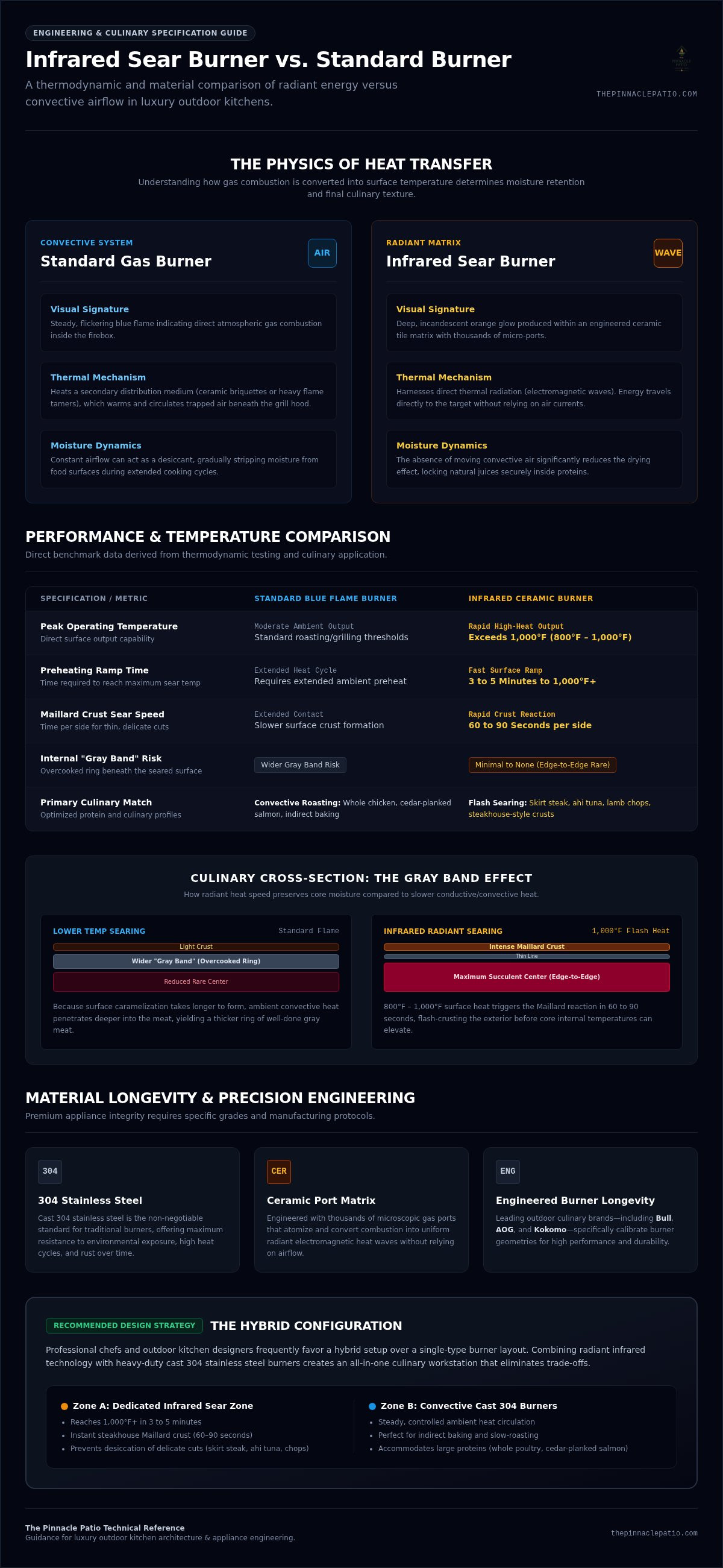
The visual distinction between these two systems is striking and serves as your first guide to their performance. A standard burner produces a steady, flickering blue flame, which is the hallmark of gas combustion heating the atmosphere within the firebox. Conversely, an infrared unit transforms that combustion into a deep, incandescent orange glow within a specialized ceramic tile matrix. Infrared grilling is the use of electromagnetic waves to create high-intensity surface heat.
How Standard Blue Flame Burners Work
Traditional built-in grills frequently utilize cast 304 stainless steel burners that ignite to create an open flame. This flame doesn't usually interact with your food directly. Instead, it heats a secondary medium, such as ceramic briquettes or heavy-duty flame tamers, which then warms the air trapped beneath the grill hood. This convective process creates a stable, ambient environment that's perfect for roasting a whole chicken or baking a cedar-planked salmon.
Recognize that convection relies on the constant movement of hot air. This airflow can sometimes act as a desiccant, stripping moisture from the surface of your proteins as they cook. While standard burners are the foundation of a versatile grill, they often require more time to reach searing temperatures, which can lead to a wider "gray band" of overcooked meat beneath the crust.
The Infrared Mechanism: Intense Radiant Heat
The infrared mechanism offers a more direct approach to heat transfer. Gas is pushed through thousands of microscopic ports in a ceramic plate, igniting to create a high-intensity radiant field. This allows the burner to reach surface temperatures exceeding 1,000°F in as little as three to five minutes. Because this energy travels in waves, it doesn't rely on air as a medium, which significantly reduces the drying effect of moving currents.
This focused intensity is what makes the infrared sear burner vs standard burner comparison so vital for enthusiasts. By delivering rapid energy directly to the meat, you can achieve a profound Maillard reaction while the interior remains tender and moist. It's an intentional design choice for those who value the art of the perfect sear, providing a professional-grade tool that complements the foundational versatility of traditional burners.
Performance Comparison: Searing Texture vs. Temperature Control
The choice between an infrared sear burner vs standard burner often determines the character of your outdoor culinary results. While standard burners serve as the foundational workhorse for a wide range of recipes, infrared units act as precision tools designed for a specific, high-impact outcome. Understanding the performance gap between these two technologies allows you to choose a configuration that aligns with your entertaining style and palate preferences.
The Maillard Reaction and the Infrared Advantage
Achieving a professional steakhouse crust requires temperatures that standard gas flames often struggle to sustain. Infrared burners excel here, reaching surface temperatures between 800°F and 1,000°F in less than five minutes. This intense heat triggers the Maillard reaction almost instantly, creating a complex, caramelized exterior while the interior remains succulent. By understanding the culinary mechanics of infrared cooking, you can see how this rapid energy transfer prevents the "gray band" of overcooked meat often found when searing on lower-temperature surfaces.
For thin cuts like skirt steak, ahi tuna, or lamb chops, this speed is essential. The high-intensity radiant energy crusts the protein in 60 to 90 seconds per side, ensuring the center stays perfectly rare or medium-rare. This "instant sear" provides a psychological and practical benefit for the home chef, offering confidence that the most expensive cuts of meat will be treated with the respect they deserve.
Versatility and Control with Standard Burners
Standard burners remain the superior choice for recipes that require a delicate touch or a wide dynamic range. Because they heat the air through convection, they can be dialed down to maintain steady, low temperatures between 225°F and 350°F. This makes them indispensable for cooking bone-in chicken, thick-cut vegetables, or delicate seafood that would simply incinerate under the focused power of an infrared tile. Most infrared burners have limited turndown capabilities; even on their lowest setting, they often remain too hot for gentle roasting.
Managing the environment is also simpler with standard burners. Premium brands like Bull and Kokomo utilize heavy-duty 304 stainless steel heat shields or flavorizer bars. These components serve two vital purposes:
- They distribute heat evenly across the cooking grid to eliminate hot spots.
- They protect the burner ports from grease and drippings, significantly reducing the risk of aggressive flare-ups.
Recovery time and fuel efficiency also factor into the investment. When you lift the grill lid, a standard burner loses its convective heat to the atmosphere, requiring several minutes to return to temperature. Infrared energy, however, resides in the glowing ceramic tile rather than the air. The recovery is nearly instantaneous. While infrared is more efficient for quick, high-heat sessions, standard burners are the more economical choice for the sustained flames needed during long afternoon gatherings. If you're unsure how to balance these two technologies in your custom layout, our experts can help you design a configuration tailored to your entertaining style.
Durability, Materials, and Long-Term Maintenance
Selecting an infrared sear burner vs standard burner isn't just about heat; it's about the longevity of your investment. High-end outdoor kitchens are designed to endure, and the materials used in your burner configuration play a pivotal role in that permanence. Professional-grade grills like Bull use cast stainless burners for extreme corrosion resistance. When weighing the long-term value of an infrared sear burner vs standard burner, consider that the former is a high-performance specialty tool while the latter is the durable backbone of your firebox.
Cast Stainless Steel vs. Ceramic Components
The physical weight of a cast 304 stainless steel burner, found in premium built-in grills from brands like Bull and AOG, provides exceptional heat retention and structural integrity. Unlike thinner tubular burners, these solid blocks of metal won't warp or burn through over years of use. They carry a sense of heritage, often backed by lifetime warranties that reflect their status as a permanent home improvement.
In contrast, infrared burners rely on a delicate ceramic tile matrix. To understand how infrared grill burners operate, one must appreciate the thousands of micro-orifices that allow gas to pass through. While incredibly efficient, these ceramic plates are vulnerable to thermal shock. Dropping cold liquid or heavy marinades onto a white-hot tile can cause the ceramic to crack. Protecting these components from excessive drippings is essential to prevent clogging, which ensures the burner continues to glow with the uniform intensity required for a perfect sear.
Cleaning and Coastal Environment Considerations
For those living in coastal areas, the choice of materials becomes even more critical. Salt air is a relentless catalyst for corrosion. While 304 stainless steel remains the gold standard for resisting rust in standard gas ports, ceramic infrared surfaces require a different kind of vigilance. Moisture can settle in the porous ceramic, so regular use and proper covering are necessary to maintain performance. Standard burners are generally more resilient in these harsh environments, though they still require the protection of high-grade stainless steel housings.
Maintenance routines also differ significantly. Standard burners require you to periodically scrub the 304 stainless steel heat tents or flavorizer bars to remove grease buildup. Infrared burners are largely self-cleaning through a "burn-off" method. After cooking, you simply run the burner on high for five minutes to incinerate any residue, turning it into fine ash. You'll know it's time to consider a replacement if you notice uneven flames on your standard burners or a dull, patchy glow on your infrared tile. These subtle signs indicate that the burner's efficiency has been compromised by time or environmental exposure.
Designing Your Ideal Grill Configuration
Designing an outdoor culinary space requires more than just high-performance appliances; it demands an intentional layout built around how you actually cook. The most sophisticated configurations today move away from all-convection or all-infrared setups. Instead, a hybrid approach has become the professional standard. Industry data indicates that over 80% of custom built-in configurations now utilize a mix of technologies to ensure total culinary freedom. When deciding on an infrared sear burner vs standard burner arrangement, it's best to think in terms of heat zones rather than raw power.
Placing a high-intensity ceramic burner on the far left or right creates a dedicated sear station, allowing you to finish a dry-aged ribeye with a professional crust while your seasonal vegetables roast gently over a standard burner's ambient heat. This zonal strategy ensures that every component of your meal is treated with the specific thermal energy it requires. You can explore our collection of high-performance built-in grills to see how these modular configurations look in premium 304 stainless steel housings.
The Hybrid Burner Layout
For a standard 30-inch grill, replacing one traditional burner with an infrared unit typically converts 25% to 33% of your cooking surface into a high-heat zone. This is often the "sweet spot" for homeowners who want the ability to flash-sear steaks without sacrificing the indirect space needed for larger roasts. When configuring your Pinnacle Outdoor Kitchen, consider your typical guest count. Larger 36-inch and 42-inch grills provide enough room to maintain three or four standard burners alongside a dedicated infrared station, giving you the dynamic range to manage multiple courses simultaneously.
Rotisserie and Rear Infrared Burners
It's vital to distinguish between a bottom infrared sear burner vs standard burner and a rear infrared rotisserie burner. While a bottom sear burner replaces a primary cooking element to deliver vertical heat, a rear IR burner is mounted vertically on the back wall of the firebox. This design radiates horizontal heat toward a spit rod, which is the secret to professional-grade rotisserie results. Because the heat source is behind the meat rather than beneath it, you don't have to worry about flare-ups from dripping fats. Combining a rear IR burner with standard bottom burners on their lowest setting allows you to achieve a crisp, golden exterior on a whole bird while maintaining a succulent interior.
Final Verdict: Which Burner Investment Fits Your Lifestyle?
Deciding between an infrared sear burner vs standard burner is less about technical superiority and more about your culinary identity. If you're a high-heat purist who views a Saturday evening as an opportunity to master the perfect crust on a wagyu ribeye, the infrared upgrade is a non-negotiable tool. For the versatile family cook who values the ability to roast a whole chicken while simmering a side of delicate asparagus, the foundational power of standard burners remains unmatched. You're choosing the primary "voice" of your outdoor living space.
Budgeting for this upgrade involves more than the initial retail price, which typically ranges from $150 to over $500 depending on the brand and engineering. You're investing in a specific outcome. Brands like Bull and AOG approach this integration with professional foresight. Bull's system allows for a seamless drop-in replacement, enabling you to swap a cast stainless burner for an infrared unit as your skills evolve. AOG offers dedicated infrared systems for their L-Series models, providing a factory-integrated feel that ensures consistent, 16,000 BTU performance for those who demand precision.
Matching Burners to Your Cooking Style
Your decision should reflect the rhythm of your social gatherings and the specific proteins you prefer to serve. Consider these configurations based on your intent:
- The Traditionalist: Choose 100% standard burners if your repertoire focuses on slow-roasts, delicate seafood, and garden-fresh vegetables that require gentle, convective heat.
- The Connoisseur: Choose a hybrid setup if you desire the flexibility to perform a 60-second flash-sear without losing the indirect heat zones needed for larger proteins.
Building a custom outdoor island is a significant commitment. Consulting with a specialist at The Pinnacle Patio ensures that your burner configuration aligns perfectly with your cabinetry layout, ventilation requirements, and gas utility specifications.
Expert Guidance for Your Outdoor Sanctuary
Technical specifications provide the framework, but the true value of a luxury outdoor space lies in its ability to facilitate connection. At The Pinnacle Patio, we curate brands like Kokomo and Wildfire because they understand this balance of engineering and atmosphere. Whether you're comparing the 12,000 BTU output of a Kokomo sear burner against the 20,000 BTU power of a Bull unit, our role is to act as your visionary guide in the selection process. We help you filter the noise to find the tools that match your lifestyle.
To ensure your grill configuration matches your culinary vision, schedule a complimentary consultation with our experts at The Pinnacle Patio. We'll help you navigate the nuances of the infrared sear burner vs standard burner debate to create a sanctuary that stands the test of time, reflecting your taste for both quality and intentionality.
Elevating Your Outdoor Culinary Journey
Mastering the technical balance of your outdoor kitchen is a journey toward creating a permanent sanctuary for connection and refinement. You've discovered that the choice between an infrared sear burner vs standard burner isn't about finding a single winner; it's about curating a space that responds to your specific culinary vision. By embracing a hybrid configuration and prioritizing 304-grade stainless steel, you're investing in a legacy of performance that withstands both time and the elements.
As an authorized retailer for Bull, AOG, and Kokomo Grills, we provide the expert guidance necessary to translate these technical nuances into a bespoke lifestyle experience. Whether you're seeking the intense radiant glow of a dedicated sear station or the steady convective foundation of cast stainless burners, your configuration should be as unique as the moments you'll host.
We look forward to helping you design an outdoor space that elevates every gathering into something extraordinary.
Frequently Asked Questions
Can I use an infrared burner for normal grilling?
No, infrared burners aren't designed for traditional low-and-slow grilling or delicate items like fish and vegetables. Because their minimum operating temperature often exceeds 700°F, they lack the turndown range required for gentle roasting. For most homeowners, the ideal solution is a hybrid setup where the infrared unit handles the initial sear and standard burners provide the ambient control needed for the remainder of your cook.
Do infrared burners get hotter than standard gas burners?
Yes, infrared burners achieve significantly higher temperatures than standard gas tube or cast burners. While a traditional burner typically heats the air to between 450°F and 600°F, an infrared ceramic tile can reach surface temperatures between 1,000°F and 1,800°F. This intense radiant energy is what allows for the rapid Maillard reaction that characterizes a professional-grade steakhouse crust with exceptional moisture retention.
How long do infrared sear burners typically last?
The lifespan of an infrared burner depends heavily on maintenance and environmental exposure. While premium cast 304 stainless steel burners from brands like Bull often carry a lifetime warranty, ceramic infrared elements are more delicate. These specialized components typically last between three and five years if protected from moisture and thermal shock. Using a high-quality grill cover is essential for preserving the ceramic matrix in coastal environments.
Is an infrared burner harder to clean than a standard burner?
Infrared burners are actually simpler to maintain because they are largely self-cleaning. After your cooking session, running the burner on high for five minutes incinerates food particles and grease into a fine ash. You don't need to scrub them like you would the flavorizer bars on a standard burner. However, you must never use liquid cleaners or wire brushes on the ceramic surface, as this can cause permanent structural damage.
What is the best configuration for a 4-burner built-in grill?
For a 4-burner built-in grill, the most effective configuration is a hybrid layout featuring one infrared sear burner and three standard cast stainless burners. This arrangement allocates 25% of your cooking surface to high-intensity radiant heat while leaving 75% for versatile convection cooking. It allows you to manage a dedicated sear station on one side without sacrificing the expansive space needed for indirect roasting or delicate side dishes.
Can I replace a standard burner with an infrared burner later?
You can often upgrade your system later if you choose a modular brand like Bull or Kokomo. Many of these premium fireboxes are designed with drop-in compatibility, allowing you to remove a standard cast burner and replace it with an infrared sear burner vs standard burner cartridge using simple hand tools. This flexibility is a significant benefit for homeowners who want to evolve their outdoor kitchen capabilities as their culinary skills grow.
Do infrared burners use more gas than standard burners?
Infrared burners are generally more fuel-efficient than standard burners because they significantly reduce total cooking time. While the BTU rating of an infrared unit might be similar to a standard burner, typically 12,000 to 20,000 BTUs, the intensity of the radiant heat means you spend less time preheating and cooking. You can often achieve a perfect sear in roughly half the time required by a traditional convective flame.
Why do professional steakhouses use infrared heat?
Professional steakhouses utilize infrared heat because it produces intense radiant energy without the drying effects of moving air currents. Traditional burners rely on convection, which can strip moisture from the surface of the meat. Infrared energy travels in waves, triggering deep caramelization while keeping the interior juices intact. This technology is the secret behind the consistent, high-contrast textures found in the world's most exclusive dining rooms.