

Maintenance for a Gas Fire Pit: A Practical Care Guide
Could the most important part of caring for a gas fire pit be knowing what not to touch? Routine maintenance for a gas fire pit can be straightforward, but burners, decorative media, and weather-related debris can make it hard to know where basic care ends and a repair issue begins.
A simple routine helps keep the feature ready for use: clear visible debris, clean surfaces according to the manufacturer’s instructions, and look for signs of damage before lighting it. The right approach depends on the model, so use its manual for cleaning methods and inspection intervals.
This guide covers care for the burner area, decorative media, and exterior; protection from outdoor exposure; and warning signs that call for qualified professional attention. It also explains why suspected gas leaks and concerns involving gas lines or pressure are not DIY tasks, and how to think through repair versus replacement when a problem persists.
Key Takeaways
- Good maintenance for a gas fire pit combines routine cleaning, visual checks, weather protection, and model-specific guidance.
- Follow a safe cleaning sequence, using the owner’s manual for care of the burner, decorative media, and surfaces.
- Know which observations are routine and which warning signs mean you should stop using the fire pit and seek qualified professional attention.
- Build care around before-use, periodic-use, and off-season checks, adjusting the routine to the manual and the fire pit’s exposure.
- Repeated problems do not automatically mean replacement. Consider the unit’s condition and model guidance when weighing diagnosis, repair, or a new fire feature.
Why Maintenance for a Gas Fire Pit Still Matters
A gas fire pit avoids the ash and wood debris left by a wood-burning fire, but it still sits outdoors. Wind can carry leaves and pollen into the burner area, while insects may settle in accessible openings during periods of disuse. Rain, moisture, and seasonal exposure can affect the exterior, depending on the unit’s materials and placement. A cover helps limit exposure, but it cannot keep out every bit of debris.
Maintenance for a gas fire pit means routine cleaning, visual checks, suitable protection, and any professional care specified for that model. The goal is to notice visible concerns and follow manufacturer guidance, not to take apart or adjust gas or ignition components. For a broad introduction to fire pit designs and construction, see types of fire pits and their general care.
What routine gas fire pit maintenance includes
Routine care generally includes cleaning exterior surfaces, clearing loose debris from accessible areas, checking decorative media for visible displacement or damage, and looking over the unit before use. The parts to check and the appropriate cleaning methods vary by model, materials, fuel setup, and the conditions around the fire pit.
Use the product manual as the authority for your unit. Before removing fire glass, stones, or other media, or cleaning internal parts, follow its instructions for approved tools, cleaners, and reassembly. A method that works for one fire pit may not be appropriate for another.
Why a gas fire pit is not maintenance-free
Fuel-controlled operation reduces the cleanup associated with burning wood, but it does not prevent outdoor exposure. Leaves can gather around a unit, pollen can settle on surfaces, and insects may enter accessible openings. A cover helps protect the fire pit when it is not in use, yet windblown material or moisture may still reach areas that need attention.
Keeping accessible areas clear and watching for changes helps you notice concerns before use. If something appears blocked, damaged, or out of place, do not try to compensate by adjusting the gas or ignition system. Follow the manual’s guidance and leave the fire pit off if you are unsure whether it is safe to operate.
Routine upkeep is cleaning and observation; repairs to gas or ignition components belong to a qualified professional. The right care depends on the appliance’s design, materials, fuel setup, and manufacturer instructions. A model-specific approach helps distinguish ordinary outdoor debris from a concern that needs expert attention.
How to Clean a Gas Fire Pit Without Damaging Its Components
Start with the manufacturer’s instructions, not a generic list of tools or cleaners. Models differ in materials, burner layouts, ignition systems, and decorative media, so a method that suits one fire pit may not suit another. The owner’s manual should explain what you can clean yourself and what should remain untouched.
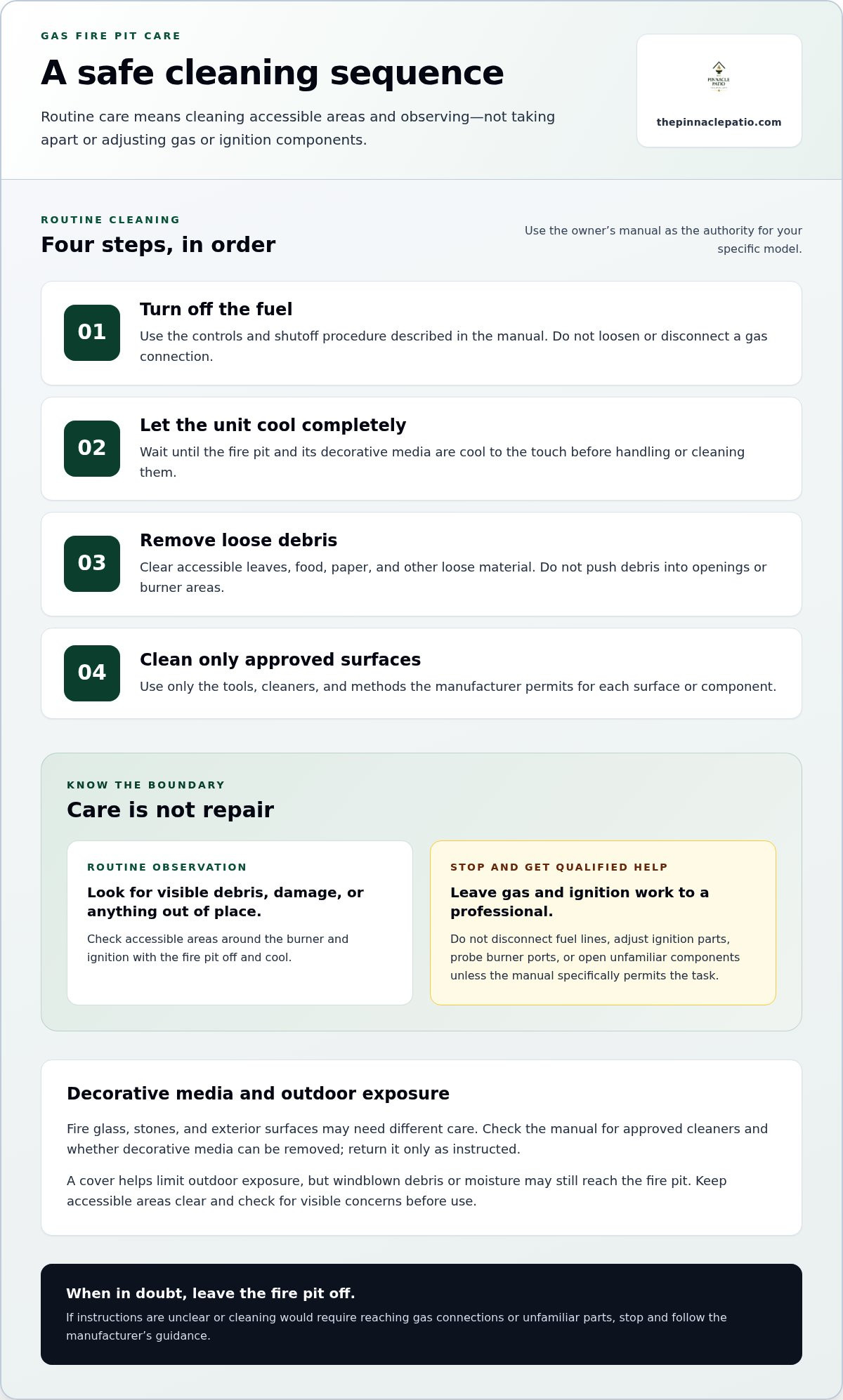
Follow a safe cleaning sequence
Use this sequence as a general framework, and follow the manual if it gives different or more specific directions. Do not disconnect fuel lines or reach into unfamiliar components to complete a cleaning task.
- Turn off the fuel. Use the controls and shutoff procedure described in the manual. Do not loosen or disconnect any gas connection.
- Let the unit cool completely. Wait until the fire pit and its media are cool to the touch before handling or cleaning them.
- Remove loose debris. Clear accessible leaves, food, paper, and other loose material without pushing it into openings or burner areas.
- Clean approved surfaces. Use only the tools and cleaning methods the manufacturer permits for the specific surface or component.
Safe cleaning means turning off the fuel, letting the fire pit cool, removing loose debris, then cleaning only what the manual approves. This is a sequence for routine care, not permission to take apart the unit. If the manual’s instructions are unclear or a task requires access to gas connections or unfamiliar parts, stop and leave that work to a qualified professional.
Clean the bowl, exterior, and decorative media
Cleaning an exterior surface is different from cleaning fire glass, stones, or other media. Identify the materials in your model, then check the manual for approved cleaners, cloths, and instructions on whether media can be removed. Water, abrasive tools, or unapproved chemicals may harm a finish or reach components that should not get wet. Do not assume a household cleaner is suitable. Follow the manufacturer’s directions for each surface, and return media only as instructed.
Check the burner area and ignition visually
With the fire pit off and cool, look for visible debris, damage, or anything that appears out of place around the burner and ignition area. Keep food, leaves, paper, and other loose material out of the fire feature. Do not probe burner ports or scrape components with a tool unless the manual specifically permits that method. A visual check is not a repair and is not a reason to disassemble the system.
If cleaning seems to require moving a gas connection, opening an unfamiliar compartment, or adjusting an ignition part, stop rather than improvise. That keeps maintenance for a gas fire pit focused on accessible cleaning and observation, not work on operating systems. If you are considering a new fire feature because your current unit’s care needs no longer suit your space, a complimentary product consultation can help with sizing, compatibility, configuration, or design guidance.
Routine Care or Professional Attention? How to Tell the Difference
A visual check can help you notice a change, but it cannot tell you what caused it or whether a gas fire pit is safe to operate. Keep the distinction clear: homeowners can observe accessible areas and describe what they see; diagnosis or repair involving gas and ignition components belongs to a qualified professional. If operation seems unusual, do not keep relighting the fire pit to test it.
| Category | Examples | What to do |
|---|---|---|
| Routine observations | Exterior condition, visible debris, cover condition, or an obvious change noticed during normal operation from a safe distance. | Record what you observe and follow the owner’s manual for routine care. |
| Stop and seek guidance | Persistent ignition trouble, abnormal flame behavior, unusual operation, or visible damage. | Stop using the fire pit. Refer to the manual and arrange qualified inspection or repair. |
| Qualified professional work | Inspection, adjustment, or repair of gas lines, valves, burners, or ignition systems. | Do not attempt the work yourself. Have it handled by a qualified professional. |
Which checks can homeowners make?
Limit checks to what is visible without opening compartments or moving gas connections: the exterior, accessible debris, the cover’s condition, and operation from a safe distance. If ignition or flame appearance changes, note when it happens and whether it recurs. These observations can help explain the concern, but they do not diagnose its cause or replace model-specific inspection and repair.
When should you stop using the fire pit?
Stop using the fire pit if ignition problems persist, the flame behaves abnormally, operation seems unusual, or you see damage. Do not try to solve suspected gas-system issues by adjusting controls or inspecting internal parts. Follow the manufacturer’s instructions and have a qualified professional assess the unit before using it again.
If you suspect a gas leak, stop using the fire pit and follow the manual and applicable emergency guidance. Do not try to locate or repair a leak yourself. If there is immediate danger, move away and contact emergency services from a safe location.
Inspection timing varies by model. Follow the manufacturer’s recommended intervals, and consider how often the fire pit is used and what its condition shows. More frequent use or a change you have observed may be a reason to consult the manual sooner, not to set an unsupported maintenance schedule. Good maintenance for a gas fire pit includes knowing when observation is enough and when the safest next step is expert attention.
Build a Simple Gas Fire Pit Maintenance Schedule
Build your schedule around the fire pit’s manual rather than a universal calendar. The manufacturer’s instructions set model-specific cleaning and inspection guidance. How often you use the unit and how much it is exposed to leaves, pollen, insects, and moisture can help you decide when to check for visible buildup between those tasks. Keep the manual accessible and note recurring concerns so they are easier to describe if professional attention is needed.
Before lighting and after use
Before lighting, look for visible leaves, insects, moisture, or other debris, and check for anything that appears damaged or out of place. After use, follow the manual’s shutdown and fuel-control instructions. Wait until the unit is fully cool before doing approved cleaning or putting on a cover. Follow the manufacturer’s directions for cooling rather than shortening the wait to fit a routine.
During regular use and between seasons
Use the manual to guide periodic cleaning and inspections, adjusting your attention to actual exposure and the unit’s condition. After wind or heavy pollen, for example, a visual check may reveal debris that was not present the last time you used the fire pit. During longer periods of non-use, a suitable cover can help limit exposure to weather and debris. Follow the manufacturer’s instructions for covering and storage, then check for accumulated moisture or debris before using the fire pit again.
A reliable schedule is manual-led: check before use, clean and inspect at the intervals the manufacturer specifies, and prepare for storage according to the model’s guidance. This keeps maintenance for a gas fire pit consistent without assigning the same weekly, monthly, or seasonal intervals to every design.
A concise care checklist
Save or print this list, then use the manual to fill in any model-specific tasks or timing. It separates routine observations from work that should be left to a qualified professional.
- Before use: Look for visible debris, moisture, or damage without opening compartments or reaching into unfamiliar areas.
- After use: Follow the manufacturer’s shutdown and fuel-control instructions; wait until the unit is fully cool before approved cleaning or covering.
- At manual-specified intervals: Complete only the cleaning and inspection tasks described for your model.
- During non-use: Follow the manual’s cover and storage guidance; check for debris or moisture before using the fire pit again.
- For gas or ignition concerns: Do not adjust, disassemble, or repair components yourself. Stop use and seek qualified professional attention.
For guidance on selecting or configuring a replacement fire feature for your outdoor space, schedule a complimentary consultation.
When Maintenance Leads to a Repair or a New Gas Fire Pit
Routine cleaning can address surface dirt and accessible debris, but it will not resolve persistent ignition issues, unusual operation, or suspected gas-system concerns. If a problem returns after you have followed the manufacturer’s care instructions, stop treating it as a cleaning task. A qualified professional can assess the fire pit and help determine whether it needs repair. Replacement is another possibility, but it is not automatically the right answer.
Deciding whether to maintain, repair, or replace
Consider what keeps happening, what you can see, and what a qualified inspection finds. Routine upkeep may be all that is needed when the concern is limited to approved cleaning. Repeated functional symptoms or visible damage call for diagnosis rather than more DIY troubleshooting. Let the model’s instructions and its observed condition inform the decision; avoid relying on assumed lifespans or general rules about when repair stops being worthwhile.
Think of the options as distinct paths:
| Option | When it may fit |
|---|---|
| Continue routine care | The fire pit is operating as expected, and care involves only the tasks allowed by its manual. |
| Seek qualified repair | A recurring concern, unusual operation, or visible damage needs assessment before the unit is used again. |
| Consider replacement | The unit’s condition or model-specific guidance makes a new feature worth evaluating alongside repair. |
These are not automatic steps in a fixed progression. A professional assessment can clarify the condition of the existing unit, while the owner’s manual provides model-specific context. Keep care tasks separate from unresolved gas or ignition concerns, and do not attempt to adjust or repair those systems yourself.
Plan a new fire feature around the space
If replacement or a new feature is under consideration, start with how you use the patio and where conversation or lounging naturally happens. Consider the intended placement, surrounding layout, and the role the fire pit should play. Then evaluate fuel compatibility and clearances using the specific product’s verified specifications and guidance, rather than assumptions based on another model.
Compare the available outdoor fire pit options with your space and priorities. A considered choice connects the feature’s design and configuration to how you plan to use the patio, while keeping compatibility and product requirements in view.
For help with sizing, compatibility, configuration, or design guidance for a new or replacement fire feature, schedule a complimentary consultation.
Make Your Outdoor Fire Feature Part of the Plan
A well-considered fire feature should suit how you use your outdoor space and the care you can comfortably maintain over time. Keep the owner’s manual with your home records so model-specific guidance is easy to find, and refer to it if your setup changes or you choose a different unit. Thoughtful maintenance for a gas fire pit starts with understanding the needs of the particular model, not relying on a universal routine.
If you are weighing a replacement or planning a new focal point, The Pinnacle Patio offers outdoor fire pits and can help you consider product sizing, compatibility, configuration, and design in relation to your space.
Choose a fire feature that suits your setting, then use its manual to keep care practical and model-specific.
Frequently Asked Questions
How often should you clean a gas fire pit?
Clean it as often as the owner’s manual directs, and check visible surfaces more often if the fire pit sits near trees or gets frequent use. A windy day, for example, may leave leaves or pollen around the unit before your next gathering. Follow the manual for model-specific cleaning and inspection intervals instead of adopting a fixed schedule from another fire pit. That is the safest way to tailor maintenance for a gas fire pit.
Can you use water to clean a gas fire pit?
Use water only where the manufacturer’s instructions permit it. A surface that seems washable may be close to electrical ignition parts, a burner, or a finish that requires a different method. Check the manual before wet-cleaning any area, and do not spray or pour water into the burner or internal components. If the instructions do not clearly approve water for the part you want to clean, use the specified method or leave the task to a professional.
Should a gas fire pit be covered when not in use?
A cover can help reduce exposure to outdoor debris and weather, but use one only as the manufacturer directs. The instructions may specify when the fire pit must be cool before covering or how it should be stored during an extended period without use. Before uncovering and lighting it again, look for accumulated moisture or debris. A cover helps protect the unit, but it does not replace a visual check.
What should you do if a gas fire pit will not ignite?
If it fails to ignite, stop repeated attempts rather than adjusting the igniter, valve, burner, or gas connection. Follow the manufacturer’s shutdown instructions and consult the troubleshooting guidance in the manual. If the cause is not clearly addressed by a user-level step, or the problem returns, keep the fire pit off and arrange an assessment by a qualified professional. If you suspect a gas leak, follow the manual and applicable emergency guidance.
How do you clean fire glass in a gas fire pit?
Follow the cleaning and handling instructions for your specific fire pit and media. Before moving fire glass, confirm the manual allows removal and explains how to put it back; the arrangement may be model-specific. Do not assume glass can be rinsed, soaked, or cleaned with household products. If the instructions do not describe a method, avoid experimenting with water or chemicals and seek guidance from a qualified professional.
Is it safe to use a gas fire pit if the flame looks different than usual?
No. If the flame’s appearance changes noticeably from its normal operation, stop using the fire pit and consult the owner’s manual. Do not try to correct the flame by adjusting gas flow or moving burner parts. Note what changed and when you noticed it, then have the unit assessed by a qualified professional before using it again. A visual difference is a reason to pause, not a reliable way to diagnose the cause.
Does a gas fire pit need an annual professional inspection?
Not every model has the same inspection interval, so follow the manufacturer’s schedule rather than assuming annual service is required for all fire pits. The manual may outline inspection needs for that particular model and its ignition system. Arrange qualified attention sooner if you notice persistent operating issues, damage, or another warning sign. Routine homeowner observations can help identify changes, but they do not replace any model-specific professional inspection the manufacturer calls for.