

Outdoor Gas Fireplaces: How to Choose a Sculptural Fire Feature
What if the fire feature you choose becomes as much a part of your patio’s design as its flame? Outdoor gas fireplaces can create a gathering point, but a sculptural feature adds another design consideration: its form should feel at home in the landscape. Start with the look you want, then check that the feature’s scale, fuel configuration, and placement suit your space.
This guide compares the decisions that shape fit and atmosphere: fuel, overall scale, ignition options, materials, and visual style. You’ll also learn how a sculptural feature differs from a conventional outdoor fireplace, so you can narrow your choices with a clearer sense of what belongs in your setting.
From the Galaxy, Comet, Aurora, Atomic, and Astro designs to the product details worth reviewing before purchase, here’s a practical, design-minded approach to choosing a fire feature for your outdoor space.
Key Takeaways
- Choose outdoor gas fireplaces by comparing the feature’s scale and sculptural form with your patio or landscape.
- Match the selected fuel variant to your planned fuel supply, and compare ignition and finish options for that specific model.
- Use Galaxy, Comet, Aurora, Atomic, and Astro as starting points for comparing distinct designs and product details.
- Before purchasing, review placement, dimensions, the selected variant, and product documentation to confirm the configuration suits your project.
- Explore the fire sculptures collection to compare current model and variant details.
What Makes Outdoor Gas Fireplaces a Sculptural Focal Point?
Outdoor gas fireplaces bring an open flame into a patio, but a sculptural fire feature is designed to make its shape part of the experience. Think of it as outdoor art with an active flame: the form draws the eye whether you’re looking across the landscape or gathering nearby. A conventional fireplace, by contrast, is often defined by its enclosure and hearth-like structure.
This is a difference in visual purpose, not a promise of greater warmth or a particular flame performance. Consider the feature both as a fire element and as an object in your landscape. Think about how it looks when lit, how it relates to nearby furnishings, and what requirements apply to the specific design and configuration.
How a fire sculpture differs from a conventional outdoor fireplace
The sculptural fire features at The Pinnacle Patio are presented as outdoor art, with active flame integrated into a design-led focal point. A conventional outdoor fireplace is often understood through its enclosure and hearth-like form, while a sculpture puts more emphasis on its overall shape. For an overview of traditional formats and uses, see Outdoor fireplace basics.
These are different design approaches, not a measure of one feature being better. To compare sculptural forms with other formats, browse the Outdoor Fireplaces collection.
Decide what role the flame should play in your outdoor space
Start by deciding where the feature should fit into the setting. Should it anchor a seating area, complement a planted landscape, or frame an entertaining space? Consider its visibility from the main viewpoints, including the approach to the patio and the places where people will gather. A bold silhouette can suit an open layout, while a more restrained form may work well in a setting that already has prominent design details.
Before settling on a design, consider:
- Placement: Where will the feature sit, and from which areas will it be seen?
- Layout: How will its footprint relate to seating, circulation, and sightlines?
- Configuration: Which product variant suits the fuel supply planned for the project?
- Site requirements: What does the selected product documentation specify for the intended setting?
These questions help distinguish a feature that belongs in the space from one chosen on appearance alone. Once its visual role is clear, compare individual designs with a better sense of how scale, configuration, and setting work together.
How to Compare Outdoor Gas Fireplaces: Fuel, Scale, Finish, and Ignition
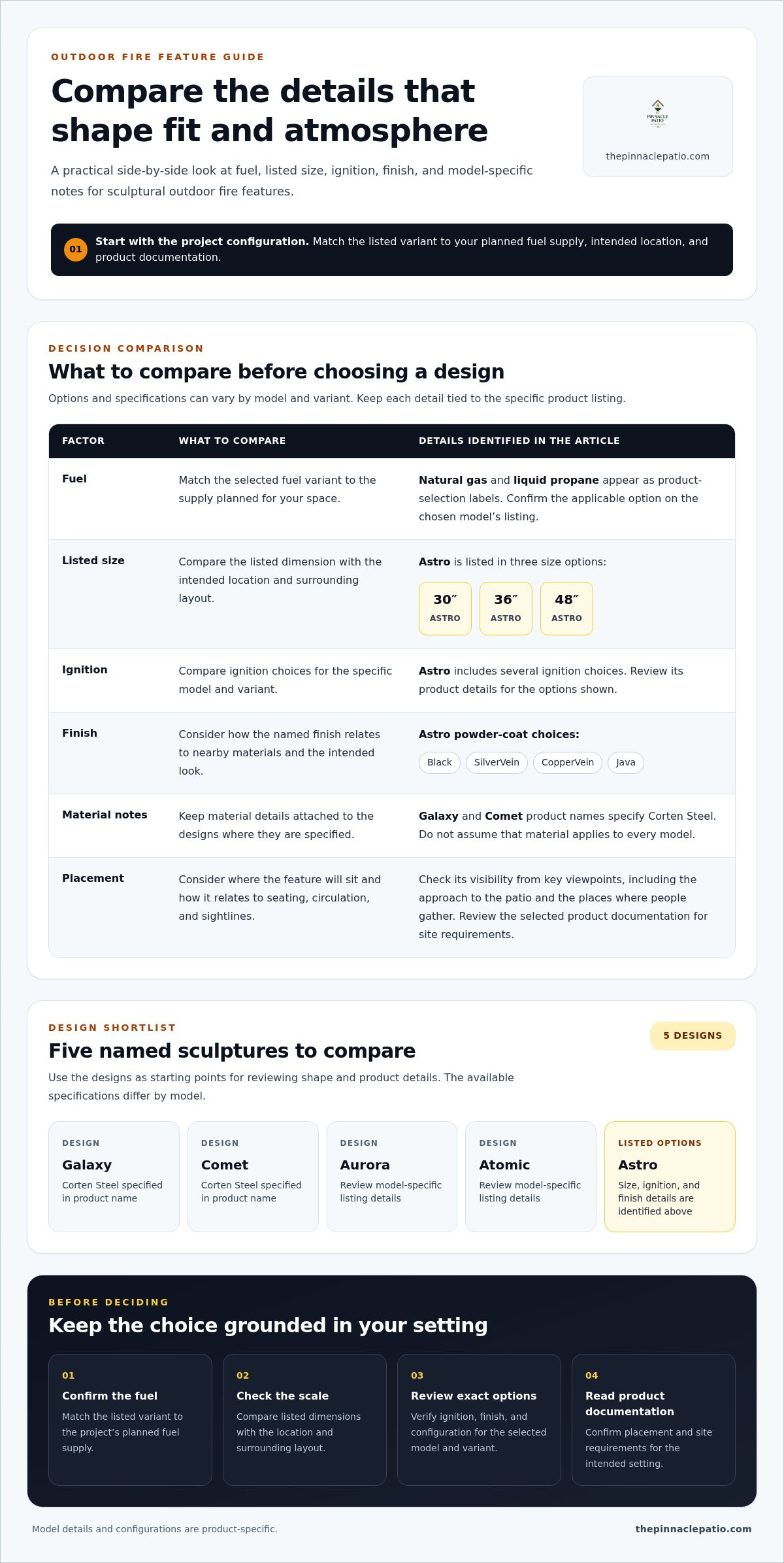
Compare the product configuration as carefully as the design. A suitable sculptural fire feature needs to match the planned fuel supply, fit the intended setting, and have a finish and ignition choice that work for your project. Details can vary by model and variant, so don’t assume an option shown for one design also applies to another.
| Factor | What to compare | Grounded example |
|---|---|---|
| Fuel | Match the selected fuel variant to the supply planned for your space. | Natural gas and liquid propane are product-selection labels. Review the chosen model’s listing for applicable options. |
| Listed size | Compare the listed dimension with the intended location and surrounding layout. | Astro is listed with 30-, 36-, and 48-inch size options. |
| Ignition | Compare ignition choices for the specific model and variant. | Astro includes several ignition choices. Consult its product details for the options shown. |
| Finish | Consider how the named finish relates to nearby materials and the look you want. | Astro lists Black, SilverVein, CopperVein, and Java powder-coat choices. |
| Model notes | Keep material and feature details attached to the design where they’re specified. | Galaxy and Comet product names specify Corten Steel. Don’t assume that material applies to every model. |
Match the listed fuel and ignition configuration to the project
Natural gas and liquid propane identify distinct fuel variants in product listings. Treat them as configuration choices, not interchangeable labels. First establish which fuel supply the project is planned around, then compare the compatible variant listed for the model. Ignition is another model-specific choice. Use the selected product’s documentation for its configuration and setup requirements rather than extrapolating from another fire feature.
Choose a size and finish that belong in the setting
Listed dimensions help you assess visual scale, but a number alone doesn’t determine how prominent a feature will feel. Consider its placement, surrounding furnishings, and sightlines. Astro’s listed sizes provide three dimensions to compare with your layout. Its named powder-coat choices offer different finish directions, while Corten Steel is specified in the Galaxy and Comet product names. Review the selected variant’s details before assuming a particular size and finish are available together.
Once you’ve identified the fuel, size, ignition, and finish criteria that matter, browse the sculptural fire feature designs and compare the listed model details.
Which Fire Sculpture Fits? Compare Galaxy, Comet, Aurora, Atomic, and Astro
The five fire sculptures offer different starting points for a shortlist, from named material and finish details to listed size options and a model-specific feature. None is automatically right for every patio. Use the comparison below to identify which design merits a closer look, then review its product listing for the exact variant and configuration you’re considering. This model-by-model approach is especially useful when comparing outdoor gas fireplaces, because details shouldn’t be assumed to carry across designs.
| Fire sculpture | Supplied distinguishing details | Useful comparison focus |
|---|---|---|
| Galaxy | The product name specifies Corten Steel. | Consider whether this named material suits the visual direction of your space. |
| Comet | The product name specifies Corten Steel. Its supplied listing shows a five-out-of-five rating. | Consider the rating alongside the design and configuration that fit your project. |
| Aurora | Described as a metal powder-coat fire sculpture. | Review the product listing for relevant size, finish, and variant details. |
| Atomic | Described as a metal powder-coat fire sculpture. Its description states that its technology reduces smoke output. | Keep this smoke-output claim specific to Atomic; it isn’t a collection-wide promise. |
| Astro | Listed in 30-, 36-, and 48-inch size options, with Black, SilverVein, CopperVein, and Java powder-coat choices. | Compare the listed size and finish options with your layout and design priorities. |
Compare design identity and configuration
Galaxy and Comet are useful points of comparison if you’re drawn to the Corten Steel named in their product titles. Aurora, Atomic, and Astro are described with metal powder-coat wording, but review each product’s details before making a closer comparison. These descriptions can help establish a shortlist, but they don’t determine which sculpture suits your patio.
Astro has listed size and finish details to weigh against your available space and preferred look. Atomic has a specific supplied claim about reduced smoke output, while Comet’s five-out-of-five rating is the rating shown in its supplied listing. Neither detail should be treated as a performance guarantee or as a comparison across all five models.
Shortlist by priority, then verify the variant
Begin with the visual qualities you want to prioritize: a Corten Steel product name, a metal powder-coat description, or Astro’s listed size and finish choices. Then compare the product listing for the exact model and variant that interests you. Fuel, ignition, finish, and other variant-level choices can differ, so review the relevant listing before purchase instead of assuming an option applies to every version. This connects the design you prefer with the configuration your project calls for.
Avoid Common Outdoor Gas Fireplace Buying Mistakes
A striking design can earn a place on your shortlist, but appearance alone can’t establish whether a fire feature suits your patio. Before choosing among outdoor gas fireplaces, account for the intended placement, planned fuel supply, and exact product variant. Overlooking any of these details can turn an appealing design into a poor fit for the project.
Check fit and setup before settling on a model
Measure the intended footprint and the space needed for people to move around it. Compare those measurements with the listed dimensions for the specific model and variant. A listed size is useful only in context: surrounding seating, circulation paths, and the planned location all affect how comfortably the feature fits.
- Placement: Identify where the feature will sit and how that location relates to seating and circulation.
- Available fuel: Establish the fuel supply planned for the space before selecting a fuel variant.
- Selected variant: Match the model, fuel, ignition, and finish choices shown for the product you intend to buy.
- Dimensions: Compare the listed product measurements with the available footprint and surrounding layout.
- Documentation: Review the selected product’s instructions for placement, clearances, and installation requirements.
Don’t assume two designs share the same setup requirements. Follow the documentation for the specific model and variant, which provides the product-specific placement and installation details. This is more reliable than applying a general rule that may not fit the fire feature you’ve selected.
Keep product claims and variants in context
Another common oversight is carrying a detail from one model over to another. A finish, ignition choice, certification, or feature belongs to the product and variant where it’s specified. For example, the reduced-smoke-output statement applies to the Atomic description; it shouldn’t be treated as a claim about every sculpture. Read each listing closely to distinguish model-level information from choices tied to a particular variant.
If you’re deciding which type of outdoor flame feature best suits the project, compare sculptural designs with other formats in the Fire Pits collection. Focus on the format and configuration that fit your setting, not simply the first design that catches your eye.
Choose Your Outdoor Gas Fireplace and Explore the Fire Sculptures Collection
A thoughtful choice starts with the space, then moves to the product details. Use this sequence to turn a design preference into a practical shortlist of outdoor gas fireplaces that suits your setting and planned configuration.
- Define the setting. Decide whether the fire feature should anchor seating, complement the landscape, or frame an entertaining area. Note the available space and the views you want to preserve.
- Match the fuel. Establish the planned fuel supply, then consider only product variants listed for that fuel.
- Compare models. Shortlist designs based on the visual role you want, then compare the size, finish, and ignition details stated for each model.
- Review the chosen variant. Before purchase, read its product documentation for the configuration, placement, and setup requirements that apply.
Turn your shortlist into a confident product choice
The Fire Sculptures collection brings together five named designs: Galaxy, Comet, Aurora, Atomic, and Astro. Use those names as a starting point for comparing the designs, not as a reason to assume their product details are interchangeable. Review each listing for its own variant choices, and compare only the fuel, dimensions, finish, and ignition information provided for that model.
As a final check, make sure the selected variant fits the available space and the project’s planned fuel supply. Product-specific documentation is the reference for setup requirements. If sizing, compatibility, or configuration depends on your project, a project-specific consultation can help you work through those decisions.
Explore related outdoor fire features
If you’re weighing sculptural forms against other designs, browse the broader outdoor fireplaces collection. Comparing formats can help clarify which visual approach best suits your outdoor space.
Explore the Fire Sculptures collection to compare current model and variant details:
Choose a Fire Feature That Feels at Home
The right choice brings together the space you have and the atmosphere you want. As you compare outdoor gas fireplaces, weigh the feature’s visual role alongside its scale, fuel, finish, and ignition options. Then review the details for the specific model and variant so your selection suits the project, not just the mood you hope to create.
The Fire Sculptures collection is described as outdoor art with active fire, bringing sculptural form and flame together in five named designs: Galaxy, Comet, Aurora, Atomic, and Astro. Each offers a distinct starting point for your shortlist. Compare current product details to find the design that aligns with your setting and preferences.
With the key details in view, you can choose a focal point that feels considered from the first gathering onward.
Frequently Asked Questions
What is the difference between an outdoor gas fireplace and a fire sculpture?
An outdoor gas fireplace centers on an outdoor flame, while a fire sculpture makes its form part of the visual experience. A conventional fireplace is commonly associated with an enclosure and hearth-like structure; a sculpture is designed as outdoor art with an active flame. The Pinnacle Patio’s fire sculpture collection includes five designs: Galaxy, Comet, Aurora, Atomic, and Astro. Product details vary, so compare each model on its own merits.
How do I choose between natural gas and liquid propane for an outdoor fire feature?
Choose the fuel variant that matches the supply planned for your outdoor space. Natural gas and liquid propane are distinct product-selection options, so don’t assume a model configured for one suits the other. Check the specific product listing for its fuel choices, then review the selected variant’s documentation for configuration and setup requirements. This helps you compare outdoor gas fireplaces against the project’s fuel plan, not appearance alone.
What size outdoor gas fireplace should I choose?
Compare the product’s listed dimensions with the available footprint, surrounding furnishings, and circulation space. Astro, for example, is listed with 30-, 36-, and 48-inch size options. Those figures can help you assess its scale, but the right fit depends on your layout and selected variant. Measure the intended placement, then review the product listing for the exact dimensions that apply.
Are all outdoor gas fire sculptures available with the same ignition options?
No. Ignition choices can differ by model and variant, so don’t assume an option listed for one sculpture is available on another. Compare the ignition details on each product listing alongside its fuel and finish information. Before purchase, use the selected variant’s documentation to understand its configuration and setup requirements. This keeps your decision grounded in the details for the fire feature you’ve shortlisted.
Does the Atomic Fire Sculpture produce no smoke?
No. The supplied Atomic description says its technology reduces smoke output, which is not the same as saying it produces no smoke. Keep that claim specific to Atomic rather than applying it to the other fire sculptures. If smoke output matters to your project, review the current Atomic product details and documentation carefully, and distinguish the stated feature from broader assumptions about how the fire feature operates.
What should I check before buying an outdoor gas fire sculpture?
Check where the sculpture will sit, the space available around it, the planned fuel supply, and the specific model and variant you intend to select. Compare only the dimensions, finish, and ignition choices stated for that listing. Then review the product-specific documentation for placement, clearance, and setup requirements. These steps help ensure the design and its configuration suit the space.
Can a sculptural gas fire feature be the focal point of a patio?
Yes. A sculptural fire feature can anchor a seating area or draw attention to a particular part of the landscape. Consider how its form will appear from the main sightlines, how it relates to surrounding furnishings, and whether it suits the gathering experience you want to create. Its visual role depends on the layout and chosen design; don’t assume particular heat coverage or operating performance without model-specific information.