

Outdoor Kitchen Ventilation Guide: The 2026 Professional Standard
Could the centerpiece of your outdoor sanctuary be the silent architect of its decline? While you've likely focused on the exquisite craftsmanship of a Bull or Kokomo grill, this outdoor kitchen ventilation guide reveals why air quality is the most critical design element for 2026. We understand the frustration of seeing a pristine ceiling stained by soot or realizing that lingering grease odors have settled into your luxury furniture. It's a common oversight that can transform a refined evening into an uncomfortable, smoke-filled experience.
You'll gain the technical clarity needed to preserve your home's architectural integrity and ensure a pristine entertaining environment. We'll cover the professional standards for the year ahead, from calculating CFM requirements based on your appliance's BTU output to navigating safety codes that require airtight, liquid-tight welded ducting. This guide explores the design principles that protect your professional-grade appliances while maintaining the sophisticated, communal atmosphere your lifestyle demands.
Key Takeaways
- Learn how professional extraction preserves your architectural investment by preventing corrosive grease and smoke from staining expensive patio ceilings.
- Use this outdoor kitchen ventilation guide to master technical requirements, including the "6-Inch Rule" for hood width and precise CFM calculations for high-BTU grills.
- Understand the vital role of vent panels in prefabricated islands to prevent gas accumulation and ensure a safe, compliant entertaining environment.
- Discover the "Cross-Breeze" principle for strategic grill placement, allowing you to work with natural wind patterns for optimal smoke control.
- Explore how a pristine, smoke-free atmosphere enables the integration of refined aesthetic features like the sculptural Eternal Flames torch collection.
The Science of Atmosphere: Why Ventilation is Essential for Luxury Outdoor Kitchens
Atmosphere is the invisible thread that binds a luxury space together. In a high-end culinary environment, air quality serves a dual purpose: it ensures immediate safety while preserving long-term aesthetic beauty. This outdoor kitchen ventilation guide moves beyond the basics of extraction. It focuses on the sophisticated interplay between heat, gas, and airflow. While many homeowners prioritize the raw power of their cooking surface, the surrounding atmosphere dictates whether that space remains a sanctuary or becomes a source of maintenance frustration.
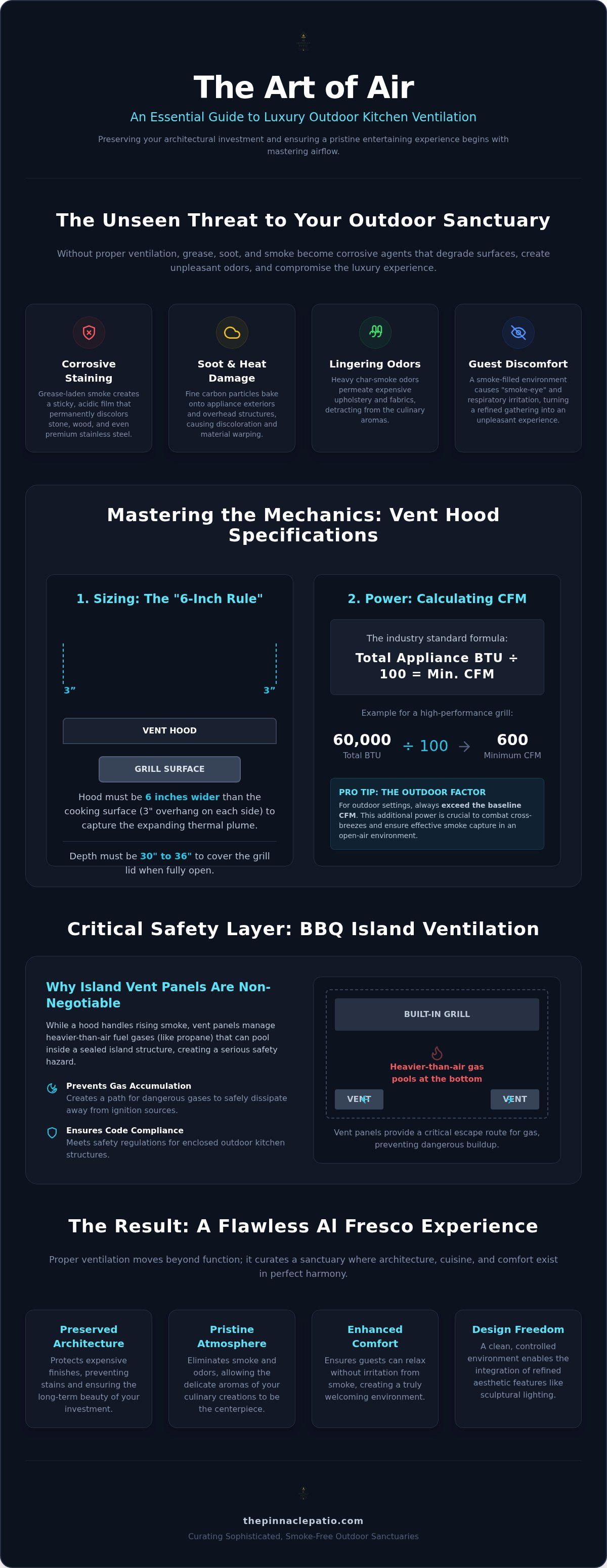
Grease-laden smoke is more than an aesthetic nuisance; it's a corrosive agent. When aerosolized fats cool, they bond to surfaces, creating a sticky film that traps acidic pollutants. Over time, this buildup can degrade even the finest finishes. The science of kitchen ventilation demonstrates that without mechanical intervention, these particles circulate and settle, causing permanent discoloration on stone, wood, and metal. By establishing an "Invisible Barrier" through controlled airflow, you effectively define the culinary zone and protect the surrounding living area from these airborne contaminants. Protecting your investment in professional-grade equipment, such as Bull Grills, requires more than just a cover; it requires a managed environment.
Preserving Architectural Integrity
Even the most durable 304 stainless steel isn't immune to the effects of persistent soot buildup. Without a dedicated extraction system, the thermal plume from a high-performance grill carries fine carbon particles that bake onto the appliance's exterior and the surrounding structure. This heat accumulation is particularly taxing on overhead pergolas or covered pavilions, where trapped temperatures can warp materials or cause structural stress. Outdoor ventilation is a combined system of mechanical hoods and passive island vents designed to manage both rising thermal plumes and heavier-than-air fuel gases. By directing this energy away from the structure, you maintain the pristine condition of your architectural details for years to come.
The Sensory Experience of Al Fresco Entertaining
A refined outdoor kitchen should feel as inviting as your primary indoor living space. Effective ventilation eliminates the discomfort of "smoke-eye" and prevents heavy odors from clinging to expensive upholstery and outdoor fabrics. It ensures that the delicate, nuanced aromas of a slow-roasted ribeye or a wood-fired pizza aren't overwhelmed by the acrid scent of char-smoke. This level of control creates a true sanctuary. It allows you to host with quiet confidence, knowing that your guests are enveloped in a fresh, vibrant atmosphere that highlights the culinary experience rather than the mechanics of the grill.
Master the Mechanics: Choosing the Right Outdoor Vent Hood and CFM
Engineering a smoke-free environment requires a precise understanding of air volume and capture velocity. While an indoor range might suffice with moderate airflow, an outdoor kitchen ventilation guide for professional spaces must account for wind interference and the massive thermal output of premium grills. The most common error in luxury design is underestimating the Cubic Feet per Minute (CFM) required to effectively clear the cooking zone. Beyond mere power, the physical dimensions of the hood play a vital role. The "6-Inch Rule" dictates that your ventilation unit should be six inches wider than the cooking surface, providing a three-inch overhang on both sides to catch the expanding thermal plume. Depth is equally critical; your hood must extend far enough to cover the grill lid when it's fully open, usually requiring a 30 to 36 inch profile.
Calculating CFM for High-Performance Grills
To find your baseline requirement, use the industry standard formula: divide the total BTU of your appliance by 100. For instance, a high-performance Kokomo Grill with a 60,000 BTU rating necessitates a minimum of 600 CFM. However, in outdoor settings, we recommend exceeding this baseline to combat cross-breezes. This aligns with EPA ventilation safety guidelines regarding the active removal of combustion byproducts. Mounting style also influences efficiency. Wall-mounted hoods are traditional, yet island-mounted pro-canopies or custom liners must be positioned at the correct height to maintain capture speed without obstructing your view of the landscape.
Material and Construction Standards
Durability is non-negotiable in the elements. Only 304-grade stainless steel offers the corrosion resistance required to withstand humidity and salt air without pitting. Inside the hood, professional baffle filters are superior to residential mesh. These stainless steel slats force air to change direction quickly, causing grease to condense and drop into a collection tray rather than clogging the motor. While extraction is the priority, noise management is equally important. High-end units are engineered to cap sound levels at roughly 70 decibels, ensuring your extraction system doesn't drown out the evening's conversation. Once your air is clear, you can focus on the visual layers of your patio, perhaps by adding the sculptural warmth of luxury fire torches to complete the scene.
The Critical Safety Layer: BBQ Island Vent Panels and Gas Dynamics
While the overhead hood manages the sensory atmosphere, the ventilation below the counter ensures the fundamental safety of your structure. This outdoor kitchen ventilation guide emphasizes that for any prefabricated outdoor grill islands, passive vent panels are a non-negotiable requirement. These panels prevent the accumulation of unburned fuel within the enclosed cabinetry, a risk often referred to as "Dead Space" gas pockets. Because Natural Gas and Liquid Propane (LP) possess different chemical weights, their movement within an island is entirely distinct. Understanding this buoyancy is the difference between a high-performing kitchen and a potential safety hazard.
Liquid Propane (LP) Venting Strategy
Liquid Propane is heavier than air. If a leak occurs, the gas doesn't dissipate into the atmosphere; instead, it sinks and pools at the lowest point of your island. To prevent this "Explosive Pocket" effect, LP vents must be installed as close to the ground as possible. Professional standards suggest placing these vents every few feet along the island perimeter to encourage constant cross-ventilation. This ensures that any escaping gas is swept out by natural air currents before it can reach a concentration level that poses a risk to your luxury investment. Without these low-level exit points, the gas remains trapped, waiting for an ignition source.
Natural Gas (NG) Venting Strategy
In contrast, Natural Gas is lighter than air. It migrates upward, seeking the highest point within the cabinet structure before it can escape. For NG configurations, vent panels must be positioned at the top-tier of the island walls, typically just below the countertop. Vent panels are passive safety insurance that must never be obstructed by landscaping or decorative masonry. Whether you're building a custom stone feature or using a sleek stainless steel island, these vents should be integrated into the design from the start. Choosing panels that match the 304 stainless steel finish of your Bull or AOG grill ensures that safety doesn't come at the expense of your aesthetic vision. This cohesive approach maintains the architectural flow while providing the necessary airflow to keep your entertaining sanctuary secure.
Airflow Design: Layouts for Smoke-Free Entertaining
Designing a high-end patio involves more than selecting premium appliances; it requires a deep understanding of fluid dynamics. This outdoor kitchen ventilation guide highlights the "Cross-Breeze" principle, which uses natural wind patterns to facilitate smoke migration. By positioning your grill so the prevailing wind hits the back of the unit, you create a natural vacuum that draws smoke away from the chef. This "back to the wind" rule is vital. It prevents acrid fumes from swirling into the cooking zone and protects the grill's internal temperature from erratic gusts that can cause uneven searing.
Integrating these principles into a modular outdoor kitchen offers the flexibility to orient your station for optimal airflow. Efficiency is also a matter of verticality. While we've discussed hood width, the distance between the cooking surface and the filters is equally paramount. A hood mounted too high loses its capture velocity, while one mounted too low can obstruct your workspace and pose a fire risk. Professional standards for 2026 suggest a mounting height of 30 to 36 inches to balance extraction power with ergonomic comfort.
The Open-Air Advantage
A dedicated ventilation hood becomes a mandatory requirement when your kitchen resides under a solid roof, pergola, or any structure where the enclosure exceeds 50 percent. Even in transition spaces with open sides, trapped heat and grease can rapidly degrade your surroundings. Without proper extraction, soot particles settle on nearby Bromic heaters. This buildup acts as an insulative layer, forcing your luxury heating elements to work harder and shortening their operational lifespan. Managing air quality ensures these precision instruments remain in peak condition.
Defining the Perimeter
Strategic layout design uses the cooking station as an anchor, keeping smoke and heat far from dining and lounging zones. This creates a clear sensory boundary between the "work" of the kitchen and the "relaxation" of the sanctuary. To maintain a cohesive aesthetic, coordinate the 304 stainless steel finishes of your hood and grill with other outdoor kitchen accessories. This intentional curation ensures that your ventilation system feels like a deliberate architectural choice rather than a functional afterthought.
Beyond the Smoke: Curating Your Sanctuary with Sculptural Lighting
A truly mastered outdoor environment is defined by its transitions. While the technical specifications in this outdoor kitchen ventilation guide focus on the mechanics of extraction, their ultimate purpose is to create an atmospheric canvas. When you successfully manage the thermal plume and grease byproducts, you unlock the ability to integrate delicate aesthetic features that would otherwise be compromised. In a space cleared of acrid smoke, the visual clarity allows for the introduction of sophisticated lighting and sculptural fire art. This transforms a functional cooking area into a curated sanctuary where the air remains as fresh as the surrounding landscape.
The interplay of light and shadow is the final layer of a luxury patio. Without professional-grade ventilation, the fine mist of aerosolized fats creates a dulling film on every surface, including your lighting fixtures. By establishing a clean air foundation, you preserve the brilliance of your design elements. This allows you to move effortlessly from the high-energy culinary zone to an ambient lounge area that feels refined, intentional, and inviting. It's here that the technical investment in a high-CFM hood pays its most significant aesthetic dividend.
The Art of the Eternal Flame
The Eternal Flames collection represents the pinnacle of this atmospheric design. Featuring the Mosaic and Globe Fire Torches, these pieces serve as vertical design anchors that draw the eye upward, mirroring the architectural intent of your ventilation system. Constructed from high-grade 304 Stainless Steel, these torches share the same DNA of durability found in professional grills from Bull or AOG. Because the air remains clean, these sculptural elements are free to develop a refined, natural patina over time. They become permanent landscape fixtures that suggest a sense of heritage and permanence, rather than mere accessories that require constant cleaning from soot accumulation.
Ready to Elevate Your Atmosphere?
The most sophisticated outdoor living plans balance high-performance culinary zones with ambient lounge areas. Achieving this harmony requires intentionality in every selection. You might choose between the robust Original TOP systems for larger estate landscapes or the more streamlined TOP-Lite systems for intimate patio settings. Each choice should reflect the same commitment to quality and craftsmanship that guided your ventilation and appliance selections. By prioritizing a smoke-free environment, you ensure that the glow of your fire art remains the focal point of every evening gathering, providing a warm and communal invitation to your guests.
Elevating the Standards of Your Outdoor Sanctuary
Mastering the elements requires a blend of technical precision and aesthetic vision. This outdoor kitchen ventilation guide has detailed the mechanics of extraction and the critical safety of gas management; however, the true reward is the permanence of your investment. By prioritizing airflow, you ensure that your premium Bull or Kokomo appliances continue to perform in a space that remains as pristine as the day it was installed. A well-ventilated patio isn't just a functional requirement; it's the foundation of a sophisticated lifestyle.
We provide a curated selection of 304 Stainless Steel fire art and expert guidance on luxury outdoor atmosphere to help you move beyond the utilitarian. Once the air is clear of grease and smoke, the focus shifts to the sensory layers that define a truly refined social gathering. These details transform a simple cooking area into an evocative destination for connection and relaxation.
We offer complimentary U.S. shipping on premium orders to ensure your journey toward a sophisticated patio is as seamless as the environment you're creating. Your visionary sanctuary is ready for its final, luminous layer. We look forward to helping you curate a space that reflects your commitment to quality and craftsmanship.
Frequently Asked Questions
Do I need a vent hood if my outdoor kitchen is only partially covered?
Yes, a hood is mandatory if your roof or pergola covers the cooking surface. Even with open sides, smoke and heat accumulate under the structure, leading to permanent soot staining on your ceiling. This outdoor kitchen ventilation guide recommends extraction for any area where the enclosure exceeds 50 percent. Proper ventilation preserves the architectural integrity of your pavilion while ensuring a fresh environment for your guests to enjoy.
How high should an outdoor vent hood be mounted above the grill?
The professional standard for mounting height is 30 to 36 inches above the cooking surface. If you mount the hood higher, the capture velocity drops significantly, allowing smoke to escape into the seating area. If it's too low, it can obstruct your view and become a fire hazard. This specific range provides the optimal balance between powerful extraction and a comfortable, ergonomic workspace for the chef.
What is the difference between a vent hood and a vent panel?
A vent hood is a mechanical system designed to extract smoke and grease, whereas a vent panel is a passive safety feature. The hood protects your patio ceiling and furniture from soot, while the panels are installed in the island base to prevent gas from pooling. Both are vital; the hood manages the atmosphere above the counter, and the panels manage the dynamics below it as part of a complete outdoor kitchen ventilation guide.
Can I use an indoor range hood in my outdoor kitchen?
You shouldn't use an indoor hood because it isn't designed to withstand the elements or high-BTU output. Outdoor hoods are constructed from 304-grade stainless steel to prevent corrosion from humidity and salt air. They also feature much more powerful motors, typically 1,000 CFM or higher, to effectively pull smoke away despite the interference of natural cross-breezes and wind gusts that occur on a patio.
How many vent panels does my BBQ island need for safety?
For standard islands, you need at least two vent panels to create a reliable cross-breeze. This prevents gas from accumulating in the "Dead Space" of your cabinetry. If your island is longer than six feet or houses multiple appliances from Bull or AOG, we suggest adding a panel every four feet. This ensures that any leaking gas is safely dissipated before it reaches a dangerous concentration within the island structure.
What CFM is required for a 36-inch professional gas grill?
To calculate your CFM, divide the total BTU of your grill by 100. A 36-inch professional grill often produces around 60,000 BTUs, requiring at least 600 CFM. However, for a truly smoke-free sanctuary, many designers opt for 1200 CFM units. This extra power ensures that even during high-heat searing or on windy days, the grease and smoke are effectively captured and exhausted from your entertaining space.
How do I clean and maintain an outdoor vent hood baffle filter?
Baffle filters are designed for longevity and ease of care. Most high-end stainless steel baffles are dishwasher safe, making maintenance a simple task. You should remove the filters every few weeks and soak them in a degreasing solution or run them through a heavy-duty cycle. Regular cleaning prevents grease from clogging the motor, which maintains the quiet, efficient extraction your luxury kitchen requires for long-term performance.
Do sculptural torches require the same ventilation as a grill?
Ambient fire features like the Eternal Flames torches don't require mechanical ventilation. Unlike high-performance grills, these sculptural pieces produce very little smoke and no grease byproducts. They're designed to be placed in fresh-air zones to provide a warm, communal invitation. While they don't need a hood, they're most appreciated in a well-ventilated kitchen where the air is clear enough to see their intricate flame patterns and artistic details.