

Pet Safety Around Outdoor Grills and Fire Pits: A Practical Checklist
What if keeping your pet safe around the grill or fire pit starts before the first flame is lit? Pet safety around outdoor grills and fire pits depends on more than supervision alone. During a gathering, attention shifts, food draws curious noses, and equipment can remain hot after cooking ends. Clear boundaries and repeatable routines help reduce risks while keeping the patio welcoming for everyone.
To make a practical plan, think through the hazards before, during, and after use. This guide covers how to set up pet-aware zones, manage tools and food, and keep pets away from equipment until cleanup is complete. It also considers the noise and activity of a gathering, so your pet has a calmer place to retreat. With some preparation, outdoor meals and evenings by the fire can feel more relaxed for people and pets alike.
Key Takeaways
- Plan separate areas for pets, guests, and cooking so boundaries are clear before outdoor use begins.
- Use a pre-use checklist to manage pet access, inspect equipment, clear loose items, and plan for interruptions.
- During cooking, keep pets away from heat, tools, and tempting food, even when guests are present.
- Maintain boundaries after cooking until cleanup is complete and equipment is managed according to its instructions.
- Pet safety around outdoor grills and fire pits relies on layout, consistent supervision, and routines, not product choice alone.
Pet safety around outdoor grills and fire pits starts with a safer space
A familiar outdoor gathering can quickly become a busy shared space. A pet follows the smell of dinner, guests carry plates across the patio, and someone tends an active grill or fire. The risk isn’t limited to the heat source: movement, dropped food, and divided attention can bring pets close to hazards before anyone notices.
Start by assigning distinct areas for cooking, serving, guest movement, and pet rest. These zones don’t need to be permanent. A clear route around the cooking area and a comfortable resting place away from the bustle can make supervision easier. The aim is to reduce unexpected crossings, not to assume that a boundary makes the area automatically safe.
Which outdoor hazards should pet owners notice first?
Scan for both fixed and temporary hazards. Grills, fire pits, outdoor fireplaces, and recently used equipment can pose heat risks. Tools, food scraps, fuel-related equipment, and crowded walkways can add hazards as the gathering unfolds. Pay attention to items that move: a serving tray might end up near a pet’s resting place, or a tool might be left within reach. For general context on fire pit types and safety, see Fire Pit Safety and Types.
- Fixed: cooking and fire features, the space around them, and the routes guests use.
- Temporary: utensils, food, waste, and other items brought out during setup or serving.
For advice about a particular animal’s health or response to heat, ask your veterinarian or consult an authoritative animal-welfare source. Individual needs can vary.
How can you create separate zones for pets and cooking?
Before guests arrive, map where your pet will settle, where people will circulate, where food will be served, and where cooking or fire features will operate. Look for crossing points, especially paths between seating and the kitchen area. Depending on the layout, a barrier, closed access point, or designated pet area may help. Choose an arrangement you can maintain throughout the gathering.
Fixed equipment also shapes how people move. An outdoor kitchen island can define the cooking area and influence traffic through the space. The fire pit collection is another feature category to consider when deciding where a fire area belongs. Neither product choice replaces active supervision or the manufacturer’s instructions.
Physical boundaries limit a pet’s access to hazards; attentive supervision helps you respond when circumstances change. Use both. Guests may move, food may be served, or a pet may become unsettled, so keep the zones practical and easy to maintain.
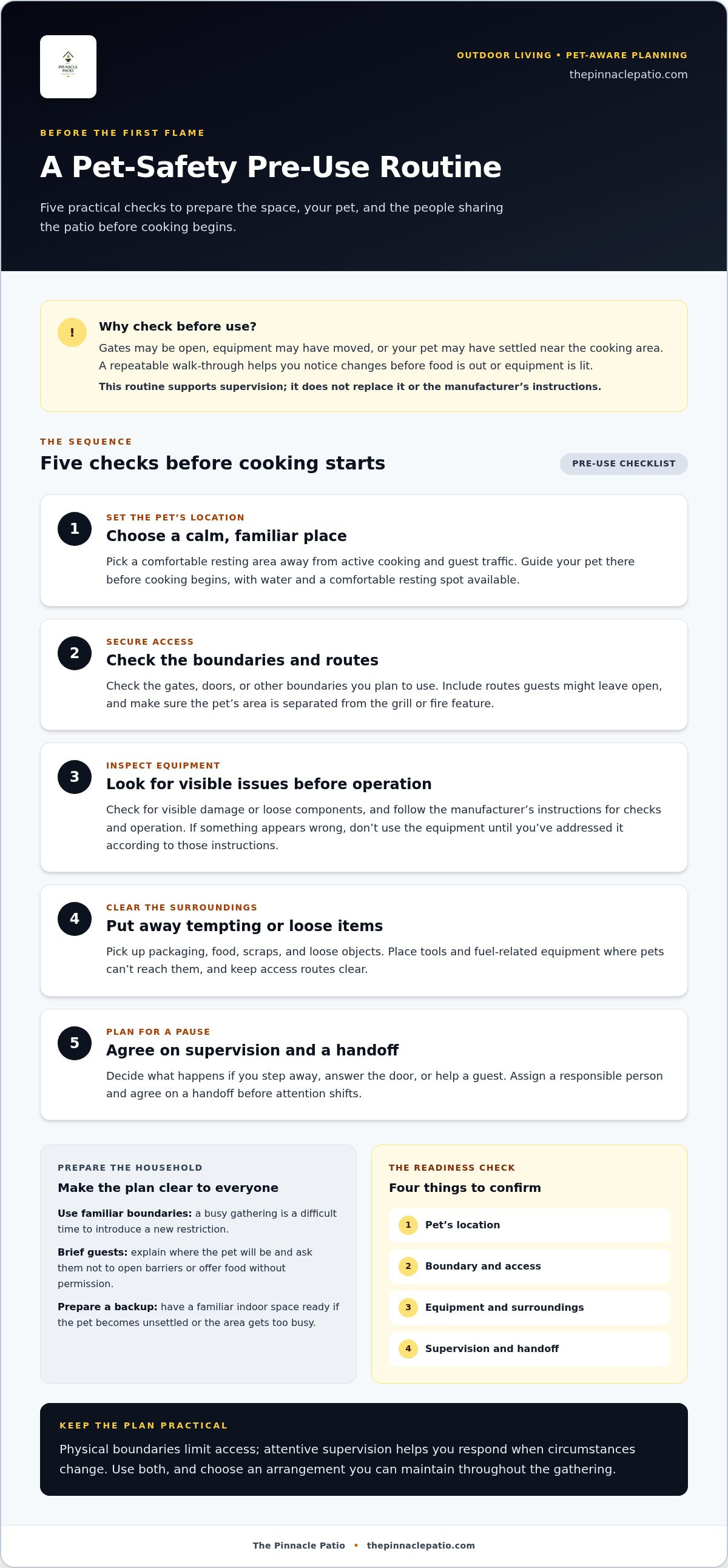
Before lighting a grill or fire pit, use this pet-safety checklist
A quick check before each cooking session helps catch changes since the last use, such as an open gate, moved equipment, or a pet settling near the cooking area. Make it a routine, not a substitute for supervision or the manufacturer’s instructions.
What should you check in the space before use?
Walk the area before bringing out food or lighting equipment. Confirm that your pet’s resting place is comfortable, away from active cooking, and outside guest traffic. Then check access routes and remove items that could attract a curious animal or create a trip hazard.
- Set the pet’s location. Choose a familiar, calm area with a clear boundary from the grill or fire feature.
- Secure access. Check the gates, doors, or other boundaries you plan to use, including routes guests might leave open.
- Inspect the equipment. Look for visible damage or loose components, and follow the manufacturer’s instructions for checks and operation. If something appears wrong, don’t use the equipment until you’ve addressed it according to those instructions.
- Clear the surroundings. Pick up packaging, food, scraps, and loose objects. Put tools and fuel-related equipment where pets can’t reach them.
- Plan for a pause. Decide what will happen if you need to step away, answer the door, or help a guest. Arrange a handoff to another responsible person before your attention shifts.
How should you prepare pets and household members?
Use boundaries and routines your pet already recognizes whenever possible. A crowded gathering is a difficult time to introduce a new restriction: unfamiliar sounds, visitors, and food smells can make it harder for an animal to settle. Guide your pet to the planned area before cooking begins, with water and a comfortable resting spot available.
- Assign supervision. Name the person responsible for the pet and agree on a handoff if that person becomes occupied.
- Brief your guests. Explain where the pet will be and ask guests not to open barriers or offer food without permission.
- Prepare a backup. If the pet becomes unsettled or the area gets too busy, have a familiar indoor space ready.
A pet-aware pre-use check confirms the pet’s location, the boundary, the equipment, and the supervision plan before cooking starts. A consistent routine also makes it easier to notice what has changed. If you’re planning a cooking or fire feature and want to discuss how it fits your space, you can schedule a consultation about your outdoor layout.
During outdoor cooking, manage heat, food, and pet access
Once cooking begins, tools move, food is served, and guests may gather near the cook. Keep the pet’s location and access boundaries clear while attention is divided. A boundary can help prevent an unplanned approach, but it doesn’t replace watching the pet and responding when the situation changes.
How can you keep pets away from active heat and equipment?
Keep pets in their planned area while a grill or fire feature is active. Treat hot surfaces, open flames, nearby equipment, and cooking tools as hazards throughout use, not just while food is on the heat. Don’t leave the cooking area unattended while pets can reach it. If the cook needs to step away, arrange a handoff rather than relying on a barrier alone.
- Keep the boundary in place. Don’t let a pet move freely into the cooking area while equipment is operating.
- Watch the tools. Put utensils somewhere the pet can’t reach instead of setting them along a walkway or within sniffing distance.
- Share supervision. Ask a household member to monitor the pet when the cook is occupied with food, equipment, or guests.
How should you manage food and guest interactions?
Food smells and social attention can draw pets closer just as people become distracted. Ask guests not to feed pets near the cooking or serving area, and keep plates, scraps, and serving items out of reach. A calm retreat away from foot traffic gives pets space from crowd movement and repeated approaches.
- Control serving areas. Don’t leave food or scraps where a pet can investigate while guests are talking or moving around.
- Make the guest plan simple. Let visitors know where the pet is resting and that treats or shared food aren’t part of the gathering unless you approve them.
- Notice changing behavior. If a pet seems unsettled, guide them to their quiet retreat rather than inviting them closer to the group.
Keep the routine consistent from the start of cooking until the activity winds down. A gate or designated pet area can create useful separation, while supervision helps you notice a dropped item, an open route, or a pet trying to approach. Boundaries limit access; supervision helps manage moments they can’t anticipate.
If you suspect your pet has been burned or has eaten something concerning, contact your veterinarian promptly and follow their guidance. Don’t try to assess or treat a suspected injury or ingestion based only on appearance. Consistent pet safety around outdoor grills and fire pits means staying attentive to both the equipment and the activity around it.
After cooking, keep pets safe until equipment is fully managed
Serving the last plate doesn’t mean the patio is ready for unrestricted access. Equipment may still need shutdown steps, and tools, accessories, or scraps may remain around the cooking area. Keep the boundary in place while you complete a deliberate closeout instead of treating the end of cooking as the signal to let pets back in.
What belongs in a post-use closeout routine?
Use the manufacturer’s instructions for shutdown and post-use handling. Steps vary by appliance or fire feature, so don’t assume a fixed cooling period or the same routine applies to every piece of equipment.
- Complete the shutdown steps. Follow the manufacturer’s instructions for turning off and handling the equipment after use.
- Keep access restricted. Maintain the pet boundary while the equipment and nearby area are still being managed.
- Clear the work area. Remove food scraps and put tools and accessories away. Check under serving surfaces and around seating for anything left behind.
- Make a final pass. Review the area and follow the manufacturer’s guidance before reopening access to the equipment or its surroundings.
If cleanup is interrupted, leave the boundary in place until you can finish. That way, an unfinished task, such as a tool left out or scraps on the ground, won’t be mistaken for a fully reset space. A consistent closeout makes it easier to see what remains before the patio returns to its usual routine.
What should you do if a pet may be injured?
If you’re concerned about your pet during closeout, pause the cleanup and keep the equipment area closed while you address the situation. Don’t remove the boundary or resume normal patio access until the space has been fully managed. This keeps equipment and remaining items from becoming additional distractions during an already unsettled moment.
Closeout is complete only when shutdown, cleanup, and the final area check are finished. Keep the boundary in place until then.
Choose outdoor cooking and fire features with pet-aware planning in mind
Feature placement influences how people move through the patio and where a pet can settle away from activity. Consider the full routine: food preparation, guest circulation, gathering, and retreat. A grill, fire pit, or outdoor fireplace can serve different purposes, but none is universally safest for pets. The right choice depends on the layout, household routines, and the manufacturer’s guidance.
How do grills and fire features change the way a patio is used?
A cooking zone needs room for the cook to work and for guests to approach food without crowding the pet’s resting area. Reviewing the built-in grill collection can help you consider where cooking belongs in the broader outdoor plan. Before settling on a location, think through the paths people will naturally take.
Fire features shape gatherings differently. A fire pit may draw guests into shared seating, while an outdoor fireplace can anchor a more defined place to sit. In either case, plan a route that doesn’t send people repeatedly past the pet’s retreat. The fire pit collection offers one category to consider as you plan how a fire feature might fit the space.
- Grill: Account for food preparation, serving, and the cook’s movement, while keeping the pet’s resting spot outside the active work area.
- Fire pit: Consider how seating gathers around it and whether guests can move through the space without crossing the pet’s area.
- Outdoor fireplace: Think about the focal point and seating arrangement, then preserve a separate place where a pet can rest undisturbed.
When can a consultation help with pet-aware planning?
Planning takes more thought when you’re comparing feature types or fitting cooking and fire elements into a specific patio. Start by sketching where the feature, seating, serving area, main walking routes, and pet retreat might go. Seeing these areas together can help you identify competing needs before choosing a configuration.
Product choice is only one part of the plan. Clear boundaries, attentive supervision, and the manufacturer’s instructions remain important whatever feature you choose. For pet safety around outdoor grills and fire pits, consider how the layout will work on an ordinary evening as well as during a gathering, when movement and distractions increase. A well-planned space can make routines easier to maintain, but no product replaces them.
If you’re comparing cooking or fire features and want to discuss how they may fit your outdoor layout, schedule a consultation.
Make your outdoor space work for every member of the household
Plan around the way your household uses the patio. Note where cooking happens, how guests move through the space, and where your pet can rest without being drawn into the activity. These everyday patterns can guide decisions about an outdoor kitchen island, built-in grill, fire pit, or outdoor fireplace, with routines and boundaries built into the plan from the start.
If you’re considering a new feature, match its layout to the space and how you’ll use it. Product sizing, compatibility, configuration, and placement all affect how comfortably the area functions. A considered plan supports pet safety around outdoor grills and fire pits without treating any single product as a substitute for attentive care.
With a clear plan and practical boundaries, your patio can remain a welcoming place to cook, gather, and unwind together.
Frequently Asked Questions
Can dogs be around an outdoor grill?
Dogs can be outdoors while a grill is being used, but they shouldn’t be able to reach the cooking area. A dog that usually ignores the grill may still investigate new smells or a dropped item. Consider habits such as jumping onto counters or weaving between people when deciding where your dog can stay. Ask your veterinarian for advice tailored to your dog’s health and behavior.
Can cats be around a fire pit?
Cats can be outside near a fire pit only if their access is carefully managed; individual behavior varies, and no setup is risk-free. A cat may hide under furniture, climb onto nearby surfaces, or move through an opening people overlook. Before use, consider how your cat explores the yard and whether you can reliably prevent access to the fire area.
How far should a pet be from an outdoor grill or fire pit?
There’s no universal pet-to-grill or pet-to-fire-pit distance that works for every product and patio. Follow the applicable product instructions for placement and operation, then consider your pet’s likely path, the layout, and whether you can maintain a boundary. Manufacturer clearance guidance may address nearby structures or materials, not establish a specific safe distance for pets.
What should I do if my pet gets burned near a grill?
If you suspect your pet has been burned, contact a veterinarian promptly for qualified guidance rather than trying to assess the injury yourself. Be ready to describe what happened, when you noticed it, and what part of the grill or surrounding area may have been involved. If the appliance instructions are nearby, details about the equipment may help explain the setting, but veterinary advice should guide your response.
Are outdoor fire pits safe for pets?
Outdoor fire pits aren’t automatically safe or unsafe for every pet. Risk depends on the animal’s behavior, whether it can approach the fire area, how the feature is being used, and how the space is arranged. Consider how your pet behaves around unfamiliar activity and warm surfaces, not only how it acts on an ordinary day. No product choice removes the need for a pet-aware plan.
Can pets eat food cooked on an outdoor grill?
Whether grilled food is appropriate depends on the ingredients, preparation, and individual pet, so don’t assume all cookout food is suitable. Marinades, sauces, seasonings, and cooking methods can change a dish from the plain ingredient it appears to be. Keep ingredients identifiable, and ask your veterinarian about a particular food if you’re unsure whether it fits your pet’s needs.
How do I keep my pet away from an outdoor cooking area during a party?
Prepare a familiar place for your pet before the gathering, and make the arrangement easy for guests to understand. For example, put a sign near a closed door or gate so visitors know not to leave it open. Keep the pet’s usual supplies in the designated area, and assign someone to check on the pet while others serve food or greet arrivals.