

Prefab Outdoor Kitchen Islands: How to Choose the Right Fit
What if the outdoor kitchen that looks most complete is the one that fits your patio least well? Prefab outdoor kitchen islands can simplify the path from an empty space to a place for cooking and gathering, but convenience only pays off when the layout suits your footprint and the way you entertain.
It’s understandable to want a ready-made configuration instead of starting from a blank page. Still, compare the choices carefully: a linear island, an L-shaped arrangement, and a larger entertaining setup each affect how you move, cook, and host. Your grill preferences, available space, utility connections, and clearances around the cooking area matter just as much.
This guide explains how ready-made, modular, and custom-designed concepts differ, then walks through the measurements and site details that can help narrow your options. You’ll also compare cooking priorities and complete outdoor kitchen spaces, including configurations designed around canopy coverage or entertaining. By the end, you’ll have a clearer sense of what belongs in your plan and which direction best fits your home.
Key Takeaways
- “Prefab” can describe ready-made, modular, or project-shaped kitchen spaces, so compare the actual configuration rather than relying on the label.
- Measure the island footprint alongside walking routes, nearby doors, and dining or seating areas before narrowing your choices.
- Use your cooking and hosting habits to decide how much work area and which serving or entertainment features matter most.
- Compare prefab outdoor kitchen islands by the details that distinguish each configuration. For example, Aruba features a 12-by-12-foot aluminum canopy.
- Before choosing a layout, review product details and consider how the planned setup relates to your site’s utilities and clearances.
What Does “Prefab Outdoor Kitchen Island” Mean for Your Project?
The word prefab describes a broad way of buying an outdoor kitchen, not a promise that every island has the same footprint, appliances, or options. One product may be presented as a complete, preconfigured layout; another may bring together separate modules. A project-shaped kitchen may begin with your site and priorities, even if some elements are predesigned.
In brief: A preconfigured island has a set layout that you select as presented, while a custom-designed kitchen is planned around the site, cooking needs, and entertaining goals. Modular arrangements sit between these approaches, using components that can be combined into a layout. The label alone doesn’t tell you what can be changed or what comes with a specific configuration.
Prefab, modular, and custom-designed: what separates the formats?
A ready-made configuration gives you a defined starting point. Modular design lets you arrange components into a larger or differently shaped setup, though the available combinations depend on the particular product. Custom design starts with the patio and the way you expect to use it, then shapes the kitchen around those needs. These formats aren’t interchangeable, and “modular” doesn’t automatically mean every component can be moved or replaced.
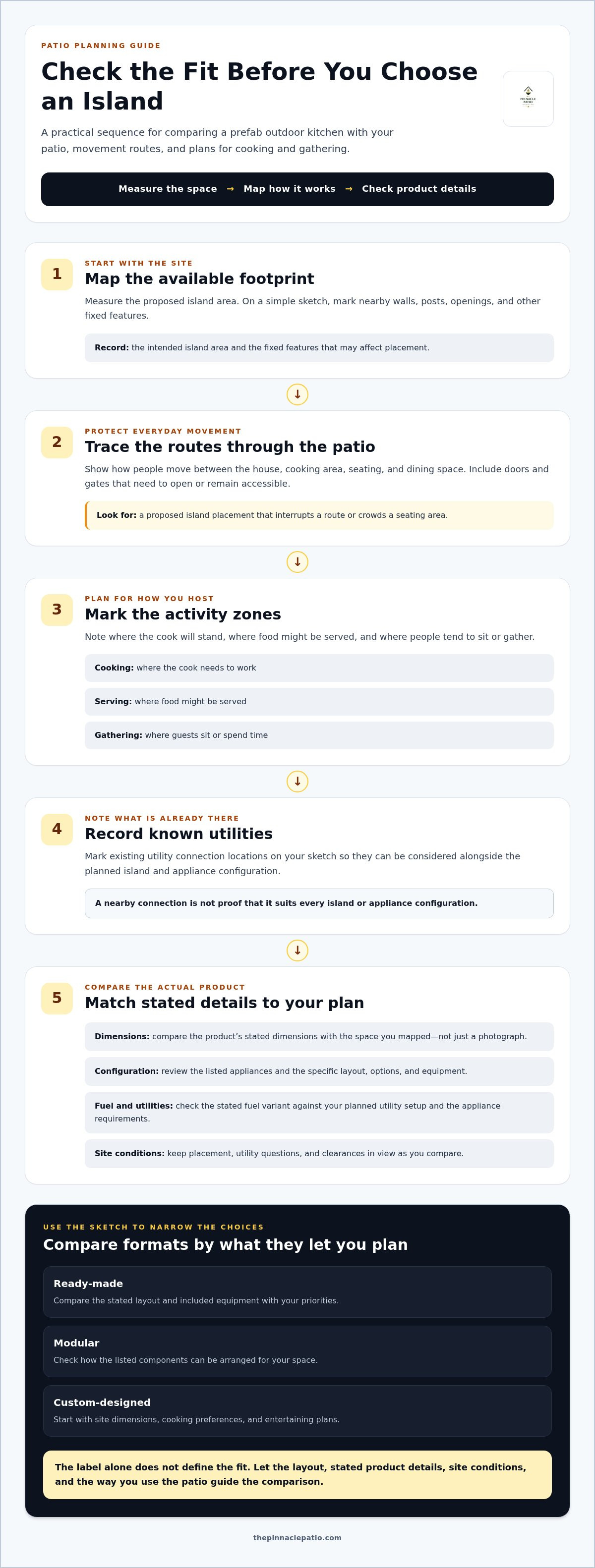
- Ready-made: Compare the stated layout and included equipment with your priorities.
- Modular: Check how the listed components can be arranged for your space.
- Custom-designed: Begin with site dimensions, cooking preferences, and entertaining plans.
For any format, read the product description for the actual configuration, dimensions, appliances, and stated options. Don’t infer that an island includes a feature simply because similar kitchens often have one. The Outdoor cooking methods and equipment overview offers useful context, but specific product details should guide your comparison.
When does a complete outdoor kitchen space make sense?
A complete outdoor kitchen space can make sense when you want cooking and gathering functions to feel coordinated, rather than choosing a standalone island in isolation. The right scope depends on the room available and the role you want the kitchen to play, from a focused grilling area to a broader setting for hosting. More elements don’t automatically make a better fit; each should serve a practical purpose in your plans.
Picture a typical meal outdoors: where cooking happens, where guests gather, and whether you need space to serve food. Then compare those priorities with the stated layout and footprint. The outdoor kitchen collection presents complete environments intended for cooking, gathering, and entertaining. Explore the configurations while keeping your own site and intended use at the center of the decision.
That distinction makes prefab outdoor kitchen islands easier to assess: treat the label as a starting point, then let the layout, product details, and fit for your project determine whether a configuration belongs on your shortlist.
How to Check Whether a Prefab Island Fits Your Patio
A product’s listed footprint is only one part of the fit. The island also needs to work with walking routes, nearby doors, and the places where guests sit or gather. Before comparing configurations, record the patio’s dimensions and map how the space functions during a typical meal outdoors. This helps you spot layouts that look suitable in a product photo but would interrupt movement or crowd a seating area.
Which measurements should you gather before comparing islands?
Start with the intended island area, then note surrounding features that could affect placement. A simple sketch makes comparisons more practical if it includes measurements and shows how people use the patio.
- Map the available footprint. Measure the proposed island area and mark nearby walls, posts, openings, and other fixed features.
- Trace movement through the patio. Show paths between the house, cooking area, seating, and dining space. Include doors and gates that need to open or remain accessible.
- Mark activity zones. Note where the cook will stand, where food might be served, and where people tend to sit or gather. This can reveal when an island’s placement would interrupt everyday use.
- Record known utilities. Mark existing utility connection locations, without assuming they suit every island or appliance configuration.
Keep your sketch and measurements together. Compare the product’s stated dimensions with the space you mapped, rather than judging by a photograph or general description. The outdoor kitchen collection offers configurations to consider against your site measurements and intended use.
How should utilities and site conditions shape the shortlist?
Once a layout appears to fit, review its stated appliance configuration and fuel variant alongside your planned utility setup. Some product listings identify natural-gas and liquid-propane variants; the version you choose needs to align with the project’s intended fuel arrangement. Don’t assume a connection is compatible simply because it is nearby. The appliance requirements and the conditions at your home both matter.
Keep unresolved questions about utility locations, appliance requirements, and island placement in view as you compare options. Avoid applying a generic clearance or foundation measurement to every setup. Use requirements stated for the product and consider the specific conditions of your patio and planned project.
Before seeking sizing guidance, have your patio sketch, measurements, preferred layout, and known utility locations ready. These details make it easier to discuss your plans and identify questions about size or configuration. If you’d like help considering your outdoor kitchen options, schedule a consultation.
Which Island Features Matter Most for Cooking and Entertaining?
The most useful configuration supports how you actually cook and host, not simply the one with the longest feature list. Separate essential functions, such as the cooking setup and usable work area, from optional features that create a more social atmosphere. For prefab outdoor kitchen islands, this distinction helps you compare layouts by purpose rather than appearance alone.
How do cooking habits influence an island configuration?
Think through a typical outdoor meal. Do you mainly grill, or do you also want room to prepare and serve food? Does one person usually cook, or do several people work in the area at once? When several people are active around the cook, work area and movement deserve extra attention. Heat zones matter, too: different cooking temperatures can help separate foods that need stronger heat from those that need gentler cooking, without assuming a particular burner count or output.
Use the table to identify what deserves priority in your plan. These are planning goals, not a promise that every island includes the listed elements.
| Priority | Consider | Ask yourself |
|---|---|---|
| Cooking | Grill configuration, cooking zones, and space to work | What do you cook outdoors most often, and how many people cook at once? |
| Preparation and serving | Room to organize ingredients and set down prepared food | Will food be prepared at the island, brought outside, or served nearby? |
| Socializing | How the cooking area relates to gathering and seating zones | Do guests tend to stay near the cook or gather elsewhere? |
| Entertainment | Features that support the kind of hosting you enjoy | Which additions will be used regularly, rather than only occasionally? |
Let those answers guide appliance selection. Compare the stated grill and appliance details for each configuration, and use the built-in grill options to explore grills as a distinct part of the decision. The Pinnacle Patio offers built-in grills from brands including Bull, AOG, and Kokomo. Don’t assume a grill, storage, or accessory is included with an island unless its product details say so.
Should the island prioritize hosting or dedicated cooking?
A cook-focused arrangement puts grilling and food preparation first. A hosting-oriented plan gives equal attention to how people gather around the cooking area, with seating and social interaction considered as part of the wider layout rather than assumed features. The Big Island Sports Bar is a named example to explore for an entertainment-oriented kitchen; compare its product details with your priorities.
Fuel choice is another practical filter, not a decorative feature. The Big Island Sports Bar is listed with liquid-propane and natural-gas variants. Compare the selected variant with your household’s planned utility setup, then review the product details for that specific configuration. Prioritize what supports the way you cook and host; treat atmosphere-focused additions as secondary until the core layout works.
Which Custom Outdoor Kitchen Spaces Match Your Priorities?
Product names can suggest a kitchen’s emphasis, but they don’t replace its description. Compare the stated features, dimensions, and fuel variants with the needs you’ve already identified. That keeps the decision grounded in what each configuration says, rather than assumptions based on a name or image.
How do the named island examples differ in stated emphasis?
Aruba is described as a kitchen featuring a 12-by-12-foot aluminum canopy. Big Island Sports Bar and Bermuda are named examples whose titles suggest an entertainment focus, while their product listings state liquid-propane and natural-gas variants. Treat those names as clues for what to explore, not as proof of features beyond the descriptions.
| Example | Stated detail | Useful comparison |
|---|---|---|
| Aruba | Features a 12-by-12-foot aluminum canopy | Consider whether a canopy-centered kitchen suits your site and intended use. |
| Big Island Sports Bar | Listed in liquid-propane and natural-gas variants | Compare the listed fuel choice with your planned household utility setup. |
| Fantasy Island | The name references 20-by-20-foot and 70-inch-TV details; listings state liquid-propane and natural-gas variants | Read the product description to understand the configuration; don’t treat name details alone as confirmation of included features. |
| Bermuda | Listed in liquid-propane and natural-gas variants | Use the stated variant information as a practical filter. |
| Custom Island Design | Kitchen described as designed around dimensions, cooking preferences, and entertaining style | Compare the project-focused approach with your own measurements and priorities. |
How can you shortlist a complete kitchen without overbuying?
Let your priorities do the editing. First, identify the cooking functions you consider essential. Next, compare each candidate’s stated dimensions with your site measurements. Then assess gathering or entertainment elements against how you actually host. This order keeps optional features from overshadowing the practical fit of the kitchen.
For custom configurations, the stated emphasis on dimensions, cooking preferences, and entertaining style gives shoppers a project-oriented point of comparison. Aruba’s canopy detail provides a specific feature to weigh against the space and experience you want. For Big Island Sports Bar, Fantasy Island, and Bermuda, the listed fuel variants offer a useful compatibility consideration. In each case, rely on the product description for configuration details, not the name alone.
- Must-have: Cooking functions that support your regular meals.
- Site fit: Stated product dimensions compared with your patio plan.
- Gathering features: Elements that support the way you entertain.
As you compare complete kitchen configurations, the outdoor kitchen collection from The Pinnacle Patio can help you consider which stated features align with your shortlist.
How to Choose Your Prefab Outdoor Kitchen Island and Take the Next Step
A considered choice comes from matching the kitchen to your routine and patio, then checking the details of the specific configuration. Prefab convenience can simplify selection, but it doesn’t remove the need to assess site fit. Use this four-step framework to move from a broad idea to a focused shortlist.
- Define how you’ll use it. Identify the cooking functions you rely on most, how many people typically cook, and whether gathering or serving space matters alongside grilling.
- Measure the site. Record the intended footprint and note paths, doors, seating, and dining areas that share the patio. These details help you compare a product’s stated dimensions with the space you have.
- Check the configuration. Review the product description for the layout, appliance setup, stated options, and any fuel variant. Don’t treat a product name or photo as a complete specification.
- Compare product details. Match each candidate’s stated details to your priorities, site measurements, and utility information. Set aside features that don’t support your plans.
What common mistakes can derail an island purchase?
An attractive layout can be tempting, but choosing by appearance before considering the footprint and circulation may leave the patio awkward to use. Measure and map the space first. Also avoid assuming an island includes a particular appliance, fuel connection, or accessory. Product descriptions are the guide to what a specific configuration states.
Another common misstep is prioritizing entertainment features before deciding what the household needs for everyday cooking. Start with the essentials, then weigh gathering features against the space available and how you host. That order keeps the shortlist focused on useful functions rather than a collection of appealing extras.
What should you do before making a final selection?
Bring three things to your comparison: site measurements, information about known utility locations, and a short list of must-have features. Use them to evaluate each product’s stated dimensions and configuration. Keep any detail that affects fit or compatibility visible as you narrow the options, rather than relying on assumptions.
Choosing an island and completing the project are separate considerations. A product purchase doesn’t, by itself, address site preparation, utility work, or on-site installation. Treat those as distinct parts of the project and use product-specific information alongside the requirements of your home and selected setup.
When you’re ready to compare complete spaces, explore the outdoor kitchen collection. The best fit is the one that aligns your cooking priorities, patio, and chosen configuration, not simply the one that promises the easiest path from browsing to purchase.
Make Your Outdoor Kitchen Feel Like Part of Home
The right choice should do more than occupy patio space. It should support the way you cook, create a comfortable setting for guests, and feel considered within the broader outdoor area. Treat your shortlist as the beginning of a practical design decision: a chance to shape an outdoor kitchen around the moments you want to make room for.
As you compare prefab outdoor kitchen islands, look beyond the appeal of a single feature and picture how the complete setting will function over time. The outdoor kitchen collection brings together environments designed around cooking, gathering, and entertaining, with named configurations that offer stated design and fuel details for comparison.
Choose a direction that suits your space and everyday use. A well-matched kitchen can make outdoor meals and time with friends feel more natural, season after season.
Explore The Pinnacle Patio’s outdoor kitchen islands and built-in grills to find a configuration that fits the way you cook and gather outdoors.
Frequently Asked Questions
What does prefab outdoor kitchen island mean?
“Prefab outdoor kitchen island” is a broad buying label, not a technical specification. Use it to begin browsing, then compare the individual product’s dimensions, listed components, and configuration information. For instance, a plan drawing can help you judge whether the island’s shape suits your patio better than a product photo can. Product details, rather than the label, are the useful basis for deciding what to investigate further.
Can a prefab outdoor kitchen island be customized?
Possibilities depend on the particular island. Before choosing, write down what needs to fit your project, such as the available footprint, preferred cooking functions, and how you expect to entertain. Then compare that list with the options described for the candidate. This helps distinguish a configuration that already suits your plans from one that would require changes, without assuming every product offers the same scope of customization.
Do prefab outdoor kitchen islands include a grill?
Some are described with built-in BBQ grills, but the product description is the reliable guide to what a specific island includes. As you compare, note the grill information separately from the island’s other listed components. If you’re considering a separate grill, compare its specifications and intended use with the kitchen configuration before treating the two as a compatible pairing. This helps prevent assumptions based on appearance or category labels.
Can an outdoor kitchen island use natural gas or liquid propane?
Some island configurations are offered in a stated fuel variant, but fuel options differ by product. Decide which fuel arrangement fits your household plans, then look for that exact variant in the product information. Don’t assume a configuration can be switched between fuels or that a nearby connection is suitable. Keep fuel selection tied to the chosen appliance and use the product documentation for setup-specific details.
Is a prefab outdoor kitchen island weatherproof?
Weather performance varies by product, so don’t treat “outdoor” as a blanket weatherproof claim. Review the island’s material and appliance specifications, along with any product-specific care guidance. Consider the conditions at the intended location, including exposure to rain, sun, and wind. A canopy may provide a design feature, but its presence alone doesn’t establish how every part of a kitchen will perform in changing weather.
Do I need a permit for an outdoor kitchen island?
Permit requirements depend on the project and its location, so check with the relevant local authority before work begins. The project scope may affect what needs review, particularly if it involves changes beyond placing the island. Keep your proposed configuration and project details on hand when seeking guidance. Avoid relying on a general answer for a different site, since local requirements and project circumstances can vary.