

The Master’s Guide to Understanding Grill BTU and Cooking Power
A higher number on a specification sheet doesn't always translate to a better sear on a prime ribeye. If you've ever felt the frustration of standing over a high-output grill only to find inconsistent cold spots, you've experienced the gap between raw data and real-world performance. Understanding grill BTU and cooking power requires looking beyond the total heat output to see how that energy is actually managed. It's about the marriage of heat and heat retention. Many homeowners find themselves lost in a sea of technical jargon, fearing they'll choose a system that underwhelms when the patio is full of guests.
At The Pinnacle Patio, we believe your outdoor kitchen should be a permanent investment in a more refined way of living, not a source of technical uncertainty. You deserve equipment that delivers professional precision every time you ignite the burners. This guide demystifies the relationship between thermal units, grill size, and the high-grade 304 stainless steel that keeps heat where it belongs. You'll gain a clear framework for comparing luxury brands. This ensures your selection provides the searing power and durability your culinary lifestyle demands.
Key Takeaways
- Learn why calculating heat flux is more critical for achieving a perfect sear than relying on total heat output alone.
- Determine the ideal grill size for your entertaining needs, whether it's a 30-inch or 42-inch model, and how many burners you'll need for effective zone cooking.
- Gain a deeper level of understanding grill BTU and cooking power by evaluating how high-grade materials like 304 stainless steel amplify thermal efficiency.
- Identify the structural features, including double-walled hoods, that preserve heat and ensure your grill's exterior maintains its polished aesthetic.
- Compare fuel types to see how natural gas and liquid propane impact gas consumption and heat generation in a luxury built-in configuration.
Defining BTU: The Language of Thermal Energy in Outdoor Cooking
A British thermal unit (BTU) is the standard measurement of thermal energy, specifically the heat required to raise the temperature of one pound of water by one degree Fahrenheit. When you are understanding grill BTU and cooking power, think of this number as the "engine displacement" of your outdoor appliance. It tells you how much fuel the grill can process in an hour. However, raw numbers are often a distraction for first-time buyers. A high-output grill that lacks proper insulation is like a powerful car with no tires; the energy is there, but it isn't being applied effectively to the surface.
High-performance brands like Bull and AOG utilize BTUs as a foundation for precision. They don't just aim for the highest number; they aim for the most effective use of heat. While a retail-grade unit might boast 60,000 BTUs, much of that energy escapes through thin lids and gaps in the firebox. A luxury built-in grill is designed for containment. It uses its thermal energy to saturate heavy cooking grates and thick walls, creating a stable environment that delivers professional results. Understanding grill BTU and cooking power is ultimately about the synergy between fuel consumption and heat retention.
The Role of the Burner in Heat Generation
The burner is the heart of the machine. Professional-grade grills often feature cast stainless steel burners rather than thin-walled pipe burners. Cast burners are heavier and built for decades of use. They provide more consistent gas distribution across the entire cooking surface. This precision ensures that your sear is uniform, whether you are cooking a single steak or a dozen burgers for a gathering. High-performance burners require a specific BTU output to maintain this consistency under the weight of heavy cooking grates, ensuring that every square inch of the surface is ready for professional use.
BTUs and the Preheating Experience
Cooking power also dictates your preheating and recovery times. A grill with a well-calibrated BTU-to-surface-area ratio will reach high-sear temperatures quickly. Most luxury models are built around a 20-minute preheat standard. This isn't just about convenience; it's about the social flow of your evening. A fast-recovery grill ensures that when you open the hood to flip your food, the temperature bounces back almost instantly. This prevents the "steaming" effect that occurs when a grill struggles to regain heat, ensuring your culinary results remain consistent even during large social events. It's a hallmark of a well-engineered outdoor kitchen that respects your time and your guests.
The Efficiency Equation: Why BTU per Square Inch Matters Most
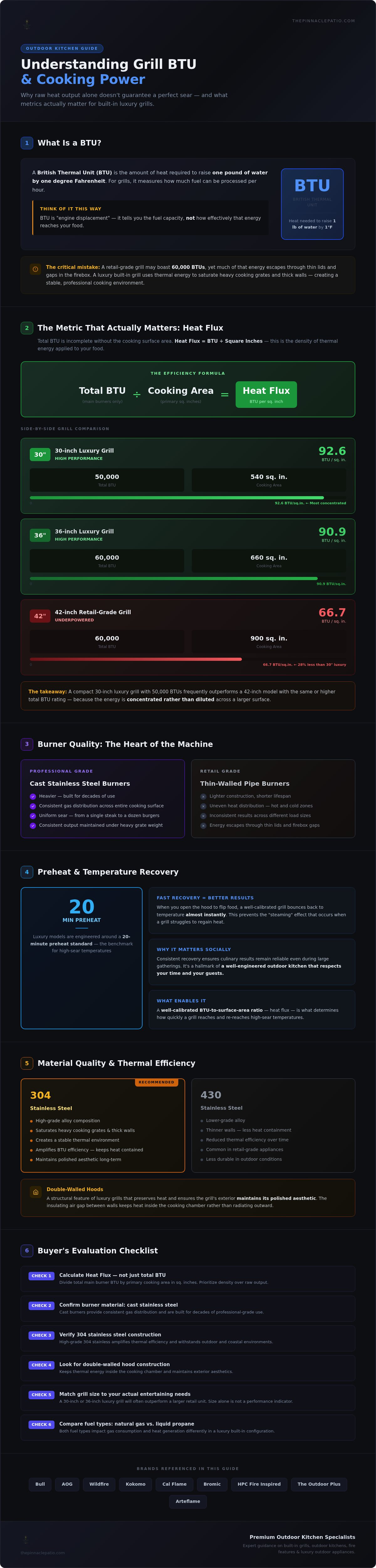
Most retail specifications emphasize total heat output, yet this number is incomplete without considering the physical dimensions of the cooking surface. Understanding grill BTU and cooking power requires a shift in perspective toward heat flux. This metric represents the density of thermal energy applied to your food. A compact 30-inch grill with 50,000 BTUs will frequently outperform a sprawling 42-inch model with the same rating because the energy is concentrated rather than diluted. High-performance cooking is not about the volume of gas burned; it's about the intensity of the heat delivered to the grate.
| Grill Configuration | Total Main BTUs | Primary Cooking Area | Heat Flux (BTU/sq. in.) |
|---|---|---|---|
| 30-inch Luxury Grill | 50,000 | 540 sq. in. | 92.6 (High Performance) |
| 36-inch Luxury Grill | 60,000 | 660 sq. in. | 90.9 (High Performance) |
| 42-inch Retail-Grade Grill | 60,000 | 900 sq. in. | 66.7 (Underpowered) |
Calculating Heat Flux for Your Built-In Grill
To evaluate a grill's true potential, divide the total BTU of the main burners by the primary cooking area in square inches. High-end brands like Wildfire and Kokomo prioritize this heat density to ensure their equipment meets the demands of professional chefs. When performing this comparison, it's vital to distinguish between the primary surface and the total surface area. Warming racks should be excluded from your power calculations, as they aren't designed for searing. A "sweet spot" for luxury performance typically sits between 80 to 100 BTUs per square inch, providing the rapid recovery and high temperatures necessary for perfect crust formation.
Infrared vs. Convection Heat
While traditional convection burners rely on circulating hot air, infrared burners use ceramic plates to emit intense radiant energy. This technology allows a grill to reach extreme temperatures with significantly lower gas consumption, making it an efficient choice for localized searing. Many luxury built-in grills are designed with a hybrid approach. They utilize convection burners for their deep fireboxes and even heat distribution, while incorporating a dedicated infrared sear zone for finishing steaks with professional marks. This balance provides the culinary versatility needed for everything from slow-roasting a whole chicken to flash-searing tuna. If you're unsure how these power metrics fit into your specific layout, you can schedule a consultation to match these technical requirements with your island design.
Sizing for Success: Matching Cooking Power to Your Ambitions
Selecting the right footprint for your grill is a decision that balances aesthetic presence with thermal necessity. While a larger chassis offers more room for variety, it also increases the volume of air that must be heated and maintained. Understanding grill BTU and cooking power in the context of size means recognizing that a 42-inch grill requires a significantly different energy profile than a 30-inch model to achieve the same searing results. The goal is to ensure your chosen appliance has the thermal mass and burner count to support your specific style of entertaining. This choice is a foundational element in the art of the outdoor kitchen island, where every component must work in harmony.
When browsing our selection of built-in grills, you'll notice that as the width increases, so does the complexity of the burner system. A larger firebox isn't just about cooking more food at once; it's about the luxury of space and the ability to execute complex, multi-course menus with ease. The relationship between the burner output and the physical dimensions remains the most reliable indicator of long-term satisfaction.
The 30-Inch and 32-Inch Professional Standard
The 30-inch and 32-inch configurations are the most popular choices for residential luxury kitchens. These sizes typically offer the highest heat-to-fuel efficiency because the firebox volume is compact enough to reach high temperatures rapidly. In brands like Bull and AOG, you'll frequently find three or four high-output burners delivering between 45,000 and 60,000 total BTUs. This setup is ideal for homeowners who prioritize precision and quick recovery times. These models excel at maintaining a consistent "heat floor," ensuring the temperature stays stable even when the lid is frequently opened during a social gathering.
The 42-Inch and 48-Inch Culinary Powerhouses
For those who view outdoor cooking as a grand performance, the 42-inch and 48-inch models provide the ultimate canvas. Managing the massive BTU requirements of these larger surfaces requires a sophisticated burner arrangement. These grills often utilize five or more burners to create distinct heat zones. This allows you to sear high-heat proteins on one side while gently roasting delicate vegetables on the other. Understanding grill BTU and cooking power at this scale is about control. Because of the larger internal volume, these grills must feature superior insulation to prevent energy loss. Without this structural integrity, a large grill can struggle to maintain the searing temperatures necessary for professional-grade results.
- Zone Cooking: The ability to create multiple temperature environments across one surface using 42-inch or 48-inch widths.
- Chassis Volume: The internal space that dictates how many BTUs are needed for saturation.
- Thermal Mass: How well the grill's materials hold onto heat once the burners are engaged, especially in 36-inch and larger models.
Engineering Excellence: How Material Quality Amplifies Power
While a high BTU rating might capture your attention on a specification sheet, the quality of the stainless steel determines how much of that heat actually reaches your food. Understanding grill BTU and cooking power requires you to view the grill chassis as a thermal vessel. If the vessel is thin or poorly insulated, the energy simply escapes into the atmosphere. This is why material choice is the silent partner of heat output. Professional-grade hardware ensures that every unit of energy is harnessed, creating the stable, high-heat environment necessary for culinary excellence.
Thermal Mass and Heat Retention
The concept of thermal mass is central to high-performance outdoor cooking. Thick metal walls act as a stabilizer, absorbing heat and radiating it back toward the cooking surface. This creates a consistent environment that resists fluctuations when you introduce cold proteins. A double-walled hood is a hallmark of superior engineering. It acts as an insulator, trapping heat inside the firebox while protecting the exterior from the high-temperature discoloration that plagues lower-end models. Within the firebox, heat tents and flavorizer bars work to redistribute BTU energy, transforming raw flame into a broad, even radiance that eliminates hot spots.
Heavy-duty cooking grates serve as thermal batteries. Once these grates are saturated with heat, they provide the massive energy transfer required for those iconic, deep sear marks. This stored energy is what allows a built-in grill to recover instantly after the lid is opened, ensuring your cooking process remains uninterrupted during a busy social gathering.
The 304 vs. 430 Stainless Steel Debate
Not all stainless steel is created equal. The Pinnacle Patio prioritizes brands like Bull and Kokomo because they utilize 304-grade stainless steel, which contains higher levels of chromium and nickel. This composition is essential for heat retention and corrosion resistance. In contrast, 430-grade steel is often used in retail-grade units as a cost-cutting measure. While it may look similar on the showroom floor, 430-grade steel is more prone to rusting and heat loss. In coastal environments, where salt air is a constant factor, 304-grade stainless steel is a non-negotiable requirement for the longevity of your investment.
Lower-end grills often use "filler" materials in the firebox or internal components that bleed heat. These components degrade quickly under the stress of high-BTU burners. By choosing a grill built entirely from 304-grade stainless steel, you're investing in a machine that manages its cooking power with efficiency and grace for decades. It's the difference between a temporary appliance and a permanent culinary destination.
Curating Your Kitchen: Selecting Your High-Performance Grill
The final step in your journey is translating technical specifications into a centerpiece for your home. Understanding grill BTU and cooking power is the key to a successful investment, but that power must be fueled correctly to reach its potential. Whether you select natural gas or liquid propane, the BTU rating of a grill generally remains consistent across fuel types. However, the delivery of that fuel impacts how you experience that power. Choosing a high-performance model from our Built-In Grills Collection ensures that your hardware is optimized for the specific demands of your outdoor space.
Our curated selection features brands that represent the pinnacle of outdoor engineering. Bull grills are renowned for their focus on eliminating cold spots, ensuring that their high BTU output is distributed with absolute uniformity. Kokomo grills emphasize heavy-duty construction and professional-grade heat density, making them a favorite for those who prioritize raw searing capability. AOG grills offer a sophisticated balance of elegance and precision, designed for homeowners who value a refined aesthetic alongside reliable cooking performance. Each brand manages thermal energy differently, yet all prioritize the 304 stainless steel construction necessary for culinary longevity.
The Natural Gas Advantage for High-Power Grilling
Luxury built-in grills are frequently optimized for permanent natural gas lines. This configuration provides a constant, high-pressure fuel supply that is essential for maintaining the performance of high-BTU burners. You'll never face the frustration of a fading flame in the middle of a sear because a tank is running low. For a permanent outdoor kitchen island, a natural gas connection reflects a commitment to both convenience and performance. It allows the grill to reach its maximum thermal potential every time you turn the dial, providing a seamless experience for the host and guests alike.
Final Decision Framework: Power, Precision, and Permanence
To select the right model, match your frequent guest count and preferred menu complexity to a specific power profile. If your culinary style focuses on high-heat steaks and rapid sears, prioritizing a model with a dedicated infrared zone is essential. For those who enjoy slow-roasting or diverse heat zones, a larger convection-based system with multiple burners offers more flexibility. Use this checklist to guide your final selection:
- Fuel Consistency: Confirm your utility access to ensure steady pressure for high-output burners.
- Menu Range: Choose a burner count that allows for at least three distinct heat zones.
- Environmental Resilience: Verify the use of 304 stainless steel for all internal and external components.
- Chassis Depth: Ensure the firebox is deep enough to facilitate proper convection and heat circulation.
Selecting a grill is about more than just numbers; it's about the atmosphere you intend to create. If you require guidance on matching BTU needs to your specific island configuration or utility layout, our experts are available to assist.
Elevating Your Outdoor Culinary Vision
A successful outdoor kitchen is built on the balance of energy and endurance. By understanding grill BTU and cooking power, you can look beyond misleading marketing numbers to find a system that delivers professional results. Focus on heat flux to ensure your grill has the density required for a perfect sear, and insist on 304-grade stainless steel to ensure that heat remains contained. These choices transform a simple grill into a legacy investment for your home.
As an authorized retailer for Bull, Kokomo, and AOG, we specialize in matching high-performance hardware with your unique lifestyle. Whether you're designing a compact 30-inch station or a sprawling 42-inch culinary destination, our national delivery and expert guidance ensure you receive components built for precision and permanence. We focus on the technical nuances of heat retention and material durability so you can focus on the experience of gathering.
Your journey toward a refined outdoor lifestyle begins with the right foundation. We look forward to helping you curate a space where every gathering becomes an extraordinary experience.
Frequently Asked Questions
What is a good BTU rating for a built-in gas grill?
A standard benchmark for a high-performance built-in grill is approximately 12,000 to 15,000 BTUs per main burner. However, the most reliable metric is heat flux, which should ideally range between 80 and 100 BTUs per square inch of primary cooking surface. This density ensures your grill reaches searing temperatures quickly and maintains them even when cold proteins are added. Brands like Bull and Kokomo prioritize this ratio to deliver professional culinary results in every configuration.
Does a higher BTU always mean a better grill?
Not necessarily. A higher BTU rating simply indicates how much fuel the grill consumes, not how effectively it manages that energy. Understanding grill BTU and cooking power requires looking at heat retention. A grill made from thin materials with high BTUs will bleed heat, whereas a 304-grade stainless steel model with lower BTUs might outperform it by trapping thermal energy. Efficiency and insulation are just as vital as raw power in a luxury appliance.
How many BTUs do I need to sear a steak properly?
To achieve a professional-grade sear, you need a concentrated burst of energy rather than a high total rating. Most luxury grills utilize main burners rated at 15,000 BTUs each to reach the 500 to 600 degree Fahrenheit range required for crust formation. For even higher precision, many homeowners incorporate a dedicated infrared sear burner. These specialized components focus heat directly onto the protein, creating perfect marks without overcooking the interior or losing moisture.
Do infrared burners have higher BTUs than standard gas burners?
Infrared burners often have similar BTU ratings to standard convection burners, but they utilize that energy differently. While a standard burner heats the air, infrared burners use ceramic plates to emit radiant energy. This allows them to reach much higher surface temperatures with the same fuel consumption. This efficiency makes them a premier choice for localized searing zones within a larger built-in configuration, providing professional versatility for complex outdoor menus and varied cooking styles.
Does the number of burners affect the total BTU rating?
Yes, the total BTU rating of a grill is the sum of all its main burners. A 42-inch grill with five burners will naturally have a higher total rating than a 30-inch model with three burners. However, understanding grill BTU and cooking power means recognizing that more burners don't automatically make a grill "hotter." Instead, multiple burners allow you to create specific heat zones, which is essential for managing different proteins and vegetables simultaneously across the surface.
How does stainless steel quality impact a grill's cooking power?
Material quality is the silent partner of cooking power. High-grade 304 stainless steel has superior thermal mass compared to 430-grade steel, meaning it absorbs and holds heat more effectively. This stability prevents temperature drops when you open the hood. Grills built with thick, double-walled 304 stainless steel act like a thermal battery. They ensure that the energy produced by your burners stays focused on the cooking surface rather than escaping through the chassis or thin firebox walls.
Will a high-BTU grill use significantly more fuel?
High-BTU grills do consume more fuel because they process a larger volume of gas per hour. If you frequently host large gatherings and utilize all burners at maximum output, your fuel consumption will be higher than a smaller, lower-power unit. This is why luxury built-in grills are often optimized for permanent natural gas lines. This setup provides a consistent, uninterrupted fuel supply, allowing you to enjoy high-power grilling without the concern of empty propane tanks during an event.
Is there a difference in BTU output between natural gas and propane?
There is typically no difference in the BTU output between natural gas and liquid propane models of the same grill. Manufacturers engineer their orifices and valves to ensure that the heat generation remains identical regardless of the fuel type. While the energy density of the gases differs, the grill's performance specifications are standardized. Your choice should be based on your utility access and whether you prefer the permanence of a gas line or the portability of liquid propane tanks.