

The Mastery of High-Performance Built-in Gas Grills: A 2026 Guide
The most expensive mistake in outdoor design isn't a choice of stone or layout; it's selecting a centerpiece that cannot withstand the elements it's meant to embrace. You've likely envisioned an outdoor kitchen that serves as a permanent extension of your home's refinement, where every gathering is anchored by a reliable, professional-grade built in gas grill. We understand the frustration of deciphering technical specs while trying to design a space for connection. Whether you're decoding the price premium of 304-grade stainless steel or worrying about how salt air might degrade your investment, these choices define the longevity of your sanctuary.
Choosing luxury equipment should be as satisfying as the first sear on a high-performance burner. This guide provides the expert clarity you need to transform a simple patio into a curated culinary destination. We'll examine why material integrity matters more than raw BTU numbers, how to apply the latest 2026 safety standards, and the nuances of sizing for premier brands like Bull, AOG, and Kokomo. You'll discover how to select a station that offers master-level heat control and the enduring beauty your lifestyle requires.
Key Takeaways
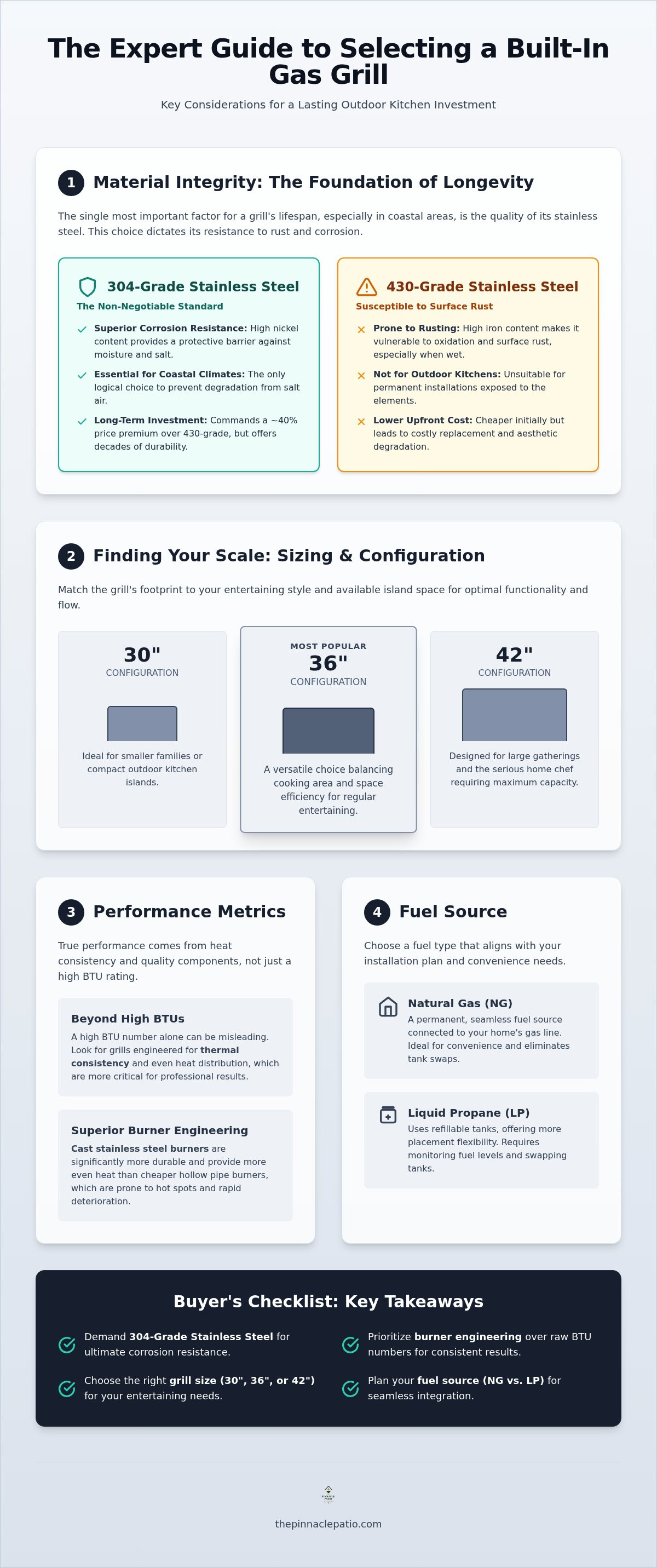
- Learn why 304-grade stainless steel is the non-negotiable standard for longevity, especially in coastal climates where corrosion is a constant threat.
- Determine the optimal scale for your island by matching a built in gas grill in 30, 36, or 42-inch configurations to your specific entertaining needs.
- Understand why thermal consistency and burner engineering are more critical for professional results than high BTU numbers alone.
- Evaluate the logistical benefits of natural gas versus liquid propane to ensure a seamless, permanent fuel source for your outdoor kitchen.
- Gain insight into how premier brands like Bull, AOG, and Kokomo balance aesthetic elegance with industrial-grade performance.
Defining the Built-In Gas Grill: The Anchor of Your Outdoor Sanctuary
A built in gas grill is more than just a cooking tool. It's the functional heartbeat of a sophisticated exterior space. While the history of the barbecue grill began with simple, mobile charcoal basins, today's high-performance units are engineered as permanent architectural fixtures. They serve as the definitive anchor of a luxury outdoor kitchen, offering a sense of heritage and permanence that freestanding models simply cannot replicate.
Understanding the distinction between configurations is vital for your planning process. Drop-in units are designed to be lowered into a precision-cut opening in your countertop, resulting in a clean, flush appearance. Conversely, slide-in configurations often feature a more prominent front profile, allowing the control panel to sit forward of the island's face. Both styles provide a level of durability and heat retention that far exceeds portable alternatives. The surrounding masonry or cabinetry of your island acts as a secondary insulation layer, shielding the firebox from external elements and ensuring consistent internal temperatures even in challenging weather.
The Aesthetic of Seamless Integration
A premium grill should elevate the visual profile of your entire patio. When you browse our curated built-in grills, you'll see how these units are built to harmonize with high-end outdoor finishes. The polished surfaces of a Bull or AOG grill complement natural stone and modern cabinetry alike. This visual synergy is a core component of sculpting your sanctuary. It creates a space that feels intentional rather than assembled, moving your outdoor area from a mere backyard to a true culinary destination.
Performance vs. Convenience: The Built-In Advantage
While portability has its place, the built-in advantage lies in uncompromising performance and longevity. These units are designed for integration with permanent natural gas lines, removing the need for frequent tank swaps. The professional-grade materials, such as 304 stainless steel, are selected for their resistance to the elements. This makes them a wise long-term property investment. Unlike cart grills that may require replacement every few years, a high-performance built in gas grill is built to endure. It offers the refined control needed for complex culinary styles while serving as a durable centerpiece for years of communal gatherings.
Engineering Excellence: Decoding Stainless Steel Grades and BTU Performance
The integrity of a built in gas grill is defined by the quality of its metallurgy and the precision of its thermal management. While the exterior may look identical across various brands, the internal components determine whether your investment lasts for decades or degrades after a single season. Choosing the right materials is the first step in curating a high-performance cooking station that remains the heart of your outdoor sanctuary.
The 304 Stainless Steel Standard
For a permanent outdoor installation, 304-grade stainless steel is the industry benchmark for corrosion resistance. Unlike 430-grade, which contains higher levels of iron and is susceptible to surface rust, 304-grade features a high nickel content that creates a protective barrier against moisture and salt air. This distinction is vital for homeowners in coastal environments. While 304-grade typically commands a price premium of approximately 40% over 430-grade, the longevity it provides makes it the only logical choice for a luxury island. Beyond the grade itself, look for hand-welded seams and polished edges. These details signify craftsmanship that prevents grease and moisture from infiltrating the internal structure of the grill.
Burner design is equally critical to the lifespan of the appliance. Premium brands like Bull and Kokomo utilize cast stainless steel burners rather than traditional hollow pipe burners. Cast burners are significantly heavier and more durable, resisting the warping and "burn through" that often plagues entry-level equipment. They're designed to distribute gas evenly, providing a consistent flame pattern that's essential for professional culinary results.
BTUs and Heat Distribution
It's a common misconception that higher BTU (British Thermal Unit) ratings automatically equate to better performance. In reality, efficiency and heat management are far more important. A well-engineered built in gas grill uses heat zone separators to allow for simultaneous high-heat searing and low-temperature roasting. This level of control is achieved through high-quality flame tamers or ceramic briquettes, which minimize flare-ups and radiate heat evenly across the cooking surface. For those seeking the ultimate sear, integrating an infrared burner provides intense, concentrated heat that mimics a professional steakhouse environment. Adhering to established gas grill safety guidelines ensures these high-performance components operate safely within your island enclosure. If you're uncertain which burner configuration suits your culinary style, you might schedule a consultation to discuss specific brand capabilities and thermal precision.
Finding Your Scale: Navigating 30-Inch, 36-Inch, and 42-Inch Configurations
Selecting the scale of your built in gas grill requires a thoughtful balance between culinary ambition and the physical constraints of your outdoor island. It is not simply a matter of "bigger is better." Instead, the width of your grill should reflect the cadence of your social life and the complexity of the menus you intend to execute. While Bull models offer specific sizing tiers, brands like AOG and Kokomo provide equally refined options that cater to diverse spatial requirements.
- 30-inch models, such as the Bull Angus, are perfectly suited for intimate family dinners or compact urban patios. They provide ample space for primary proteins without overwhelming a smaller footprint.
- 36-inch to 38-inch models, like the Bull Brahma, represent the versatile industry standard. These units offer the surface area needed to manage multiple heat zones, allowing you to sear steaks while roasting vegetables over indirect heat.
- 42-inch grills and larger, including the Bull Diablo at 46 inches, are designed for the dedicated host who regularly entertains groups of twelve or more. These professional-capacity stations provide the thermal real estate necessary for high-volume production without sacrificing precision.
Spatial Planning for Your Island
An integrated kitchen must function as fluidly as its indoor counterpart. It is essential to allocate landing zones of at least 12 to 18 inches on either side of your built in gas grill. This space is crucial for placing platters, prep tools, or resting meat after it leaves the heat. When planning a larger 42-inch unit, consider how its visual weight impacts the rest of your layout. A massive grill can crowd out other essential features like pizza ovens or sinks if the island is not scaled proportionally. Proper planning ensures the grill remains a functional centerpiece rather than an architectural obstacle.
Feature Density by Size
As the chassis of the grill widens, the opportunities for specialized features increase. Larger models often incorporate dedicated infrared rotisserie burners and internal halogen lighting for evening cooking sessions. In premium wide-format units, you will frequently find integrated wood chip smoker boxes. These additions allow you to introduce complex, smoky flavor profiles that smaller, more basic units cannot easily accommodate. Choosing a larger size is often less about the number of burgers you can cook and more about the variety of techniques you can employ simultaneously. For guidance on how these dimensions affect your utilities and island compatibility, you may schedule a consultation with our design experts.
Strategic Integration: Planning for Utilities, Clearances, and Installation
The permanence of a built in gas grill demands a rigorous approach to utility planning. Unlike a portable cart, an integrated unit becomes a fixed part of your home's infrastructure. This requires a clear decision on fuel sources during the earliest stages of your design. Natural gas is the preferred choice for most luxury installations due to its lower long-term cost and the convenience of a continuous supply. For homes without natural gas infrastructure, liquid propane remains a powerful alternative. While propane is roughly two to three times more expensive per BTU than natural gas as of 2026, it offers high energy density and flexibility for remote island locations.
Ventilation is perhaps the most critical safety consideration in your layout. According to the 2022 ANSI Z21.58 safety standards, built-in enclosures must include specific vent panel sizes to prevent the accumulation of combustible gases. This isn't merely about clearing smoke; it's a fundamental safety requirement that protects your property and your guests. Proper airflow ensures that any leaked gas dissipates safely rather than pooling inside the masonry of your island.
Utility Requirements for Professional Grills
A clean aesthetic depends on hidden connections. You should plan your gas line entry point to align precisely with the grill's intake, keeping hoses out of sight and protected from the elements. Most high-performance models from Bull, AOG, or Kokomo also require electrical power. You'll need a dedicated GFI outlet to power internal halogen lighting and rotisserie motors. Safety dictates that an accessible shut-off valve must be installed within reach. This allows you to cut the fuel supply instantly without reaching behind a hot appliance during an emergency.
Safety and Clearances
The material of your island determines whether you need an insulated jacket, often referred to as a grill liner. If you're building with combustible materials like wood or certain composites, a stainless steel liner is mandatory to shield the frame from intense heat. Even with non-combustible masonry, you must maintain proper clearances from walls and overhead structures. If your built in gas grill sits under a roof or pavilion, an outdoor-rated vent hood is necessary. Keep in mind that if your hood's capacity exceeds 400 CFM, local codes often require a makeup air system to maintain proper air pressure. Consulting your local building department ensures your sanctuary meets all regional safety regulations and insurance requirements.
Curating Your Culinary Destination: Selecting the Ideal Professional Brand
Selecting the ideal built in gas grill is the definitive moment where technical research meets culinary aspiration. It's the process of choosing a manufacturer that mirrors your commitment to craftsmanship and longevity. While many retailers offer an overwhelming list of options without context, we focus on a curated selection of brands that have proven their worth in the most demanding outdoor environments. Whether you prioritize thermal precision or industrial-grade durability, your choice defines the character of your outdoor sanctuary.
Bull Grills has established itself as a premier industry standard by prioritizing thermal consistency. Their engineering focuses on eliminating the erratic heat patterns often found in entry-level units, providing a reliable surface for precise searing across every square inch of the rack. For the chef who values heavy-duty construction, Kokomo Grills offers high-performance engineering designed for high-frequency use. Their burners provide the kind of industrial-grade output that withstands the rigors of frequent entertaining. Meanwhile, AOG Grills provides a sophisticated, timeless profile that complements modern architectural styles. Their longevity is rooted in the extensive use of 304 stainless steel throughout the firebox and exterior, ensuring the unit remains a permanent fixture in your landscape for decades.
The Pinnacle Selection
We meticulously curate our built-in grill collection based on three pillars: material integrity, manufacturer support, and aesthetic harmony. This rigorous filtering process ensures that every appliance we offer integrates perfectly with Pinnacle Outdoor Kitchens. By selecting brands with proven parts availability and robust warranty support, we ensure your investment remains functional and beautiful for years to come. The synergy between a high-performance built in gas grill and a precision-engineered island creates a seamless experience that elevates every social gathering.
Finalizing Your Vision
Moving from research to implementation requires a final verification of your site requirements. A professional installation relies on the accuracy of your utility placements and the compatibility of your island materials. If you're designing a custom space, a complimentary consultation can help you confirm that your chosen grill matches your guest count and cooking style. Before you finalize your purchase, ensure you've addressed this final checklist:
- Confirm your fuel source is either natural gas or liquid propane.
- Verify if your island construction requires an insulated jacket for heat protection.
- Match the grill width (30, 36, or 42-inch) to your available landing zone space.
- Ensure your ventilation panels are positioned according to the latest safety standards to prevent gas buildup.
Elevating Your Outdoor Culinary Legacy
Your choice of a built in gas grill is a profound investment in the atmosphere of your home and the enduring quality of your communal gatherings. By prioritizing 304-grade stainless steel and precision thermal engineering, you ensure your outdoor sanctuary remains a high-performance destination for decades. We've navigated the critical importance of material integrity, strategic utility planning, and the nuanced selection of premier brands like Bull, AOG, and Kokomo.
The Pinnacle Patio serves as your visionary guide, offering the professional expertise needed to navigate complex sizing and configuration decisions. We're dedicated to helping you curate a space that reflects your taste and supports your culinary ambitions. Our focus on high-performance outdoor living ensures that every component of your kitchen is selected for its craftsmanship and longevity.
We're ready to help you translate your architectural vision into a permanent, sophisticated reality that elevates every extraordinary moment spent under the open sky.
Frequently Asked Questions
What is the difference between 304 and 430 stainless steel for built-in grills?
304-grade stainless steel contains a high nickel content that provides superior resistance to corrosion and oxidation. This makes it the non-negotiable standard for a built in gas grill intended for long-term use, especially in humid or coastal environments. In contrast, 430-grade is more iron-rich and susceptible to surface rust over time. While 304-grade carries a higher price premium, its ability to maintain a professional finish makes it a superior investment for luxury outdoor islands.
Do I need an insulated jacket for my built-in gas grill?
An insulated jacket is mandatory if you're installing your grill into an island constructed from combustible materials, such as wood or certain composite frames. This stainless steel liner acts as a thermal barrier, protecting the structure from the intense heat generated by the firebox. Even if your island is masonry-based, some homeowners choose a liner to ensure a precision fit and provide an extra layer of protection for the surrounding stone or stucco finishes.
Can I convert a liquid propane grill to natural gas later?
Many professional models from brands like Bull or AOG can be converted using a manufacturer-specific conversion kit. This process involves replacing the orifices and potentially the regulator to accommodate the different pressure requirements of natural gas. However, it's essential to verify the specific model's capabilities before purchase. Because a built in gas grill is a permanent fixture, we recommend finalizing your fuel source during the initial utility planning phase to avoid future logistical complications.
What are the standard sizes for built-in gas grills?
The industry typically categorizes grills into three primary widths: 30-inch, 36-inch, and 42-inch configurations. A 30-inch model is ideal for intimate family meals, while the 36-inch width serves as the versatile standard for most entertaining needs. Larger 42-inch units provide the professional capacity required for hosting large groups. When selecting a size, you must also account for the cutout dimensions specified by the manufacturer, as these differ slightly from the overall exterior width of the unit.
Are built-in grills better than freestanding grills?
Built-in models offer superior heat retention and durability because they're integrated into a permanent, insulated structure. This configuration provides a more stable cooking environment and eliminates the "wobble" associated with cart-based units. Beyond performance, a built-in unit serves as an architectural centerpiece that increases property value. It allows for a seamless culinary workflow by integrating with countertops and storage, transforming a simple patio into a sophisticated, high-performance outdoor kitchen destination.
What utility connections do I need for a luxury built-in grill?
Most professional installations require a dedicated gas line for either natural gas or liquid propane and a 110V GFI electrical outlet. The electrical connection is necessary to power internal halogen lighting, LED control knobs, and rotisserie motors. You should also ensure a safety shut-off valve is positioned in an accessible location within the island. Planning these connections during the design phase ensures a clean aesthetic where all hoses and wires remain hidden from view.
How do I clean and maintain my professional built-in gas grill?
Maintain the professional finish of your 304-grade stainless steel by using a specialized cleaner and a microfiber cloth, always wiping with the grain. You should periodically remove the grates and flame tamers to clear any debris from the burners, ensuring consistent gas flow. For the interior, a simple degreaser and a soft brush will prevent carbon buildup. Using a high-quality, weather-resistant cover when the grill isn't in use is the most effective way to preserve your investment.
What is a rotisserie burner and do I need one?
A rotisserie burner is a dedicated infrared heating element located at the back of the grill. It provides consistent, indirect heat that is perfect for slow-roasting large proteins like whole chickens or prime rib. This feature allows the meat to self-baste in its own juices, resulting in a level of tenderness that standard burners can't replicate. If you enjoy diverse culinary styles and frequent hosting, the rotisserie burner is a highly recommended addition for professional-level results.