

Upgrading Your Outdoor Cooking Setup: A Thoughtful Buyer’s Guide
The most useful upgrade may not be a larger grill. When you’re upgrading your outdoor cooking setup, the right choice depends on what you cook, how you host, and how your space works today. A grill that lets you create separate heat zones may make more difference than adding an appliance you rarely use.
It’s natural to weigh a new grill against an island or supporting appliances, especially when dimensions, fuel connections, and clearances matter. Start with your everyday routine: the meals you prepare, the people you host, and how you move between cooking and serving. Then compare those needs with the products that fit your space.
This guide walks through a practical upgrade plan. You’ll compare grills and islands by footprint, cooking needs, utilities, and hosting flow, then use product documentation to check dimensions and compatibility. The goal is a setup that fits the way you use your outdoor space, not a list of features for its own sake.
Key Takeaways
- Identify what limits your cooking or interrupts hosting, then use those priorities to shape the upgrade.
- Compare a grill upgrade, an island, and a broader kitchen configuration by footprint, utility needs, cooking tasks, and hosting flow.
- Upgrading your outdoor cooking setup doesn’t require replacing every major component; a focused appliance upgrade may be enough.
- Measure the space and map utilities before choosing equipment. Use product documentation for exact dimensions and clearances.
- Explore outdoor kitchen islands and built-in grills from The Pinnacle Patio, with consultation available for project-specific sizing and configuration guidance.
Upgrading Your Outdoor Cooking Setup Starts With How You Use It
A more capable outdoor cooking space can make dinner preparation easier and hosting more relaxed. Begin with the moments that feel cramped, interrupted, or less enjoyable, rather than starting with an appliance checklist.
For a week or two, notice what slows you down. Maybe there’s nowhere to prep ingredients, several dishes compete for one cooking surface, tools are hard to reach, or you have to leave your guests to manage the grill. Separate these recurring functional problems from aesthetic preferences, such as wanting a more cohesive look. Both can matter, but repeated friction is a useful guide to what will improve everyday use.
Which parts of your current setup create the most friction?
Assess the whole working area, not just the grill. Look at prep space, cooking capacity, storage, and how easily you can move between them. Notice whether guests gather near the cooking area and whether that feels sociable or crowded. A one-off inconvenience may not justify a major change; a recurring bottleneck deserves a place on your priority list.
- Prep: Is there room to stage ingredients and serving dishes?
- Cooking: Does your grill suit the meals you routinely prepare?
- Movement: Can you reach tools and move through the area without interrupting cooking or conversation?
How do cooking and hosting habits shape the upgrade?
Multi-dish meals may benefit from distinct work areas, so preparation, cooking, and serving don’t compete for the same surface. Casual meals may call for a simpler improvement, while larger gatherings or varied menus can make extra workspace or another cooking appliance more useful. This overview of outdoor cooking methods and equipment offers broader context as you consider what you enjoy making.
Picture the experience you want: cooking while staying part of the conversation, serving a full menu with less back-and-forth, or keeping a familiar routine while improving one frustrating detail. That vision can point toward a focused appliance change or a more comprehensive arrangement. A successful upgrade fits the way you really cook, host, and move through the space. Use that standard to guide the choices that follow.
Compare Outdoor Cooking Upgrades by Performance, Fit, and Compatibility
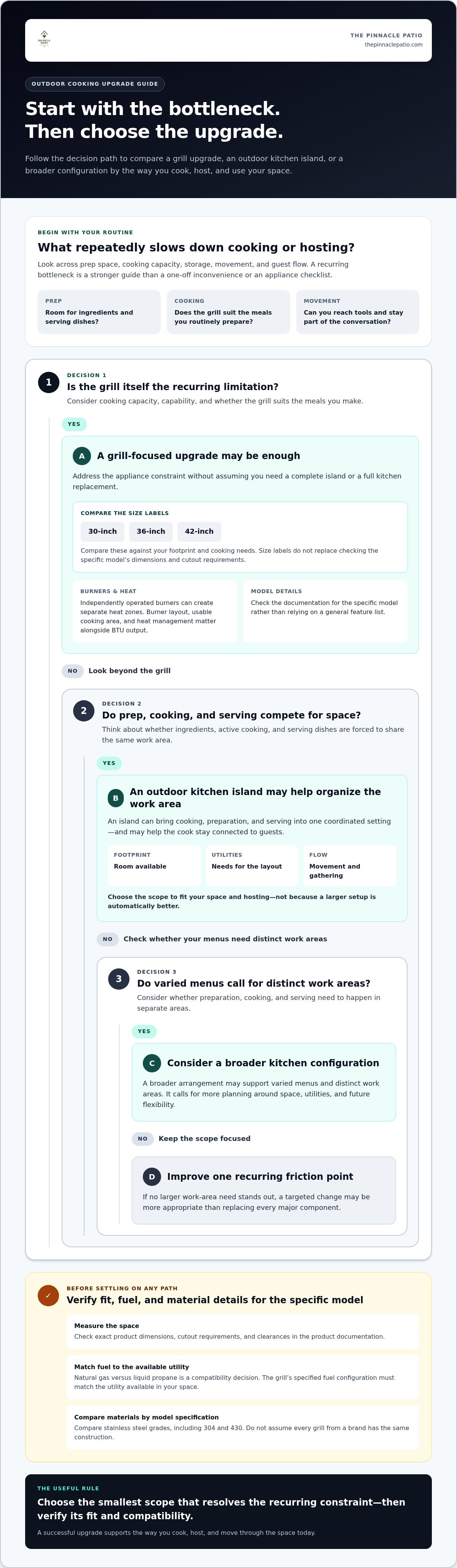
Once you know what you want to improve, compare options against your space and utilities, not just a feature list. The right scope may be a grill better suited to your cooking, an island that adds a dedicated work surface, or a broader configuration that gives cooking and serving more room to coexist.
- Grill-focused upgrade: A practical option when cooking capacity or capability is the main constraint. Check the grill’s dimensions, the meals you prepare, fuel compatibility, and the space available.
- Outdoor kitchen island: Can bring cooking, preparation, and serving into one coordinated setting. Consider its footprint, utility needs, and effect on movement and guest gathering.
- Broader kitchen configuration: May support varied menus and distinct work areas, but calls for more planning around space, utilities, and future flexibility.
Burner count matters most when you consider how the burners work for your meals. Independently operated burners can let you create separate heat zones for different foods. Likewise, BTU output alone doesn’t describe the cooking experience; burner layout, usable cooking area, and heat management matter too. Treat specifications as decision points, and verify each detail against the documentation for the specific model.
When is a built-in grill upgrade enough?
If the grill itself is the recurring limitation, upgrading that appliance may address the problem without committing to a full island. Compare 30-inch, 36-inch, and 42-inch grills against your available footprint and cooking needs. These size labels are useful comparison points, but they don’t replace checking the model’s actual dimensions and cutout requirements. Explore the built-in grill collection to compare options.
When does an outdoor kitchen island make sense?
An island can organize cooking, preparation, and serving in one place, helping the cook stay connected to guests. Choose its scope based on the room available and the way you host, rather than assuming that a larger setup is always better. Browse the outdoor kitchen collection as you consider a coordinated layout.
Which material and fuel details deserve careful comparison?
Compare stainless steel grades, including 304 and 430, using the specifications for each model. Don’t assume every grill from a brand has the same construction. Treat natural gas versus liquid propane as a compatibility decision: the grill’s specified fuel configuration must match the utility available in your space. If dimensions, fuel, or island fit raise questions, a project-specific consultation can help bring those choices together as you plan your upgrade.
Upgrade Your Cooking Setup with an Outdoor Kitchen?
Upgrading doesn’t mean replacing every major component or building a complete outdoor kitchen. The right scope depends on what’s limiting your routine. If the grill is the bottleneck, a focused appliance change may address it. If cooking, preparation, and serving all compete for space, a coordinated island may better fit the way you host.
Think of these as two paths, not simply “small” and “large.” A focused upgrade centers on the appliance and its fit. An island brings more of the working area into the plan, so layout, utilities, and movement around the space become part of the decision. Compare both options by how well they fit your needs and the verified product details, rather than assuming one will cost less, save time, or make installation easier.
What can a focused upgrade improve?
If you like your current layout but the grill limits the meals you can prepare or the cooking capacity you need, replacing that appliance may be enough. Additional storage or prep space is useful when it solves a real workflow problem, such as having nowhere to set ingredients while cooking. Even a single-appliance change calls for careful checks: compare the selected grill’s dimensions, cutout requirements, fuel configuration, and clearances with the existing space and utilities.
A smaller scope can also be phased. Before selecting a grill, consider whether you might later add an island or other components. Planning for that possibility can help you make compatible choices now without committing to additions you don’t yet need.
What does a coordinated island add to the decision?
An island makes grill placement part of a broader arrangement. Consider where preparation happens, how food moves from the grill to the serving area, and whether people can gather without obstructing the cook. An island may help organize these activities, but it doesn’t create usable space by itself. Its footprint and position must suit the area and preserve practical circulation.
Explore the outdoor kitchen collection as you consider island options and plan your layout. A coordinated island may leave room for future choices if you account for those needs early, but each appliance and connection still has to work with the configuration. The Pinnacle Patio’s complimentary consultations can help align sizing, compatibility, and design decisions as you plan.
Choose a focused upgrade when one appliance is the clear constraint; consider an island when the workflow itself needs attention. A phased plan works best when each decision supports how you use the space now and what you may reasonably want from it later.
Plan Your Outdoor Cooking Setup Upgrade in Five Practical Steps
A clear sequence turns an idea into a configuration you can evaluate with confidence. Keep a record of measurements, product details, and open questions as you go. Each decision can then build on the last instead of relying on assumptions.
- Define your needs. Identify the cooking tasks, preparation space, or hosting flow you want to improve. Separate essential requirements from features you may want later.
- Measure the space. Record the available footprint and note nearby walls, counters, access routes, and other fixed features. Use the selected product’s documentation for exact dimensions and required clearances.
- Map utilities. Note the location of existing connections and other relevant utilities. Match them to the specific equipment’s documented requirements before treating them as compatible.
- Compare verified products. Review model dimensions, fuel type, materials, and configuration details in product documentation. Consider what each feature means for your planned use, not just how it reads on a specification list.
- Finalize the configuration. Check that the grill, island, and any selected accessories work together in the layout. Record unresolved questions before settling on a configuration.
How should you document space, clearances, and utilities?
Sketch the area and mark its usable footprint, nearby utility locations, and fixed features that affect placement. For each shortlisted model, compare its documented dimensions and installation clearances with the sketch. Requirements vary by product, so don’t apply one model’s measurements to another. Confirm that a utility connection matches the selected equipment’s specifications.
How can you check whether components work together?
Compare the grill’s dimensions, specified fuel type, and intended configuration with the island and the space available. Then consider how preparation, cooking, serving, and selected accessories fit into one working arrangement. Browse the outdoor kitchen collection for island options to consider as you review your configuration.
Before choosing, gather product documentation and mark any unresolved questions about dimensions, clearances, utilities, or compatibility. This is especially helpful when upgrading your outdoor cooking setup involves coordinating a built-in grill with an island. The Pinnacle Patio offers complimentary consultation for project-specific sizing and configuration guidance.
Choose a Curated Outdoor Cooking Setup That Fits Your Plans
The most considered upgrade answers a real need without adding complexity for its own sake. Bring your cooking habits, available footprint, and utility locations together with the specifications of the products you’re considering. This keeps the decision grounded in how you’ll use the space, whether you’re replacing a grill or planning a coordinated island.
Which details should guide your final selection?
Use your shortlist to compare documented dimensions, materials, fuel type, and compatibility. A grill that suits your menu still needs to fit its intended configuration and align with the utilities available. An island should support preparation and serving while leaving workable circulation around the cooking area. The best setup isn’t defined by how many components it includes; it’s the one that fits your household’s priorities and intended use.
The Pinnacle Patio offers outdoor kitchen islands and built-in grills, including options from AOG Grills. Explore The Pinnacle Patio outdoor kitchen collection as a starting point for considering a coordinated island and grill. A complete configuration may suit your plans, but it isn’t a requirement for upgrading your outdoor cooking setup.
When is a consultation useful for an outdoor cooking upgrade?
Guidance can be especially useful when choices depend on one another, such as matching a built-in grill to an island, working within a defined footprint, or aligning fuel and configuration details. Bring your measurements, cooking priorities, and shortlisted products to make the discussion specific. This gives you a clearer basis for comparing options and resolving fit questions before finalizing a setup.
Ready to bring your plan into focus? Schedule a complimentary consultation for sizing, compatibility, and configuration guidance.
Build an Outdoor Cooking Space Around the Way You Live
Upgrading your outdoor cooking setup starts with a clear picture of what you want to improve. Let cooking habits and hosting routines guide the scope, then compare available space, utilities, and product-specific dimensions before choosing equipment. A focused grill upgrade may be the right answer; a coordinated island may make more sense when preparation and serving also need attention.
The Pinnacle Patio offers outdoor kitchen islands and built-in grills, including options from Kokomo Grills, Bull Grills, and AOG Grills. By considering fit, compatibility, and intended use, you can choose a configuration that suits your household over time without adding components simply for their own sake.
Bring your measurements, priorities, and shortlisted products to a complimentary consultation for project-specific sizing and configuration guidance.
A thoughtful plan makes the next step clearer. Choose the setup that supports the meals, gatherings, and everyday moments you want to enjoy outdoors.
Frequently Asked Questions
What is the best first upgrade for an outdoor cooking setup?
The best first upgrade addresses a recurring limitation in how you cook or host. If you’re short on cooking capacity, compare grill options. If prep space or serving flow is the frustration, consider whether an island would help. Before upgrading your outdoor cooking setup, note your usual meals, available footprint, utility locations, and the product specifications that affect fit.
Should I upgrade my grill or add an outdoor kitchen island?
Upgrade the grill when the appliance itself is the main constraint, such as limited capacity for the meals you prepare. Consider an island when preparation, cooking, and serving need a more coordinated arrangement. An island isn’t automatically a better fit: weigh its footprint, utility needs, and effect on circulation. Choose based on the recurring problem you want to solve.
How do I choose between a 30-inch, 36-inch, and 42-inch built-in grill?
Use these sizes as starting points, then compare the actual dimensions and cutout requirements listed for each model. Consider how much cooking area your usual meals require, how often you cook for a group, and how much room the grill and surrounding work areas can occupy. A wider size label alone doesn’t establish fit or suitability, so verify the specific product documentation before choosing.
What is the difference between 304 and 430 stainless steel for an outdoor grill?
Grade 304 stainless steel contains nickel and generally offers stronger corrosion resistance than grade 430. The specific grade used can vary by grill model and component, so check the manufacturer’s specifications rather than assuming every part has the same construction. For coastal exposure, material selection deserves particular attention because salt and moisture can accelerate corrosion.
Can I use a natural gas grill with a liquid propane setup?
Don’t assume a grill configured for natural gas can connect directly to liquid propane, or vice versa. The fuel type and configuration must match the specific grill’s documented requirements and the utility available at your home. Some products may support a manufacturer-approved conversion, but compatibility varies by model. Review the product documentation before purchase, and don’t rely on a general assumption about fuel interchangeability.
What should I measure before upgrading an outdoor kitchen?
Measure the available footprint and note fixed features, nearby utility locations, and the routes people use around the cooking area. Then compare shortlisted equipment with its documented dimensions, cutout measurements, and installation clearances. Include space for preparation and serving in your layout plan. Requirements vary by product, so use the selected model’s documentation rather than estimates or measurements from a similar appliance.
Do I need to upgrade my entire outdoor cooking area at once?
No. A focused upgrade, such as replacing the grill that limits your cooking, may be enough. You can also plan in phases, provided each choice fits the current setup and considers likely future needs. Before committing to an appliance, check its dimensions, fuel configuration, and compatibility with the space. A coordinated island can be added to your plans later if your priorities or hosting routine call for it.