

What Makes a Grill “High-Performance”? The Features That Matter
A bigger BTU number doesn’t automatically mean better grilling. Understanding what makes a grill "high-performance" starts with how well it turns burner output into controlled, even heat across the cooking surface, and whether that control suits regular outdoor use. Product descriptions often spotlight impressive totals, but those figures alone can’t tell you whether you can sear over one zone while cooking more gently in another, or how the grill is built to handle the elements.
Specifications are useful when they connect to the meals you actually prepare. This guide explains how to compare main-burner output with cooking area, assess burner design and heat zones, and review materials and construction. Use those details alongside your cooking habits and outdoor kitchen plans to judge which features matter for your use, rather than choosing by a spec sheet headline.
Key Takeaways
- To understand what makes a grill "high-performance," look for consistent cooking control rather than relying on a single headline specification.
- Consider how burner layout and individual controls could support the direct and indirect cooking your meals require.
- Evaluate construction details using verified information for the specific grill, not assumptions based on a brand or material label alone.
- Use your typical meals, entertaining frequency, available space, and heat needs to guide which features deserve priority.
- Compare built-in grill options available at The Pinnacle Patio with your kitchen’s sizing and compatibility needs in view.
What makes a grill high-performance? Start with cooking results
Grill performance is the ability to deliver controlled, repeatable cooking. A capable grill gives you practical command over heat, so you can adjust how food cooks instead of relying on a large output figure. Performance is not just one good sear or an impressive meal. It is how predictably the grill responds when you make familiar dishes.
That’s the useful answer to what makes a grill "high-performance": balanced heat control, distribution, burner design, sound construction, and a good fit for the way you cook. These qualities work together. A burner specification describes one part of the system, but it can’t tell you on its own how evenly heat reaches the cooking surface or how flexibly you can use it.
What should a high-performance grill help you do?
Start with the tasks your outdoor meals involve. You might need concentrated heat to sear one food, steady heat for another, and room to manage both without rushing. Burner arrangement and controls affect whether you can create useful areas with different heat levels. The cooking surface and overall design also influence how easily you can work across the grill.
Repeatability matters when you cook for family or host guests. A grill that responds predictably can make it easier to coordinate several foods and time a meal. It does not guarantee a particular result: technique, ingredients, conditions, and the specific model all matter. For context on how heat transfer shapes grilling as a cooking method, see The Science of Grilling.
Why one specification cannot tell the whole story
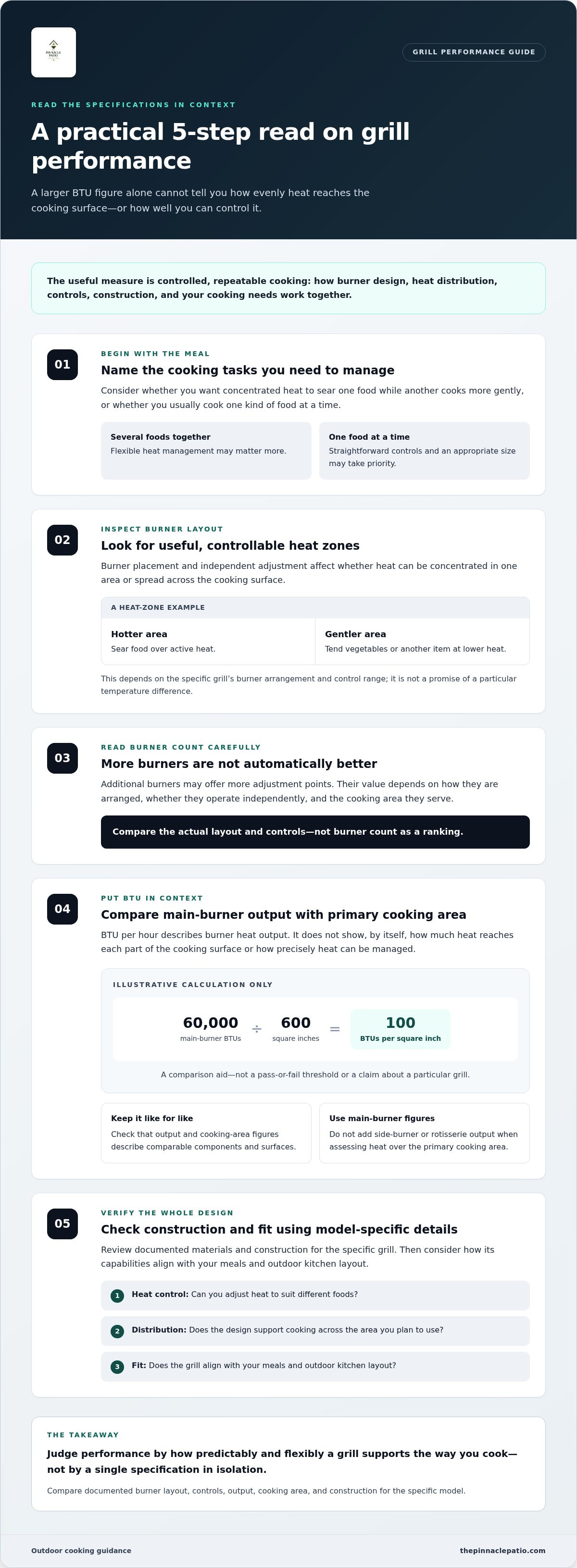
BTU describes burner heat output, but a total BTU figure is not a verdict on cooking quality. Put it in context: consider how the output is arranged, what area it serves, and how the grill distributes and lets you control heat. Compare figures only when they describe like-for-like specifications.
When reviewing a product description, separate the main cooking system from other listed features. Then consider how the complete design supports the cooking you have in mind. Use model-specific information instead of making assumptions based on a brand name or grill category.
- Heat control: Can you adjust heat to suit different foods?
- Distribution: Does the design support cooking across the area you plan to use?
- Fit: Does the grill align with your meals and outdoor kitchen layout?
These questions turn specifications into useful decision criteria. If you often cook several foods at once, flexible heat management may matter more than a feature that adds little to your usual meals. If you grill occasionally, straightforward controls and an appropriate size may take priority. Neither use case defines performance by itself. The right measure is how well a grill’s documented capabilities serve its owner.
When comparing built-in grill options, begin with the cooking tasks you want to handle, then read specifications in that context. Next, consider how burner layout, heat zones, and output influence cooking across the surface.
How burners, heat zones, and BTU output shape grill performance
Burners turn a grill’s controls into usable cooking areas. Their placement and independent adjustment help determine whether heat is concentrated in one area or spread across the cooking surface. That distinction matters when a meal calls for more than one approach: direct cooking places food over an active heat source, while indirect cooking positions it away from the active heat. Whether a grill supports both depends on its burner layout and controls.
Burner count alone doesn’t establish grill performance; what matters is how effectively the burners create controllable heat for the food you cook. More burners may offer more adjustment points, but their value depends on their arrangement, how independently they operate, and the cooking area they serve.
How multiple burners create more cooking flexibility
Separate controls can let you set one part of the grill to higher heat and another to gentler heat. For example, you might sear food over a hotter area while tending vegetables or another item over a lower-heat area. This is a practical way to use heat zones, not a promise that every grill can maintain a particular temperature difference. The model’s layout and control range determine what’s possible.
A grill with fewer burners may suit someone who usually cooks one kind of food at a time. If you often prepare several dishes together, additional independently controlled areas may be more useful. Compare the actual burner arrangement and controls instead of treating burner count as a ranking.
How to interpret BTU output without overvaluing it
BTU, or British thermal unit, is a measure of heat energy. Grill specifications commonly use BTUs per hour to describe burner output. That rating indicates nominal heat capacity, not how much heat reaches each part of the cooking surface or how precisely you can manage it. A large total can’t, by itself, show whether the grill suits your needs.
For a more meaningful comparison, look at the main burners and primary cooking area together. As a simple calculation, divide the listed main-burner BTU rating by the primary cooking area. For illustration only, a hypothetical grill with 60,000 main-burner BTUs and 600 square inches of primary cooking area yields 100 BTUs per square inch. This is a comparison aid, not a pass-or-fail threshold or a claim about any particular model.
Keep the comparison like for like. Confirm that ratings refer to the same components and that cooking-area figures describe the same type of surface. Don’t add side-burner or rotisserie output to the main-burner figure when assessing heat over the primary grilling area. Then weigh the numbers against burner control, heat distribution, and the meals you typically prepare. A grill planning consultation can help bring cooking requirements and outdoor kitchen configuration into the same decision.
Beyond BTUs: assess materials, construction, and long-term use
Materials and assembly affect how a grill stands up to regular use and outdoor exposure. A polished exterior alone doesn’t reveal what the firebox, burners, fasteners, or other components are made from, or how those parts are joined. To assess what makes a grill "high-performance" over time, look beyond appearance and review the specific materials and construction details documented for the model.
Stainless-steel grades are one part of that review, but they aren’t a complete measure of quality. Component design, material thickness, assembly, and the conditions around the grill all matter. Coastal air, for example, makes corrosion resistance an important consideration, but no material label can guarantee how a grill will look or perform throughout its service life.
What stainless-steel grades can and cannot tell you
Shoppers may encounter 304 and 430 stainless steel in grill descriptions. In general, 304 offers greater corrosion resistance than 430, but the grade matters only if it is accurately identified for the specific component and model. Don’t assume a brand uses one grade throughout its range. Look for manufacturer documentation that names the material and indicates where it is used.
Construction details that support confident ownership
Review the grill as an assembly, not just a collection of material labels. Check manufacturer descriptions for the firebox and hood construction, burner material, fasteners, and component design. Burner material is a specification to assess, not a shortcut to a quality ranking. If details such as thickness or joinery aren’t stated, treat them as unanswered questions rather than filling gaps with assumptions.
For an outdoor kitchen exposed to damp or salty conditions, give material selection particular attention. Consider the full setting and the specific parts most exposed to the elements. The same approach applies when comparing built-in grills: assess documented details model by model instead of extending one material claim across an entire brand.
A concise comparison helps separate verified information from assumptions:
| Comparison point | Documented detail | Unanswered question |
|---|---|---|
| Material grade | Grade named for a specific component in manufacturer documentation. | Grade of other components, if not specified. |
| Construction | Manufacturer-described materials and component design. | Thickness, joinery, or assembly details not provided. |
| Outdoor exposure | Materials identified for the model’s documented parts. | How those materials suit the conditions where the grill will be used. |
A claim about one part doesn’t describe the whole grill. A documented stainless-steel body, for example, doesn’t tell you the burner material or how other components are constructed. Keep confirmed details separate from unanswered questions as you compare models. This is especially useful when choosing a built-in grill for a larger outdoor kitchen.
Match grill performance to the way you cook outdoors
A grill’s capabilities matter most when they suit your meals, entertaining style, and planned space. Before comparing models, write down what you cook and how often. That turns specifications into practical questions: Do you need more than one heat zone? How much cooking area do you use at once? Will the grill fit the planned kitchen layout?
Use this five-part framework to focus your evaluation:
- 1. Cooking habits: Note the foods and methods you use most, from quick weeknight meals to longer, multi-item cooking sessions.
- 2. Entertaining: Consider how often you cook for a group and whether you want to prepare several foods at the same time.
- 3. Space: Decide how much counter and circulation space the grill can occupy within the outdoor kitchen.
- 4. Heat needs and specifications: Identify the heat control you need, then compare verified, model-specific burner, cooking-area, and output details.
- 5. Compatibility: Check the selected grill’s dimensions, cutout requirements, clearances, and utility needs against the project plan.
Which cooking habits should guide your evaluation?
Occasional grilling for a few people may call for a different balance of cooking area and controls than frequent meals for larger gatherings. Consider a typical menu. If you often cook foods that need different heat levels at once, independently controlled zones may help you manage the sequence. If your meals are usually simpler, extra cooking flexibility may matter less than ease of use and a comfortable fit.
Make the comparison specific to your routine. List the dishes you make most, whether you cook them together, and how much food you prepare for a usual gathering. That gives you a grounded way to prioritize capabilities instead of giving every specification equal weight.
How do grill size and outdoor-kitchen fit work together?
Use 30-inch, 36-inch, and 42-inch grills as planning categories, not universal measures of cooking capacity. Nominal width alone doesn’t establish usable grate area or the room required for the appliance. Compare the selected model’s specifications directly, and verify its cutout dimensions and clearances against manufacturer documentation before finalizing the layout.
A grill also needs to work as part of the whole space, alongside counters, storage, and the routes people use around the cooking area. The outdoor kitchen collection can help you consider grill choices in the context of a complete layout. For a built-in appliance, sizing and compatibility matter because the grill must suit the planned island configuration.
A useful answer to what makes a grill "high-performance" includes one final measure: how well its verified capabilities fit your cooking habits and the space you’ve designed.
Choose a high-performance built-in grill with a complete view
A considered choice brings the full picture together: heat control, distribution, verified construction, cooking habits, and fit. A specification matters when it helps you understand how a grill may serve your meals and work within your outdoor kitchen. No single number or feature defines a high-performance grill for every homeowner. The better choice is the one whose documented capabilities align with how you cook and the space you’ve planned.
Bull, AOG, and Kokomo are among the brands available through The Pinnacle Patio. Compare individual models using the same criteria rather than assuming a brand name guarantees a particular material, burner design, fuel option, or cooking result. What makes a grill "high-performance" is the combination of verified details and a practical fit for your own use.
How to compare built-in grill options responsibly
Build a simple side-by-side comparison for the specific models you’re considering. Record documented burner configuration, main-burner output, primary cooking area, listed materials, and dimensions. Keep unverified details out of the comparison, and make sure figures describe equivalent components and configurations. This helps you identify meaningful differences without declaring one brand or model universally best.
- Cooking control: Consider how burner layout and controls align with the heat zones you want to use.
- Construction: Record only materials and component details identified for that specific model.
- Cooking area: Compare manufacturer-listed primary cooking areas alongside output, not in isolation.
- Fit: Match model dimensions and documented cutout requirements to the project plan.
Specifications can vary between models within the same brand, so don’t extend one product’s details to an entire lineup. If a product description doesn’t answer a question that matters to your decision, mark it as unresolved rather than filling the gap with a general assumption. This keeps your comparison useful and accurate.
When expert guidance can make the decision easier
A shortlist can look promising on paper and still need to be assessed against project dimensions. Grill size, cutout measurements, clearances, utilities, and surrounding appliances all affect compatibility and configuration. Reviewing these considerations together can help narrow the options that suit your cooking priorities and space, while keeping product guidance distinct from installation or construction work.
Explore the built-in grill collection to compare available options from Bull, AOG, and Kokomo. Keep your preferred meals, desired heat control, verified construction details, and kitchen plan in view. That makes product research more focused and helps ensure the specifications you value are relevant to everyday use.
If sizing, compatibility, or configuration is shaping your shortlist, a conversation can help bring those project details into the decision. The goal is a grill that suits your cooking and fits your outdoor kitchen.
Make your next step a confident one
Choosing a grill is also an opportunity to shape how you’ll use your outdoor kitchen over time. Before settling on a model, turn your priorities into a practical shortlist: the meals you enjoy making, the space available, and the specifications that matter to your plans. That keeps the question of what makes a grill "high-performance" connected to your home, rather than to an abstract ideal or a single feature.
As you move from research to planning, consider how the grill will work within the wider space and which details need to align before you decide. A focused conversation can help bring those project considerations into view and make your next choice more assured.
With a clear sense of how you want to cook and gather outdoors, you can choose a grill that suits the space and the way you plan to use it.
Frequently Asked Questions
Does a higher BTU rating always mean a grill performs better?
No. A higher BTU rating indicates greater stated burner output, but it doesn’t by itself show how effectively a grill cooks. Check what the rating includes and whether it applies to the main burners or the full appliance. Compare figures for similar configurations, then consider the primary cooking area and the heat control you need for regular meals.
Can a smaller grill still be high-performance?
Yes. A smaller grill can be a strong fit if its cooking area and controls suit the meals you prepare. For example, a household that usually grills for a few people may prefer a compact cooking surface that’s easy to manage over unused extra space. If you often cook for a larger group, consider whether you’re comfortable preparing food in batches or need more room to cook at once.
Are infrared burners necessary for a high-performance grill?
No. Infrared burners are an optional feature, not a requirement for a capable grill. They may appeal to cooks who want a dedicated high-heat cooking method, while other households may prioritize straightforward temperature adjustment or cooking flexibility. Consider how often you’d use the feature and whether it complements your usual menu. Check the specific model’s documentation to understand its burner configuration and intended use.
How do I compare stainless-steel grades on outdoor grills?
Start by checking which grade the manufacturer identifies for each component, rather than relying on a general brand description. As a broad material distinction, 304 stainless steel is typically more corrosion-resistant than 430, but neither grade guarantees a particular service life. If a grill will face coastal or damp conditions, factor that exposure into your comparison and review the documented materials for the parts that matter to you.
Does natural gas or liquid propane make a grill higher-performance?
No. Neither fuel type automatically makes a grill perform better. The practical choice depends on the grill’s compatible fuel configuration and the supply planned for your outdoor kitchen. Before comparing models, identify which fuel setup fits your project, then compare cooking features among grills configured for that fuel. Use the manufacturer’s documentation for model-specific fuel information rather than assuming a brand or grill category supports either option.
What should I check before choosing a built-in grill for an outdoor kitchen?
Confirm the model’s dimensions, cutout requirements, clearances, fuel configuration, and utility needs against your kitchen plan. Also consider how the grill will sit beside counters, storage, and other appliances, and whether its cooking area suits your usual meals. Use manufacturer documentation for model-specific requirements. If you’re still shaping the layout, settle the appliance choice and island plan together so the components work as a coordinated space.