

When Do You Need a Grill Liner? Built-In Grill Guide
What if the stone finish around your built-in grill hides a combustible frame? The finish alone doesn’t tell you whether a liner is needed. If you’re asking, “when do you need a grill liner?” the answer depends on the enclosure materials and the exact grill model.
Manufacturers commonly require an insulated liner when a built-in grill is installed in a combustible enclosure. An island built entirely from non-combustible materials may not need one, but requirements vary. The current installation manual for your specific grill is the authority.
Before choosing an island or ordering a grill, check what the liner does, identify the enclosure materials, and confirm the model’s requirements. Here at The Pinnacle Patio, this guide explains how to distinguish a specified safety component from an optional accessory, and what to verify before finalizing your plan.
- To answer “when do you need a grill liner?” compare the grill’s current installation instructions with the proposed island materials.
- Identify the exact grill model before finalizing the enclosure opening or selecting a liner.
- Use the manufacturer’s documentation to confirm whether a liner is specified for your installation.
- Gather the grill model, installation instructions, and island material details before making a decision.
- Compare built-in grill options from leading brands alongside outdoor kitchen island configurations.
Table of Contents
- When Do You Need a Grill Liner? Start With the Enclosure
- How Grill Liners, Built-In Grills, and Island Designs Must Work Together
- Grill Liner or No Liner? Compare the Scenarios Before You Decide
- How to Confirm Whether Your Outdoor Grill Needs a Liner
- Choose a Compatible Built-In Grill and Island With Confidence
When Do You Need a Grill Liner? Start With the Enclosure
Whether a built-in grill needs a liner depends on the grill model and the enclosure it will sit in. Manufacturers commonly specify an insulated jacket, also called a grill liner, for installations in combustible enclosures. A liner is not a universal requirement: some grill and enclosure combinations may not call for one. Check the current instructions for the exact grill before finalizing the island plan.
Look beyond the visible finish. The enclosure’s underlying construction, the grill’s instructions, and the planned installation all affect the decision. A stone exterior, for example, doesn’t confirm what the island is made of beneath the surface. If you’re planning the full cooking area, the outdoor kitchen island selection can help you consider the grill as part of the overall configuration.
What does a grill liner do in a built-in enclosure?
A grill liner is a separate component that a manufacturer may specify for a particular built-in installation. When the instructions describe it as an insulated jacket, its intended role is to create a protective barrier between the grill and combustible enclosure materials. It is not the grill or the island structure, and it does not replace other components the manufacturer may specify.
The liner’s purpose and fit can vary by model. Review the grill’s current manual and the liner documentation to confirm what the component is designed to do and how it applies to your installation. A liner alone doesn’t establish that an installation is safe or code-compliant. Follow all applicable manufacturer instructions and requirements.
Why enclosure material changes the question
Combustible materials can burn. Examples used in outdoor kitchen construction include wood, composite, PVC, and HDPE. Noncombustible construction may include metal framing, concrete, stone, or brick. Since enclosures can have multiple layers, identify the core rather than judging by the finish. The backing of a board product can also affect how it is classified.
For a broader overview of grill types and their history, see Barbecue grill. For a liner decision, the specific built-in model’s installation documentation is the relevant reference. Check its instructions for enclosure materials and any specified liner instead of assuming every grill or outdoor kitchen follows the same rule.
How Grill Liners, Built-In Grills, and Island Designs Must Work Together
Choose the grill before deciding on a liner. The exact model determines which installation instructions apply, including whether a liner is specified for the planned enclosure. Similar-looking grills can have different requirements, so relying on a general assumption may leave you with an island opening or component plan that doesn’t match your appliance.
Once you have a model in mind, use its current manufacturer instructions to inform the enclosure plan. The International Code Council’s discussion of code requirements for outdoor kitchens underscores why manufacturer instructions, including clearance details, matter when planning a built-in grill. Those instructions connect the appliance to its opening, surrounding materials, and any specified liner.
Which grill details should you confirm first?
Record the grill’s exact model name and locate its current installation documentation before settling on an island design. Check the model-specific directions for enclosure materials, opening details, and whether a liner is required or specified. Confirm the fuel type and configuration in the same documentation rather than relying on a product description or a similar model’s manual.
Keep the model information and instructions together. A product page can help you compare options, but it shouldn’t replace the manufacturer’s installation instructions when deciding when do you need a grill liner. If you’re still weighing models, browse the built-in grill collection, then check the instructions for the specific grill you select.
What should the island plan account for?
Use the grill documentation to coordinate the island opening and surrounding construction. Don’t finalize the cutout, enclosure materials, or liner choice based only on the grill’s overall width or appearance. The manual may address installation details that aren’t apparent from a product photograph.
- Opening and fit: Compare the proposed opening with the dimensions and configuration in the grill documentation.
- Enclosure materials: Share the planned construction details with the project professional and confirm they align with the manufacturer’s instructions.
- Unresolved requirements: Flag questions about clearances, fuel connections, ventilation, or specified components for the project professional to assess.
Product selection and site-specific installation decisions are related, but they are different tasks. The grill documentation helps you choose compatible components; the project professional can assess the planned site and applicable requirements. If sizing or compatibility questions remain, discuss your grill and island configuration before finalizing the design.
Grill Liner or No Liner? Compare the Scenarios Before You Decide
The best way to answer “when do you need a grill liner?” is to check the current installation instructions for the exact grill model and planned enclosure. General guidance can frame the decision, but it cannot replace model-specific directions. Use the comparison below to identify what is confirmed and what still needs an answer.
| Situation | What to verify | Next action |
|---|---|---|
| The current instructions specify a liner for your planned enclosure. | Confirm the documentation applies to your exact model and enclosure type, and identify the liner specified by the manufacturer. | Follow the instructions and confirm component compatibility before finalizing the island opening or ordering parts. |
| The current instructions describe your planned installation without specifying a liner. | Check that you have complete, current documentation for the exact model and that your enclosure materials and configuration match the stated conditions. | Proceed on the basis of those instructions. Ask the manufacturer or project professional about any mismatch or ambiguity. |
| The enclosure uses mixed materials, or the instructions don’t clearly address your setup. | Gather the model, enclosure construction details, and planned installation configuration. Identify what the documentation leaves unanswered. | Pause the design decision and request clarification from the manufacturer or a qualified project professional. |
A product listing that doesn’t mention a liner isn’t proof that one isn’t required. The manufacturer’s current instructions for the exact model take precedence over generalized online advice, descriptions for a similar grill, or assumptions based on appearance.
When a grill’s instructions specify a liner
Follow the model-specific documentation and confirm that the liner you’re considering is the component specified for that grill. Don’t substitute a different liner or change the enclosure plan because the parts appear to fit or the island looks similar to an example. Resolve compatibility questions before finalizing the opening or ordering components.
When the instructions don’t clearly settle the question
Check that you have the correct model documentation and enough information about the enclosure’s construction and installation configuration. A mixed-material island can raise questions that the visible finish won’t answer. Share the details with the grill manufacturer or a qualified project professional, and ask how the instructions apply to the proposed installation.
Keep the decision tied to the exact model, complete instructions, and matching enclosure details. If any of these are uncertain, treat the liner question as unresolved rather than assuming either choice is appropriate.
How to Confirm Whether Your Outdoor Grill Needs a Liner
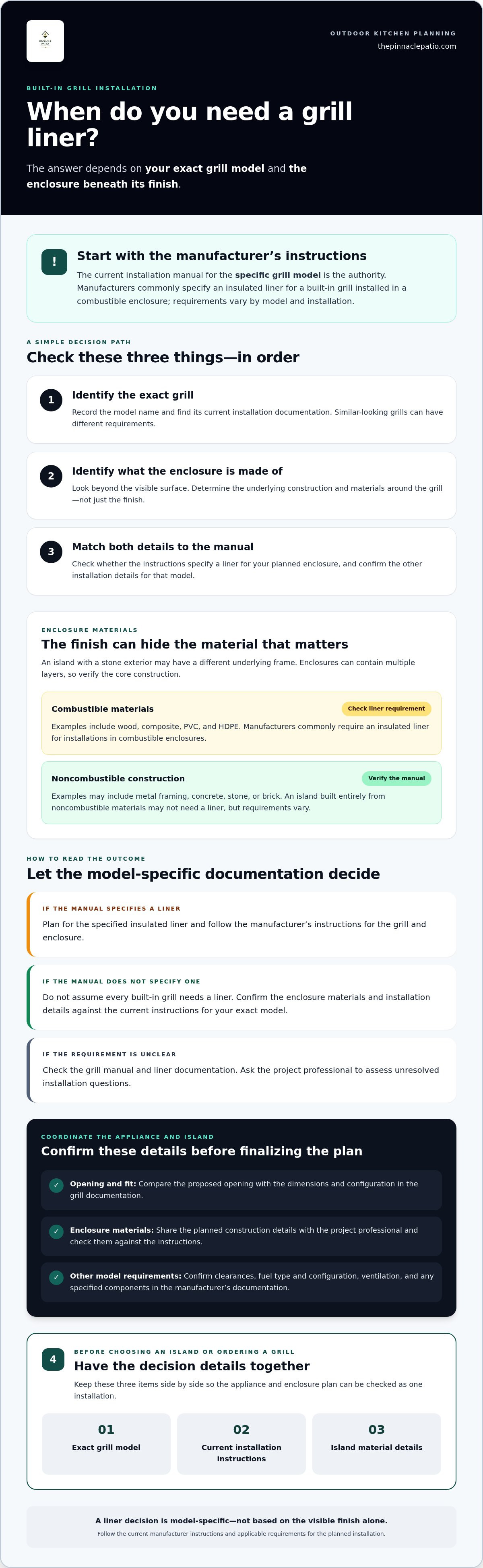
A pre-purchase review can help prevent a liner assumption from becoming a design change. Gather the grill’s model information, the manufacturer’s current installation instructions, and a clear description of the proposed island construction. Use the checklist to separate what the documents confirm from what still needs an answer.
A practical pre-purchase checklist
- Identify the exact grill model. Record the model name, not just the brand or product family. Similar-looking grills can have different installation requirements.
- Locate the current manufacturer instructions. Use the documentation for that model and check what it says about the enclosure, liner, opening, and other installation details relevant to your plan.
- Document the proposed island construction. Ask the project professional to describe the enclosure materials and configuration, including the structure beneath finished surfaces.
- Compare the plan with the instructions. Note which requirements are clearly addressed and whether the grill, enclosure, and any specified components align.
- Write down unresolved questions. Record uncertainties about liner compatibility, the opening, clearances, or other components before purchasing parts or finalizing the design.
This record helps answer when do you need a grill liner without relying on memory, a general rule, or a brief product listing. Keep confirmed details separate from open questions. For example, “the current manual specifies a liner” is a documented fact. “The stone finish means the enclosure needs no liner” is an assumption unless the model’s instructions and project details support it.
Who can help resolve compatibility questions?
For a grill’s product-specific requirements, consult its current manufacturer documentation or support team. Ask the project professional to assess site-specific construction and installation conditions. If the documentation doesn’t clearly address your setup, share the model and enclosure details when requesting clarification. Don’t turn an unanswered question into a purchase decision.
For grill sizing or configuration guidance, bring the model information and island plan to the conversation. A product consultation can help clarify selection questions, while site-specific installation decisions should remain with the appropriate project professional.
Choose a Compatible Built-In Grill and Island With Confidence
Plan the grill and island as one configuration, not as separate purchases. The grill model determines which manufacturer instructions apply, and the island plan must account for the enclosure and any liner or other component those instructions specify.
The Pinnacle Patio offers built-in grills from Bull Grills, AOG Grills, and Kokomo Grills, along with outdoor kitchen islands. Requirements can vary by model, so don’t assume one brand’s liner guidance applies to another grill, or that a similar-looking model has the same requirements. Check the selected grill’s current documentation to confirm fit and liner requirements before finalizing the island plan.
Align the grill choice with the island plan
As you compare options, keep the intended island configuration in view. Review the grill’s documentation alongside the proposed opening and enclosure information, and resolve compatibility questions before ordering components. Explore outdoor kitchen islands as you consider how the grill will fit into the larger cooking space.
It can help to have these details ready as you narrow your choices:
- The exact grill model under consideration
- The manufacturer’s current installation instructions
- The proposed island configuration and available material information
- Any unanswered questions about the liner, fit, or installation requirements
This gives you a clearer basis for deciding when do you need a grill liner and helps prevent assumptions from shaping a long-term purchase. If a requirement isn’t clear in the documentation, seek clarification from the grill manufacturer or project professional rather than treating an omission in a short product description as confirmation.
Make the next decision with expert guidance
The Pinnacle Patio sells grills and outdoor kitchen islands, but doesn’t provide on-site installation, hardscaping, or masonry. A consultation can support product sizing, compatibility, and configuration decisions. Site-specific construction and installation questions belong with the appropriate project professional. Bring the model details, instructions, island plan, and remaining questions so the discussion can focus on your intended setup.
Plan Your Grill and Island as One Configuration
The answer to when do you need a grill liner depends on the specific grill, its current installation instructions, and the enclosure materials and configuration. Confirm those details before finalizing the island opening or ordering components. If a requirement is unclear, ask for clarification rather than relying on a general rule or product listing.
The Pinnacle Patio offers built-in grills from Bull Grills, AOG Grills, and Kokomo Grills, as well as outdoor kitchen island products for configuration planning. Have the grill model, manufacturer instructions, island details, and any outstanding compatibility questions ready for your next planning conversation.
With the right information in hand, you can make a considered choice and move ahead with greater confidence in your outdoor kitchen plan.
Frequently Asked Questions
When do you need a grill liner for a built-in grill?
You need a liner when the current installation instructions for your exact grill model specify one for your planned enclosure. Manufacturers commonly require an insulated jacket when a built-in grill is installed in a combustible enclosure, but requirements vary by model. Check the manual for the grill and enclosure combination you’re planning. Don’t use another model’s instructions or a general rule as a substitute.
Is a grill liner required for every outdoor kitchen?
No, a liner isn’t automatically required for every outdoor kitchen or built-in grill. The requirement depends on the grill model, enclosure construction, and installation details. A fully noncombustible enclosure may not require a liner under some manufacturers’ instructions, while combustible construction often does. Confirm the specific requirements in the current manual before choosing the island configuration or ordering components.
Can you install a built-in grill without a liner?
Yes, if the current instructions for that exact grill model and planned enclosure don’t require one. Don’t infer that a liner is unnecessary because a product listing omits it or another installation uses no liner. Confirm that the enclosure materials and configuration match the manual’s directions. If the instructions don’t clearly address your setup, ask the grill manufacturer or a qualified project professional before proceeding.
What happens if you choose the wrong grill liner?
The liner may not match the grill model or the manufacturer’s installation requirements, so don’t assume it will fit or serve the intended role. An incompatible component can leave important questions about the enclosure and installation unresolved. Check the exact model documentation and confirm the specified liner before ordering. Avoid substituting a similar-looking liner or modifying the island based on appearance alone.
How do you know whether a grill enclosure is combustible?
Check the enclosure’s underlying construction, not only its finished surface. Wood, composite, PVC, and HDPE are examples of combustible materials; stone or brick finishes don’t establish what the frame beneath them is made from. If the island combines materials or you can’t confirm its construction, ask the project professional to identify the materials and compare them with the grill manufacturer’s instructions.
Does a grill liner replace the need to follow installation instructions?
No, a liner doesn’t replace the grill’s installation instructions or establish that an installation is safe or code-compliant on its own. Follow the current documentation for the exact model, including directions for the enclosure and any separately specified components. If the manual leaves a question about your planned setup, seek clarification from the manufacturer or a qualified project professional rather than relying on the liner alone.
Should you choose the grill or the liner first?
Choose the grill model first, then use its current manufacturer instructions to determine whether a liner is specified for your enclosure. The model documentation informs the liner choice and helps coordinate the grill with the island opening and construction. Finalize the configuration only after checking the grill, proposed enclosure materials, and any specified components together. This avoids basing a purchase on assumptions or instructions for a different model.